




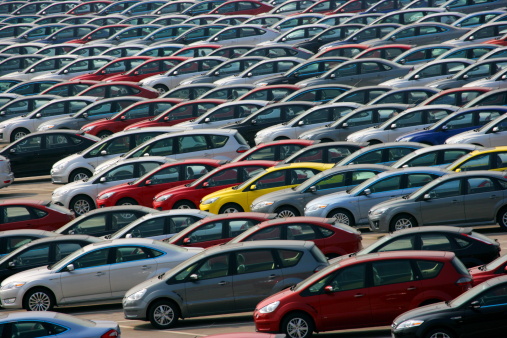
 Car buyers often value safety above all the other features of their new cars, SUVs, or light trucks. It’s true that manufacturers often stress other features such as gas mileage or bells and whistles like the latest moonroof or comfortable seat. Still, virtually none neglect descriptions of safety features, which include airbags, crumple zones, and anti-lock brakes. The problem is that this mix and assortment of features leaves buyers with the difficult task of determining which autos are extremely safe and which only claim to be. 24/7 Wall St. sifted through the claims and the data from auto safety measurements used across the industry to find the safest cars sold in America.
Private organizations such as Edmunds, Consumer Reports, and J.D. Power have their own safety benchmarks. While these are often based on government tests and figures, each firm uses its own unique methodology to create its lists of safest cars. The two organizations that issue the most widely and closely followed research are The Insurance Institute for Highway the Safety (IIHS) and the National Highway Traffic Safety Administration (NHTSA).
The IIHS describes itself as “an independent, nonprofit scientific and educational organization dedicated to reducing the losses — deaths, injuries and property damage — from crashes on the nation’s roads.” The organization measures front crash, side impact, and rear crash effects, as well as roof strength. The weakness of the IIHS system is that its highest rating, Top Safety Picks, number about 100 cars. 24/7 views this set of measurements as incomplete because such large number of vehicles pass the test.
Tests done by the NHTSA, a division of the Department of Transportation, are extremely thorough. The agency posts the results of the tests at Safercar.gov, and its Five-Star Safety Ratings database goes back to 1990. Starting with 2011 models, the NHTSA has upgraded its rating system by introducing “tougher tests and rigorous new 5-Star Safety Ratings that provide more information about vehicle safety and crash avoidance technologies,” the agency notes.
The Five-Star Safety Ratings evaluation covers dozens and dozens of models. However, Catherine Howden of the Department of Transportation told 24/7 Wall St. that “NHTSA rated 81 percent of the light vehicle fleet for the 2012 model year, and estimates 85 percent of the light vehicle fleet for the 2013 model year will be rated.” The ratings are based on measurements of overall safety, frontal crash, side crash, and rollover. Each car can receive up to five stars in each of the four categories, but only four model cars received five stars across all four categories. These are “The Safest Cars In America.”
When reviewing the four cars, 24/7 Wall St. looked at major safety features, even if they were not a part of the government evaluation.
1. Chevrolet Camaro.
The Camaro is among America’s iconic muscle cars. It was built and marketed by Chevy from 1966 to 2002. Over the course of that period, it competed with such cars as the Ford Mustang and Pontiac Firebird. As a matter of fact, the Mustang and Camaro fight for the attention of buyers today after the model was re-launched in 2009.
The Camaro comes in several models, depending in large part on engine size. The base Camaro has a sticker price of $23,345. The highest-end Camaro, the ZL1, has an engine comparable to the one used in Chevy’s sports car flagship — the Corvette. Its eight-cylinder engine has a horsepower output of 580. The price of this model can be as high as $54,350.
All Camaro models come with StabiliTrak, a stability control system made by GM, and with limited slip differential that helps the car maneuver in difficult driving situations. The Camaro also has daytime running lights and a tire pressure monitoring system. Although the government tests do not consider this, the fact that the Camaro is built close to the ground and therefore has a low center of gravity makes it less likely to roll over than many cars and light trucks.
2. Honda Accord.
The Accord is usually among the top ten selling cars in the U.S. In September, Honda sold 29,182 Accords. For the first nine months of the year, total sales were 247,847, up 37% from the same period in 2011. The Accord is a relatively low priced, mid-sized car that happens to have a large number of standard safety features.
The Accord has three basic models. The first is a four door version with a four-cylinder engine. The next has four doors and a six-cylinder engine. The last is a sedan version. The base Accord has a sticker price of $21,680. The Accord competes primarily with the Toyota Camry, the Ford Fusion, and Nissan Altima.
Among the safety features of the Accord are Honda’s Advanced Compatibility Engineering, which is built to distribute the energy of a frontal crash more evenly throughout the car’s frame. Anti-lock brakes are standard on most cars, but Honda also has a system to distribute brake force among the four wheels as needed when the car stops sharply. Front airbags deploy based on the crash force and tension on seat belts. The Accord is also available, in some models, with a radar system that senses the distance between the front of the car and a vehicle ahead of it its, and another feature that detects whether the car has drifted out of its lane.
3. Kia Optima.
Each of the two major versions of the Optima makes our list — the four-door front-wheel-drive version and its hybrid counterpart. The Optima also made the Five-Star Safety Ratings list with its 2011 and 2012 models.
Kia is part of the family of brands made by Korea’s huge car maker Hyundai which also markets in the U.S. under the Hyundai brand. Each of the car lines has done particularly well in America and has been able to gain market share due to its reputation for being a low-priced, high-quality car. Hyundai and Kia vehicles combined sold over 974,000 cars and light truck in the U.S. through the first nine months of the year. That is more vehicles than Nissan sold over the same period. The Optima has a base price of $21,200. The base price for the hybrid version is $25,700.
These cars have active headrests that react to the force of a crash; pretensioner seat belts that tighten in certain crash conditions; front and rear crumple zones to absorb the impact of crashes; electronic stability control; and a braking system that balances load with brake pressure.
4. Volvo S60.
One of the stablemates of the S60 — the Volvo V40 — was recently named “the safest car in the world,” scoring five stars in the Euro NCAP crash tests.The “premium hatchback recorded the highest score of any car to undergo the tests,” The Telegraph of the U.K. recently reported.
Volvo, for years the major car maker in Sweden, is now owned by China’s Zhejiang Geely Holding Group. Ford was the company’s owner from 1999 to 2010. Volvo has struggled to compete in the U.S. with larger carmakers at the high-end of the luxury import market — BMW, Mercedes, and Audi. It also competes with the high-end models of Ford and GM. Through September, Volvo sold on average of nearly 6,000 cars a month in the U.S. Geely hopes that, over time, Volvo can build a brand presence in China, which would lift the brand’s sales.
The V60 four-door comes in front-wheel-drive and all-wheel-drive versions. The S60 is Volvo’s mid-tier sedan with a base price of $31,750. This model has a five-cylinder 250 horsepower engine. The V60 is heavy and weighs over 3,500 pounds. Weight tends to be an advantage in a collision. The S60 has advance stability control to aid handling in difficult driving situations. The car also has an optional pedestrian detection system, which helps maneuver in city driving situations.
-By Douglas A. McIntyre








 Top Gaining Stocks
 Top Losing Stocks