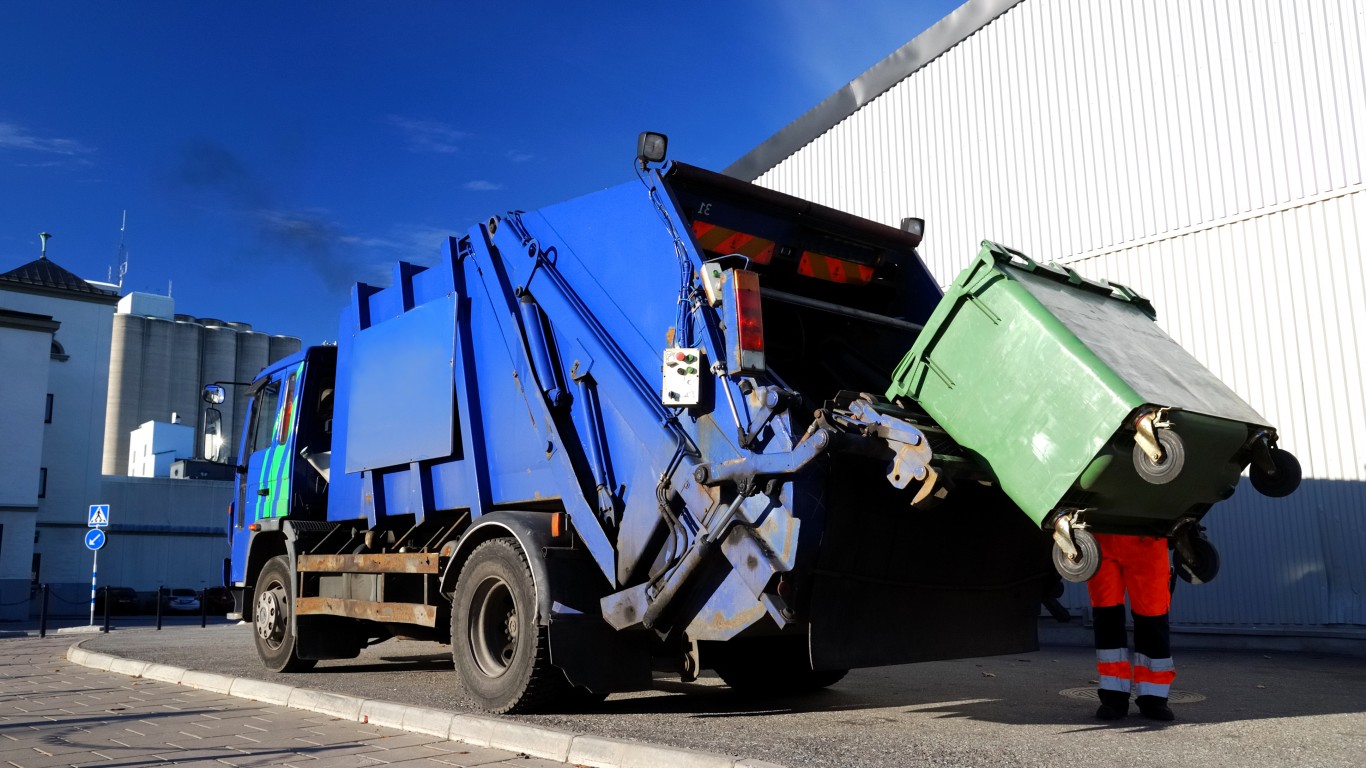
Waste Management Returned 290% in a Decade. These 4 Stocks Share Its Boring Advantage

This post may contain links from our sponsors and affiliates, and Flywheel Publishing may receive compensation for actions taken through them.

Boring works. Over the past decade, Waste Management (NYSE:WM | WM Price Prediction) has returned 290.37% on price alone, without ever being confused for a growth story. The five names below share a simple trait: their customers barely think about the invoice, and they could not stop paying it without breaking something operational. Each has demonstrated the ability to raise prices faster than costs rise, and each has a dividend record that documents it.
Waste Management: Trash Is a Toll Road
WM collects and disposes of solid waste, runs landfills and recycling, and now operates a healthcare-waste business from the Stericycle deal. Municipal and commercial customers sign multi-year contracts, and switching haulers is expensive and disruptive. In Q2 FY26, core price came in at 5.7% with Collection & Disposal yield of 3.6%, and adjusted operating EBITDA margin expanded 40 basis points to 30.9%. Management noted that “despite ongoing inflationary pressures, including labor cost increases of approximately 4%, we limited the increase in collection operating costs to less than 1.7% compared to the second quarter of 2025.” The dividend record backs the pricing story: the quarterly payout has stepped up from $0.75 in 2024 to $0.825 in 2025 to $0.945 in 2026, with no stock splits complicating the comparison. Risk: Collection & Disposal volumes were down 1.8% year over year, and recycled commodity and RNG credit prices have weakened.
Republic Services: Same Toll Road, Different Booth
Republic Services (NYSE:RSG) does what WM does. Customer captivity is the same: contract structures, route density, and landfill scarcity all make leaving impractical. In Q1 FY26, core price on total revenue was 5.7%, with open market pricing at 8.4%, and adjusted EBITDA margin expanded 50 basis points to 32.1%. On the Q2 FY26 call, CEO Jon Vander Ark said “this level of pricing exceeded our cost inflation, which drove margin expansion in the underlying business” and reiterated “we always take price over volume.” Republic announced an increase to its dividend for the 23rd consecutive year; the quarterly payout most recently stepped up from $0.625 to $0.67. The dividend record is clean through the available history, with only a single 1.5x adjustment recorded in 2007. Risk: recycled commodity prices declined to $120/ton from $155, and organic volume ran negative.
Rollins: Pest Control on Autopilot
Rollins (NYSE:ROL) runs Orkin and a family of pest-control brands. The recurring commercial and termite work is contracted, scheduled, and hard to cancel because customers are paying to prevent problems they cannot see. In Q2 FY26, commercial revenue grew 8.6% and termite & ancillary grew 10.5% even as consumer-initiated residential leads softened. On the call, CEO Jerry Gahlhoff said “we’ve not seen any hesitancy from our customers on pricing” and the CFO added that “customer response to our recent price increase has been favorable, and we continue to expect to be positive on price costs for the year.” The regular quarterly dividend has stepped from $0.15 in 2024 to $0.165 in 2025 to $0.1825 in 2026. The per-share history is complicated by seven 1.5x share adjustments over the past two decades, so read the trajectory rather than the absolute numbers. Risk: the stock is down 45.13% year to date on softer top-of-funnel demand, and GAAP operating margin fell 110 basis points in Q2 to 18.7%.
Cintas: Uniforms Nobody Cancels
Cintas (NASDAQ:CTAS) rents uniforms, mats, restroom supplies, and first-aid stock to roughly a million businesses. The service arrives on a route, whether the customer thinks about it or not. In Q1 FY27, reported today, revenue rose 10.9% to $3.01 billion, organic growth was 8.9%, and gross margin reached 51.5%, an all-time high. Operating margin of 23.6% was also a record. Notably, CEO Todd Schneider emphasized productivity as the margin driver: “as inflation is up we don’t take the approach that well prices our costs are up so we’re just going to pass along to the customers… we’ve got to be better than that.” Margin expansion is coming from productivity rather than surcharges. Cintas said on the call it has increased its dividend every year since going public 43 years ago, and the most recent quarterly step-up went from $0.45 to $0.52. Risk: the pending UniFirst acquisition is under FTC second-request review, and integration is a live question.
Otis Worldwide: Elevators That Bill Forever
Otis Worldwide (NYSE:OTIS) sells new elevators and escalators, but the durable business is service: maintenance, repair, and modernization on an installed base measured in the millions of units. Building owners cannot easily switch, and the equipment demands regulated inspection. In Q2 FY26, service revenue grew 11% (organic +9%), modernization organic sales rose 24%, and the modernization backlog was up 26% at constant currency. CEO Judy Marks described maintenance micro-pricing as an “account by account” exercise balancing retention with price, and said “service remains the key growth engine of the business.” The quarterly dividend has moved from $0.20 in 2020 to $0.44 in 2026, with no stock splits in the record. Risk: New Equipment sales in China fell high teens to more than 20%, and service margin compressed 180 basis points in Q2 on labor and material costs the company has not yet fully recovered in price.
These are businesses whose contracts, routes, and installed bases make the invoice easy to renew and hard to escape, and the dividend records document what that has looked like in cash. Yields here are modest; what matters is that the pricing was there when it was needed. If multi-decade raise streaks are what you’re screening for, we ranked ten of the longest in a free Dividend Kings report. Read the margin trend, watch the volume trend, and let the boring work.
Contact [email protected] for any questions or corrections.
Chris Lange is a financial and geopolitical writer with more than a decade of experience covering a myriad of topics. He has published thousands of articles for 24/7 Wall St., with past coverage focused heavily on stocks, IPOs, healthcare, defense, global affairs, and technology.
His work has been quoted, or referenced by a number of outlets including Business Insider, USA Today, Yahoo Finance, MSN, The Motley Fool, and many other publications. A graduate of Southwestern University, he studied business with a focus on investments and has previous experience in banking and startups.
When not reading or writing the news, he is following his passion for Lacrosse, playing chess, or building solar projects with his dad.