AppLovin Has Fallen Nearly 60% in 2026: 180% Returns Are In Store For Investors According to This Wall Street Pro
AppLovin's stock has cratered while its underlying business posts explosive revenue growth and billion-dollar profits, a contradiction that has Wall Street's sharpest minds drawing radically different conclusions about where this AI ad-tech giant goes next.

This post may contain links from our sponsors and affiliates, and Flywheel Publishing may receive compensation for actions taken through them.

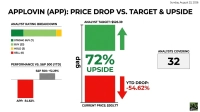
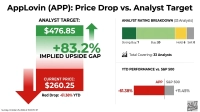
AppLovin (NASDAQ:APP | APP Price Prediction) currently trades at $281.31. The consensus price target sits at $497.05, which implies about 76.7% upside to where analysts think it belongs.
AppLovin runs an AI-driven advertising platform built on its AXON engine, matching mobile game and e-commerce advertisers with likely converters. It now operates as a pure ad-tech company with a 87.9% gross margin and 75.8% operating margin.
Karl Keirstead at UBS holds the Street-high $790 target with a Buy rating, implying about 180.8% upside. This gap suggests either analysts are badly off or the market is too pessimistic.
Short Sellers and Two Brutal Earnings Days Sank AppLovin This Year
The Q2 2026 earnings report hit hardest. Shares fell 19.66% from $417.80 to $335.67. Revenue of $1.92 billion missed the $1.94 billion estimate. Management attributed the miss to timing: “Our pace of meaningful model improvement was lighter than normal during the quarter, and the next step up in model performance landed just after quarter end.”
This was the second earnings-day drop near 20% this year. The stock lost 19.68% after Q4 2025 despite EPS beating estimates by 10.05%. Short sellers added pressure. One report alleged ties to a money laundering syndicate, sparking a 17% drop. The company disputes the claims. Later allegations about competition cut another 8%.
The result is a 58.25% year-to-date decline. With a beta of 2.488, AppLovin magnifies every move. Shares are near their 52-week low of $275.13, well off the high of $738.01.
Wall Street Keeps Its Buy Ratings but Trims Its Numbers
Of 33 analysts covering the stock, 27 assign a Buy or Strong Buy, 6 hold a Hold rating, and none recommend a Sell. UBS bases its case on three points: AXON 2.0 keeps improving return on ad spend, e-commerce expansion could greatly expand the addressable market, and high gross margins turn revenue growth into free cash flow and buybacks.
The next test is Q3. Management guided revenue to $2.055 billion to $2.085 billion, or 46% to 48% year-over-year growth, at an adjusted EBITDA margin near 83%. The CEO said “Q3 is off to a strong start, and the business is back on the trajectory we expect.” Consumer advertiser spend finished 28% above Q4 2025 levels. The SEC closed its inquiry with “no recommended action.”
Valuation supports the optimistic view. The stock trades at about 15 times forward earnings. Consensus EPS calls for $15.6656 this year and $20.0032 in 2027.
Estimates are falling even as ratings hold. Over the past 30 days, 2027 EPS estimates saw 19 down revisions against 5 upward ones, sliding from $21.1638 sixty days ago.
Analyst Targets Carry No Guarantees
Investors comparing AppLovin with ad-tech peers such as The Trade Desk (NASDAQ:TTD) should remember that targets are opinions, and none of them come with a guarantee.
AppLovin’s Growth Rate and Stock Price Point in Opposite Directions
At $281.31, AppLovin has 76.7% implied upside to the $497.05 consensus from 33 analysts. The stock is down 58.25% year to date, while the S&P 500 is up 12.04%. Over the past month alone it has lost 9.76%.
The business looks very different from the stock. Q2 revenue grew 52.8%, net income reached $1.27 billion, and free cash flow amounted $863.3 million. Here is how analysts rate the stock:
- Strong Buy: 7
- Buy: 20
- Hold: 6
- Sell: 0
AppLovin’s Rebound Case Hinges on Q3 Results
Optimism builds if Q3 revenue lands inside the $2.055 billion to $2.085 billion guide and consumer spend keeps growing, confirming the Q2 miss was timing. The path to $497.05 runs through steady model gains and e-commerce scaling toward the 30% annual growth management targets over the long run.
Concerns mount if the next earnings report shows weak model gains. Growth would then depend on unpredictable discoveries while compute costs rise. Management called creative tools “the biggest hurdle” for e-commerce, and falling estimates suggest analysts are quietly lowering the bar.
The data leans bullish. A business guiding to growth above 40% at about 15 times forward earnings already has a lot of doubt priced in. I’d treat UBS’s $790 as a best-case ceiling and the consensus as the realistic anchor.
Contact [email protected] for any questions or corrections.
Alex Sirois is a financial writer with experience spanning both retail and institutional investing. He has written for InvestorPlace and held roles at BNY Mellon and Bernstein, giving him a perspective that bridges Main Street portfolios and Wall Street analysis.
Alex holds an MBA from George Washington University and has built his career across multiple industries, including e-commerce, education, and translation — a breadth of experience that informs how he breaks down complex financial topics for everyday investors. His writing is conversational, actionable, and grounded in long-term, buy-and-hold investing principles.
At 247 Wall St., Alex focuses on delivering analysis that is both accessible and useful, with a clear emphasis on helping readers make more informed decisions with their money.