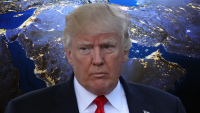
Welcome to the Trump Recession
If consumer spending is two-thirds of gross domestic product, then Americans may recoil from the shock of a Trump victory by sitting on the sidelines as consumers during the heart of the holiday season.


If consumer spending is two-thirds of gross domestic product (GDP), then Americans may recoil from the shock of a Trump victory by sitting on the sidelines as consumers, at least for a few weeks. But those few weeks are the heart of the holiday season. Many parts of the economy, from retail and consumer electronics to autos and travel count on those weeks.
Business is likely to take a passive position too, as executives try to decipher what a Trump administration will do to the trade that is essential to the revenue of so many of them, and to their taxes and the insurance their employees buy, or that they provide for them. It is hard to make a case that a recession will not run from the middle of the fourth quarter through at least the first quarter of 2017, although this cannot be exactly true, because recessions are built on two full consecutive quarters.
A crippled economy may not recover as it runs into the last three quarters of next year. Trump will become the president on January 20. In the traditional “first 100 days,” he may press legislation, and pass some of it, so different from anything in memory that it shocks the financial and economic systems in American and sends waves to nearly every other nation in the world. (Republicans also will have a majority in both the Senate and House of Representatives.) If he tries to rip up trade treaties, which he cannot do on his own, trade chaos and tariffs could ensue.
If he pulls the American military presence out of certain unstable parts of the world, local wars could rage in places where the United States has provided a measure of order and protection recently, particularly with the Air Force and Navy. Even the United Nations may lose part of its ability as peacekeeper, if Trump’s threat to pull financial support for the international body comes true. It is a UN that has had a role as watchdog over many of the world’s conflicts since 1945, even if it has not always been effective.
Wall Street will be the first part of the economy affected, immediately. Early indications are that it will plunge hundreds of points on the heels of the election. Its fragility may be worse as time goes by, because of Trump decisions and threats that could harm certain areas of the economy and certain companies. Even if these worries are open to interpretation, Wall Street hates uncertainly and usually flies to safety in such cases. Cash funds and gold should benefit. (Gold rallied immediately after Trump’s victory.) Equities will not.
The economy and business are in the first days of a shock to their systems that could stretch on for many months.
Contact [email protected] for any questions or corrections.
Douglas A. McIntyre is the co-founder, chief executive officer and editor in chief of 24/7 Wall St. and 24/7 Tempo. He has held these jobs since 2006.
McIntyre has written thousands of articles for 24/7 Wall St. He is an expert on corporate finance, the automotive industry, media companies and international finance. He has edited articles on national demographics, sports, personal income and travel.
His work has been quoted or mentioned in The New York Times, The Wall Street Journal, Los Angeles Times, The Washington Post, NBC News, Time, The New Yorker, HuffPost USA Today, Business Insider, Yahoo, AOL, MarketWatch, The Atlantic, Bloomberg, New York Post, Chicago Tribune, Forbes, The Guardian and many other major publications. McIntyre has been a guest on CNBC, the BBC and television and radio stations across the country.
A magna cum laude graduate of Harvard College, McIntyre also was president of The Harvard Advocate. Founded in 1866, the Advocate is the oldest college publication in the United States.
TheStreet.com, Comps.com and Edgar Online are some of the public companies for which McIntyre served on the board of directors. He was a Vicinity Corporation board member when the company was sold to Microsoft in 2002. He served on the audit committees of some of these companies.
McIntyre has been the CEO of FutureSource, a provider of trading terminals and news to commodities and futures traders. He was president of Switchboard, the online phone directory company. He served as chairman and CEO of On2 Technologies, the video compression company that provided video compression software for Adobe’s Flash. Google bought On2 in 2009.