





Robinhood Markets (NASDAQ:HOOD | HOOD Price Prediction) has quietly become one of the most diversified consumer finance platforms in America, yet the stock is down 20.57% year to date.
CEO Vlad Tenev just posted a monster quarter, with 13 business lines running at $100M+ annualized revenue and platform assets at $369 billion. Shares closed at $89.84. My question is simple: can Robinhood double from here and hit $180 by 2030?
The Real Reason Robinhood Is Down 20% This Year
Q2 revenue grew 32% YoY to $1.308 billion and net income jumped 48% to $573 million. Yet HOOD is down 14.01% in the past week and 11.77% over the past month.
Three things are weighing on shares. Crypto revenue dropped 38% YoY to $100 million, reminding investors how cyclical this business can be. A class action lawsuit alleges the prediction markets hub operates as unlicensed sports gambling. And with a beta of 2.34, HOOD gets hit twice as hard as the market on any risk-off day. That combination has crushed sentiment even as the underlying business accelerates.
Wall Street Sees 36% Upside. Our Model Sees More.
The Street consensus target sits at $121.86, with 4 Strong Buy, 17 Buy, 4 Hold, and 2 Sell ratings. That is 78% bullish. Our own base case lands at $126.16 for a 1-year horizon, implying 40.43% upside, with a bull case of $159.67 and confidence rated High.
My take: analysts are still anchoring to a crypto-heavy revenue mix that no longer describes Robinhood. Event contracts alone printed $156M in Q2, up more than 10x YoY. Options revenue hit $342M. The Street should be modeling a super app.
The Path to $180 Per Share
Reaching $180 from $89.84 requires a gain of 100.4%. With forward EPS of $2.68, a $180 stock implies a forward P/E of 67x. Our base case of $126.16 already implies 40x, meaning $180 requires roughly 27x of additional multiple expansion or, more realistically, EPS growth that shrinks that multiple back to a defensible number.
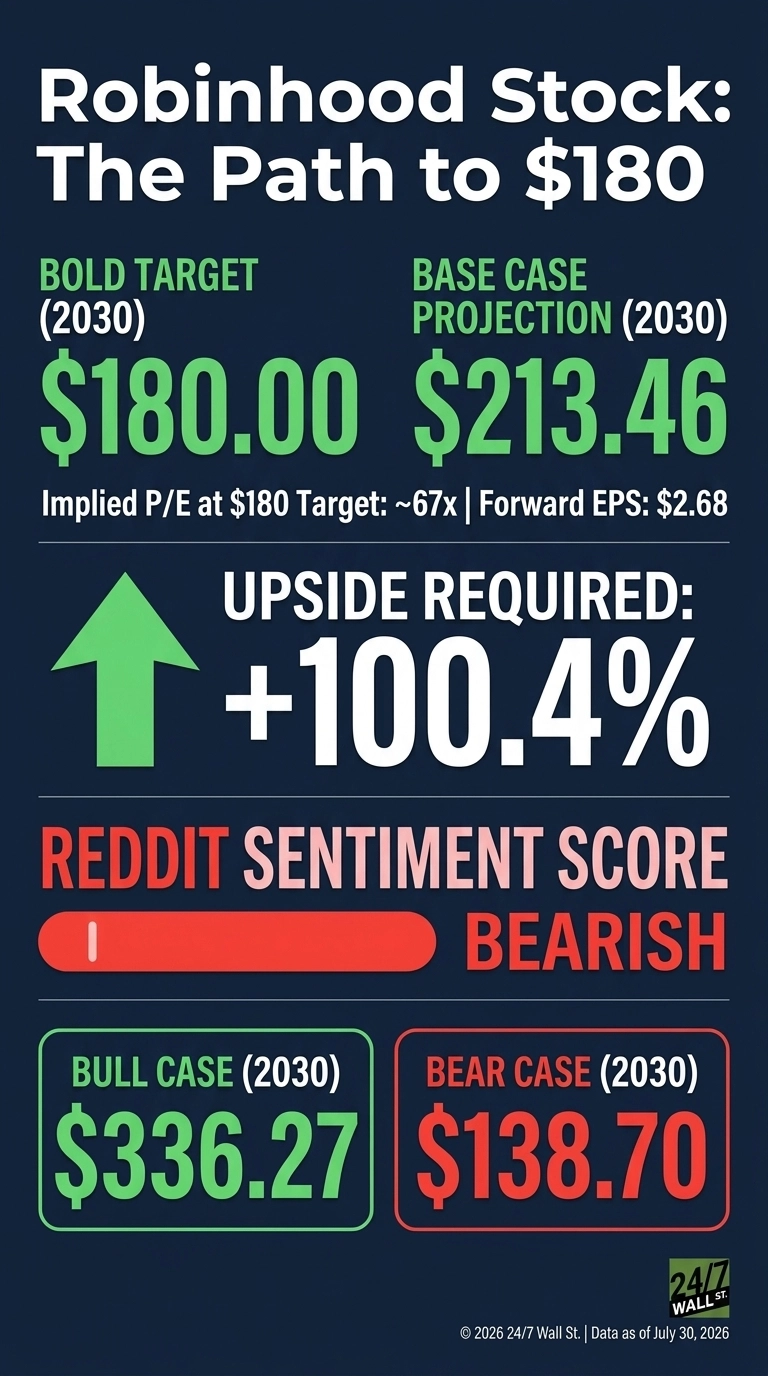
Here is where the math turns friendly. Analysts already model 2028 EPS of $4.56. Push that trajectory to 2030 at Robinhood’s product velocity, and $180 becomes a P/E in the low 30s on forward earnings.
That is achievable given Trump Accounts with 7M+ sign-ups and $1.5B deposited, Robinhood Chain, and international expansion. Tenev put it plainly: “Whether it’s the Robinhood Chain, Robinhood Ventures, or Trump Accounts, our product velocity is focused on one goal: making everyone an owner.”
The primary risk is a crypto-driven earnings reset that resets sentiment before EPS catches up.
Where Robinhood Trades Today vs Its Earnings Power
At $89.84 against forward EPS of $2.68, HOOD trades at roughly 34x forward earnings. That is not cheap on a static view, but shares sit 21% below the 52-week high of $153.86 and well above the low of $63.52. Barclays lowered the firm’s price target on Robinhood to $105 from $122 and keeps an Overweight rating.
Over five years HOOD has returned 155.59%. If EPS grows into the multiple the way the segment mix suggests, today’s valuation looks reasonable rather than rich.

Is $180 Realistic? Here’s My Take
Doubling to $180 by 2030 requires a 100.4% gain, which lines up neatly with our base case 5-year target of $213.46 by mid-2030. That makes $180 a realistic goal, not a stretch.
Three things need to keep working: event contracts scaling past $1B annualized, Trump Accounts converting sign-ups into sticky deposits, and international revenue passing 15% of the mix. A regulatory ruling that cripples prediction markets would derail the thesis fastest. Returns at this level shouldn’t be expected every year, but we’ve outlined the blueprint for how Robinhood could reach $180 in 2030.
Contact [email protected] for any questions or corrections.













 Top Gaining Stocks
 Top Losing Stocks