VEA vs VEU: Which International Vanguard ETF Is the Better Buy Today?
If you were asked what did Samsung Electronics, Saudi Aramco and Kweichow Moutai have in common, besides being 3 of the largest companies in the world? Surprisingly, the answer is this: none of them have any public stock available on…


If you were asked what did Samsung Electronics, Saudi Aramco and Kweichow Moutai have in common, besides being 3 of the largest companies in the world? Surprisingly, the answer is this: none of them have any public stock available on a US exchange. In order to get an equity stake in Saudi Aramco, Samsung, or Kweichow Moutai, one must put an order in on the actual international exchange (Riyadh for Saudi Aramco, Seoul for Samsung,and Shanghai for Kweichow Moutai), convert their dollars to the corresponding local currency, and then reverse the process when they decide to sell.
As multinational companies that originate outside the US proliferate, political and other factors may enter into the equation to eschew registration in the US. Perhaps finding their own regional markets a better fit, these companies have upsides and track records that rival many of those in the top S&P 500 stalwarts.
Fortunately, Exchange Traded Funds (ETFs) may offer investors exposure to these and other companies in a diversified fund format that offers the convenience of ordinary US stock trading protocols with built-in risk mitigation for liquidity and volatility.
With $10.4 trillion AUM, Vanguard is the second largest asset manager behind BlackRock. Founded by “the father of index investing”, John Bogle, Vanguard’s bread and butter business is its ETFs, which are predominantly passively managed and tracked with benchmark indexes.
Two of Vanguard’s international ETFs that may scratch an investor’s international itch are:
Vanguard FTSE Developed Markets ETF (NYSE: VEA) and
Vanguard FTSE All-World ex-US ETF (NYSE: VEU)
Vanguard FTSE Developed Markets ETF

Launched in July, 2007, the Vanguard FTSE Developed Markets ETF (NYSE: VEA) is designed to track the MSCI Developed All Cap ex US Index. VEA includes a range of large-cap and mid-cap stocks from Canada, Europe, Middle East, and the Pacific Rim.
An overview of VEA includes the following:
|
Net Assets |
$191.39 billion |
|
Yield |
3.36% |
|
Average Daily Volume |
12.41 million shares |
|
Expense Ratio |
0.06% |
|
Beta |
1.09 |
|
1-Year Return |
7.19% |
|
5-Year Return |
5.46% |
|
10-year Return |
5.56% |
VEA holds 3.909 stocks but its top 10 holdings give a good idea of the ETF’s breadth of coverage. Europe accounts for 52.90% of issues, 35.70% for PacRim, 10.60% for North America, and the Middle East at 0.80%.
|
Name |
Country |
Pct % |
|
ASML Holding NV |
Netherlands |
1.24% |
|
SAP SE |
Germany |
1.21% |
|
Novo Nordisk A/S |
Denmark |
1.19% |
|
Toyota Motor Corp. |
Japan |
1.01% |
|
Nestlé S.A. |
Switzerland |
0.95% |
|
AstraZeneca PLC |
UK |
0.88% |
|
Novartis AG |
Switzerland |
0.87% |
|
Roche Holdings, AG |
Switzerland |
0.87% |
|
Shell plc |
UK |
0.87% |
|
HSBC Holdings plc |
UK |
0.80% |
From a sector perspective, VEA is weighted in the following sectors:
- Financial Services – 21.72%
- Industrials – 17.65%
- Technology – 10.83%
- Consumer Cyclical – 10.37%
- Healthcare – 10.37%
Vanguard FTSE All-World ex-US ETF

The Vanguard FTSE All-World ex-US ETF (NYSE: VEU) was launched in March 2007. It tracks the FTSE All-World ex US Index. It carries a broad range of stocks from emerging markets, in addition to Europe, PacRim, Europe, North America, and the Middle East.
An overview of VEU includes the following:
|
Net Assets |
$55.84 billion |
|
Yield |
3.24% |
|
Average Daily Volume |
2.93 million shares |
|
Expense Ratio |
0.07% |
|
Beta |
1.03% |
|
1-Year Return |
9.56% |
|
5-Year Return |
5.01% |
|
10-year Return |
5.21% |
VEU holds 3.831 stocks and its top 10 holdings reflect a stronger Emerging Markets tilt. Emerging Markets make up 27.60%. Europe accounts for 39% of issues, 26.`0% for PacRim, 6.80% for North America, and the Middle East at 0.50%.
|
Name |
Country |
Pct % |
|
Taiwan Semiconductor |
Taiwan |
2.78% |
|
Tencent Holdings |
China |
1.18% |
|
ASML Holding NV |
Netherlands |
0.98% |
|
SAP SE |
Germany |
0.96% |
|
Novo Nordisk A/S |
Denmark |
0.95% |
|
Toyota Motor Corp. |
Japan |
0.81% |
|
Nestlé S.A. |
Switzerland |
0.75% |
|
AstraZeneca PLC |
UK |
0.70% |
|
Novartis AG |
Switzerland |
0.69% |
|
Roche Holdings, AG |
Switzerland |
0.69% |
From a sector perspective, VEU is weighted in the following sectors:
- Financial Services – 22.83%
- Industrials – 14.35%
- Technology – 13.86%
- Consumer Cyclical – 10.93%
- Healthcare – 8.83%
The Differences Are Minor
As one can see, a side-by-side comparison does not show any significant differences between the Vanguard FTSE Developed Markets ETF and Vanguard FTSE All-World ex-US ETF apart from:
- The much larger positions in Taiwan Semiconductor and Tencent Holdings, both in the technology category;
- VEA’s substantially bigger average daily trade volume;
- VEU’s larger weighting in emerging markets.
Other factors, such as yield, Return on Investment, expense ratio, and geographic sector, are fairly equivalent.
From a tactical growth perspective, VEU may have an advantage.
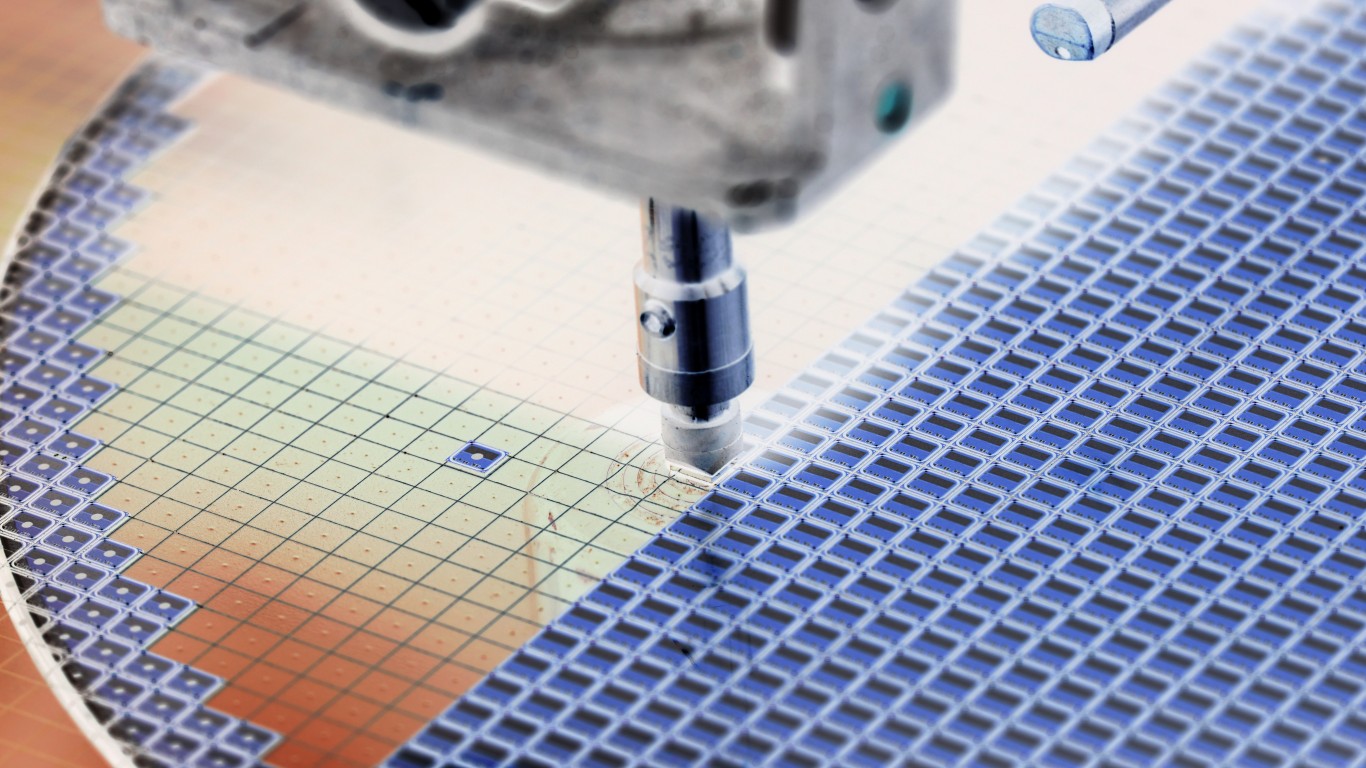
- VEU’s large position in Taiwan Semiconductor, which is nearly 3% of its portfolio, can be a huge contributor. Taiwan Semiconductor is essentially a de facto AI stock play, due to its exclusive manufacturing for the two top Graphics Processing Unit designers for AI: Nvidia and AMD. In fact, Taiwan Semiconductor’s importance to AI is so vital, that other technology titans have been trying to influence China to calm its rhetoric about retaking Taiwan militarily over fears over a potential disruption of the GPU supply chain.
- VEU’s other large position is in TenCent, which is China’s largest multimedia company. With divisions in video games, fintech, online advertising, and film production, among others, It is a media conglomerate that has smartly targeted marketing to the rest of the world with a slower and stealthy approach in the US. While its WeChat communications app is ubiquitous outside of the US and growing in popularity here, its 40% in Epic Games (publishers of Fortnite), and its sizable movie co-production projects include the hits Wonder Woman (2017), Venom (2018), and others.
- The overall larger allocation in the emerging markets sector will benefit VEU, since Europe has yet to revamp its economic policies to address the changes being instituted to cut US business red tape and revitalize investment. European companies held in both portfolios will face challenges from US rivals with deeper R&D pockets, but VEA’s overweighting in Europe will likely slow growth without a portfolio adjustment, VEU’s Tencent and Taiwan Semiconductor holdings will give it a boost that VEA will lack.
Investors looking at one or the other to add to a portfolio should obviously take all of the criteria into consideration and weigh personal preferences and objectives in making a final decision.
Contact [email protected] for any questions or corrections.
After 15 years on Wall Street with 7 of them as Director of Corporate and Municipal Bond Trading for a NYSE member firm, I started my own project and corporate finance consultancy. Much of the work involves writing business plans, presentations, white papers and marketing materials for companies seeking budgetary allocations for spinoffs and new initiatives or for raising capital for expansion or startup companies and entrepreneurs. On financial topics, I have been published under my own byline at The Motley Fool, 247wallst.com, DealFlow Events’ Healthcare Services Investment Newsletter and The Microcap Newsletter, among others. Additionally, I have done freelance ghostwriting writing and editing for several financial websites, such as Seeking Alpha and Shmoop Financial. I have also written and been published on a variety of other topics from music, audiophile sound and film to musical instrument history, martial arts, and current events. Publications include Copper Magazine, Fidelity (Germany), Blasting News, Inside Kung-Fu, and other periodicals.