Oil Trading Below $60? Grab 5 Energy Giants With Huge Dividends Now
With oil prices reaching their lowest levels since May, it makes sense for investors to consider buying these five energy giants with huge dividends.

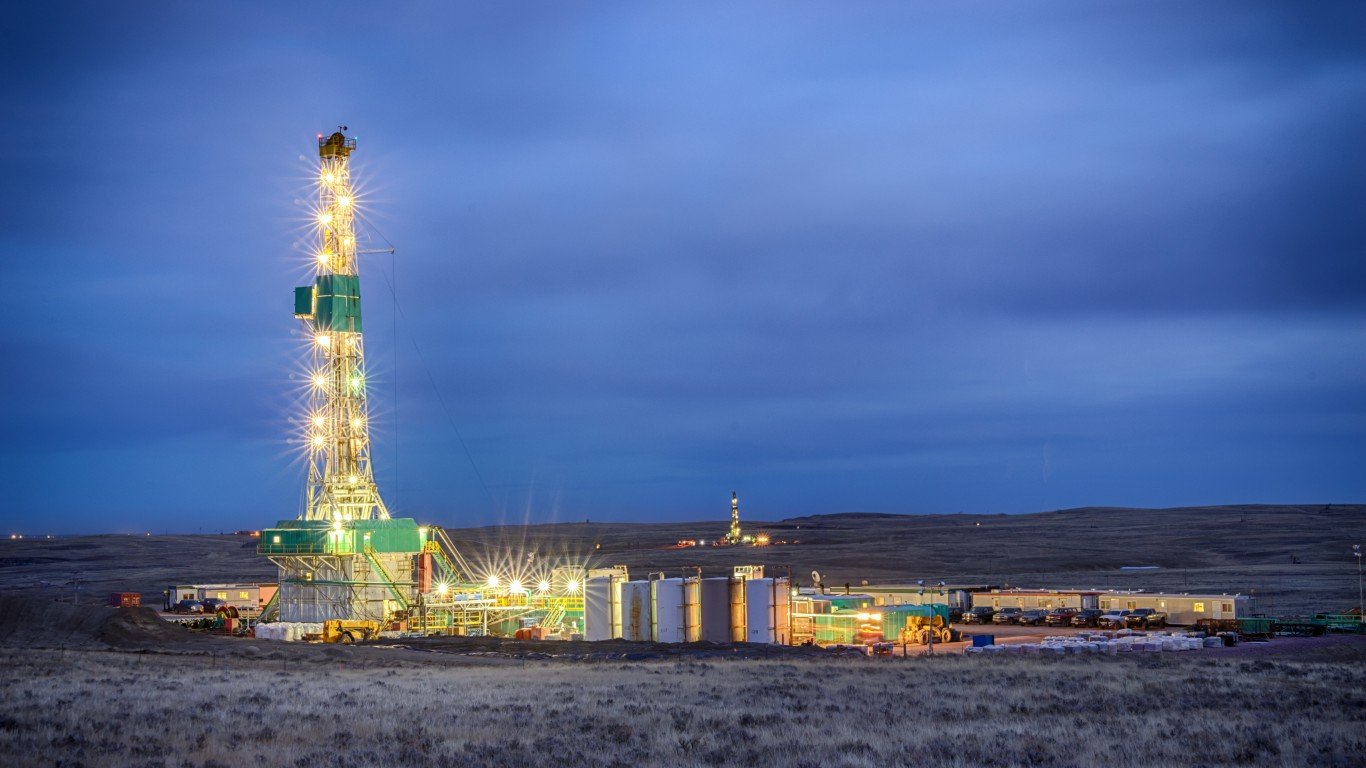
Oil prices fell below $60 per barrel recently due to a combination of oversupply and weak demand. Global oil inventories are rising, putting downward pressure on prices. At the same time, both OPEC+ and U.S. production are increasing amid relatively stable global oil demand. Some banks expect West Texas Intermediate oil prices to be below $60 for the remainder of 2025. OPEC+ recently announced plans to unwind its production cuts, but the increases are less than what was first proposed. The U.S. Energy Information Administration expects the price of crude oil to fall below the current $60 per barrel by the end of the year and average near $50 per barrel through 2026, as more supply is added to an already well-supplied market.
In addition, while concerns about global economic growth and potential recession have weighed on demand expectations, some of those worries are fading. Earlier in the year, tariff-related uncertainty also contributed to price volatility, though some of those concerns have faded since then. The combination of these factors has pushed prices to their lowest levels since 2020. This allows investors to start buying the mega-cap dividend-paying giants in the industry at a bargain price.
With benchmarks hitting a 2025 low and reaching their lowest levels since May, it makes sense for investors to consider buying some of the biggest and best mega-cap integrated leaders. Five stocks make sense now; all pay dependable dividends, and all are rated Buy at major Wall Street firms.
BP
This company is one of the premier European integrated oil giants, and it pays shareholders a substantial 5.96% dividend. BP PLC (NYSE: BP) engages in the energy business worldwide through these segments:
- Gas & Low Carbon Energy
- Oil Production & Operations
- Customers & Products
- Rosneft
BP produces and trades natural gas, offers biofuels, operates onshore and offshore wind and solar power generating facilities, and provides decarbonization solutions and services, such as hydrogen and carbon capture, usage, and storage.
The company is also involved in the convenience and mobility business, which includes managing the sale of fuels to wholesale and retail customers, convenience products, aviation fuels, and Castrol lubricants; refining, supplying, and trading of oil products; and operating electric vehicle charging facilities.
In addition, it produces and refines oil and gas and invests in upstream, downstream, and alternative energy companies. It also invests in advanced mobility, bio and low-carbon products, carbon management, digital transformation, and power and storage areas.
Berenberg has a Buy rating, but we could not find a target price in U.S. dollars.
Chevron
This American multinational energy company predominantly specializes in oil and gas. This integrated giant is a safer option for investors looking to position themselves in the energy sector, paying a substantial 4.31% dividend, which was raised by 5% earlier this year. Chevron Corp. (NYSE: CVX | CVX Price Prediction) operates integrated energy and chemicals businesses worldwide through its subsidiaries and offers investors very strong credit ratings (AA), diversified operations, good margins, a long history of paying and raising dividends yearly. The company operates in two segments.
The Upstream segment is involved in the following:
- Exploration, development, production, and transportation of crude oil and natural gas
- Processing, liquefaction, transportation, and regasification associated with liquefied natural gas
- Transportation of crude oil through pipelines, as well as transportation and storage
- Marketing of natural gas, as well as operating a gas-to-liquids plant
The Downstream segment engages in:
- Refining crude oil into petroleum products
- Marketing crude oil, refined products, and lubricants
- Manufacturing and marketing renewable fuels
- Transporting crude oil and refined products by pipeline, marine vessel, motor equipment, and rail car
- Manufacturing and marketing of commodity petrochemicals, plastics for industrial uses, and fuel and lubricant additives
It also involves cash management, debt financing, insurance operations, real estate, and technology businesses.
Chevron announced in late 2023 that it had entered into a definitive agreement with Hess Corp. (NYSE: HES) to acquire all of the outstanding shares of Hess in an all-stock transaction valued at $53 billion, or $171 per share based on Chevron’s closing price on October 20, 2023. Under the terms of the agreement, Hess shareholders will receive 1.0250 shares of Chevron for each Hess share. The transaction’s total enterprise value, including debt, is $60 billion. The Federal Trade Commission approved the deal last October, and it is expected to close this fall.
UBS has a Buy rating with a huge $197 target price.
ConocoPhillips
The big always gets bigger, and this company completed a $22.5 billion purchase of Marathon Oil this time last year. This deal added high-quality assets, particularly in the Eagle Ford and Bakken shales, to the company’s portfolio. ConocoPhillips (NYSE: COP) is an exploration and production company with a rich 3.39% dividend.
Its Alaska segment primarily explores for, produces, transports, and markets crude oil, natural gas, and NGLs.
The Lower 48 segment consists of operations located in the 48 contiguous states in the United States and the Gulf of Mexico.
Canadian operations consist of the Surmont oil sands development in Alberta, the liquids-rich Montney unconventional play in British Columbia, and commercial operations.
The Europe, Middle East, and North Africa segment consists of operations principally located in:
- The Norwegian sector of the North Sea
- The Norwegian Sea
- Qatar
- Libya
- Equatorial Guinea
- Commercial and terminalling operations in the United Kingdom
The Asia Pacific segment has exploration and production operations in China, Malaysia, and Australia, and commercial operations in China, Singapore, and Japan. The Other International segment includes interests in Colombia as well as contingencies associated with prior operations in other countries.
Jefferies has a Buy rating with a $120 target price.
Exxon Mobil
Exxon Mobil Corp. (NYSE: XOM) manages an industry-leading portfolio of resources and is one of the world’s largest integrated fuels, lubricants, and chemical companies. It trades at 18% below fair value with a 3.46% yield. The decline in oil prices presents investors with an excellent entry point, and they will likely seize the opportunity to secure a strong dividend yield. Exxon explores for and produces crude oil and natural gas in the United States, Canada/South America, Europe, Africa, Asia, and Australia/Oceania.
Exxon also manufactures and markets commodity petrochemicals, including olefins, aromatics, polyethylene, and polypropylene plastics, as well as specialty products. Additionally, the company transports and sells crude oil, natural gas, and petroleum products.
Top Wall Street analysts expect the company to remain a key beneficiary in a higher oil price environment, and most remain very optimistic about the company’s sharp positive inflection in capital allocation strategy.
Upstream portfolio and leverage to a further demand recovery. Exxon offers greater Downstream/Chemicals exposure than its peers.
Exxon completed its purchase of oil shale giant Pioneer Natural Resources in 2024 in an all-stock transaction valued at $59.5 billion. The deal created the largest U.S. oilfield producer and guarantees a decade of low-cost production.
UBS has a Buy rating on the shares with a $143 price objective.
TotalEnergies
This integrated energy and petroleum company was founded in 1924 and is one of the seven supermajor oil companies. This French-integrated giant is another excellent way to play the energy sector from the European side. It sports a massive 7.02% dividend. TotalEnergies SE (NYSE: TTE) is an oil and gas company with a global presence that operates through four segments.
The company’s Exploration & Production segment involves oil and natural gas exploration and production activities in approximately 50 countries.
The Integrated Gas, Renewables & Power segment engages in:
- Liquefied natural gas (LNG) production
- Shipping, trading, and regasification activities
- Trading of liquefied petroleum gas (LPG), petcoke and sulfur, natural gas, and electricity
- Transportation of natural gas
- Electricity production from natural gas, wind, solar, hydroelectric, and biogas sources
- Energy storage activities and development and operation of biomethane production units, as well as providing energy efficiency services
The TotalEnergies Refining & Chemicals segment refines petrochemicals, including olefins and aromatics, and polymer derivatives, such as polyethylene, polypropylene, polystyrene, and hydrocarbon resins. It also converts biomass and processes elastomers. This segment also trades and ships crude oil and petroleum products.
Its Marketing & Services segment produces and sells lubricants. It also supplies and markets petroleum products, including bulk fuel, aviation and marine fuel, special fluids, compressed natural gas, LPG, and bitumen, and fuel payment solutions.
The company also operates approximately 15,500 service stations.
Royal Bank of Canada has a target in euros equal to $80.95 in U.S. dollars.
Four Stocks That Yield at Least 12% Are Passive Income Kings
Contact [email protected] for any questions or corrections.
Lee Jackson has covered Wall Street analysts' equity and debt research and equity strategy daily for 24/7 Wall St. since 2012. His broad, diverse career, including a stint as creative services director at an NBC affiliate in Austin, Texas, gives him unique insight into the financial industry.
Lee Jackson's journey in the financial industry spans more than 30 years, including nearly two decades as an institutional equity salesperson at Bear Stearns, Lehman Brothers, and Morgan Stanley. His career spanned pivotal sell-side Wall Street events, from the dot-com rise and bubble to the Long-Term Capital Management debacle, 9/11, and the Great Recession of 2008. This reflects his resilience and adaptability amid market volatility.
Lee Jackson’s practical financial industry experience, gained through a career at some of the biggest banks and brokerage firms, is complemented by a lifetime of writing across various platforms. This unique combination allows him to shed light on the intricacies of Wall Street in a way only someone with deep insider experience and knowledge can. Moreover, his extensive network across Wall Street continues to provide direct access for him and 24/7 Wall St., a privilege few firms enjoy.
Since 2012, Jackson’s work for 24/7 Wall St. has been featured in Barron’s, Yahoo Finance, MarketWatch, Business Insider, TradingView, Real Money, The Street, Seeking Alpha, Benzinga, and other media outlets. He attended the prestigious Cranbrook Schools in Bloomfield Hills, Michigan, and has a degree in broadcasting from the Specs Howard School of Media Arts.