Most Retirees Are Overlooking Vanguard’s Excellent Monthly Income ETF | VWOB
Retirees hunting for monthly income often gravitate toward familiar dividend aristocrats or high-yield bond funds, but many are missing a compelling option hiding in plain sight. Vanguard Emerging Markets Government Bond ETF (NYSEARCA:VWOB) delivers consistent monthly distributions, a 6.12% distribution…


Retirees hunting for monthly income often gravitate toward familiar dividend aristocrats or high-yield bond funds, but many are missing a compelling option hiding in plain sight. Vanguard Emerging Markets Government Bond ETF (NYSEARCA:VWOB) delivers consistent monthly distributions, a 6.12% distribution yield, and something most income investors do not expect from bond funds: meaningful capital appreciation.
The Return Engine: Income Plus Surprise Gains
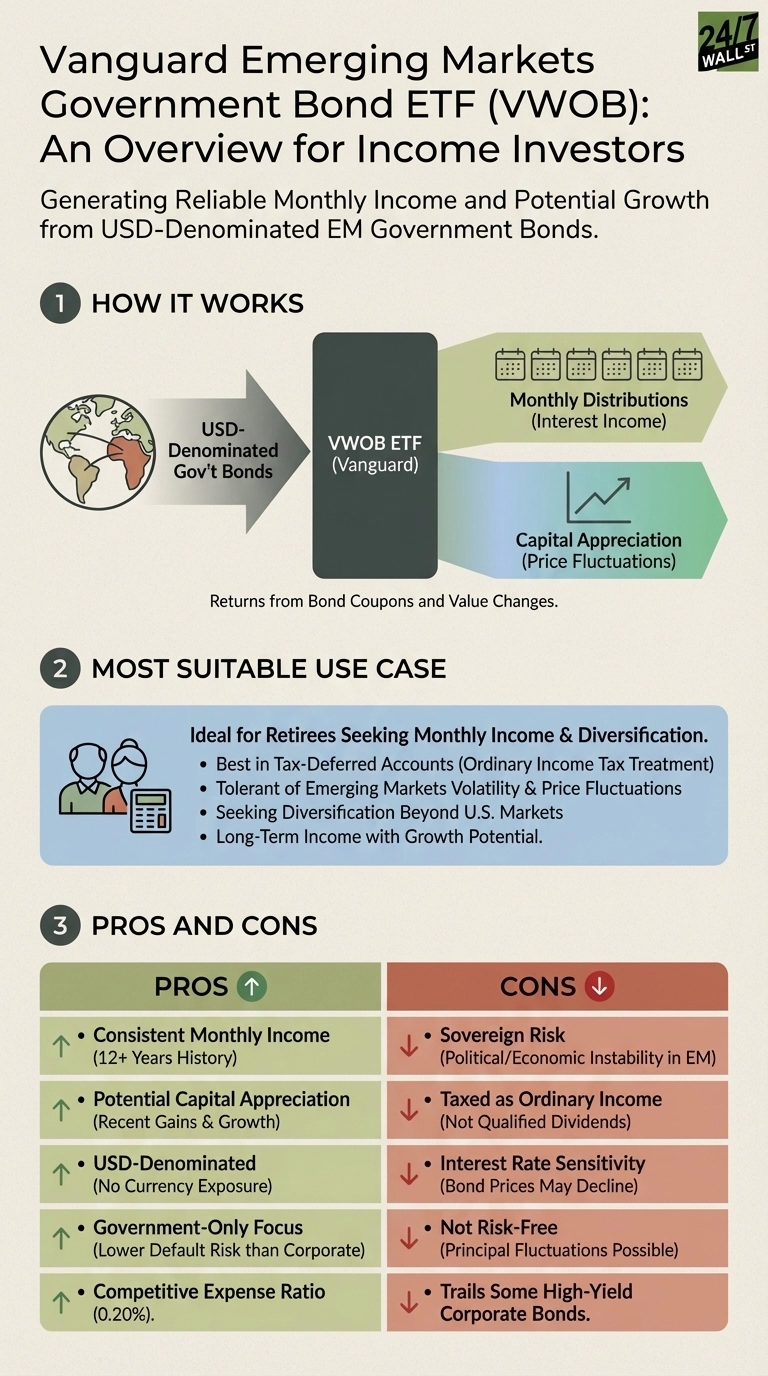
VWOB tracks USD-denominated government bonds issued by emerging market countries. The fund generates returns through two channels: interest income from bond coupons, distributed monthly to shareholders, and price appreciation as bond values fluctuate with interest rates and credit conditions. With roughly $6.4 billion in ETF net assets and more than 940 holdings, the fund offers broad exposure to sovereign debt across dozens of countries while keeping costs extremely low at just 0.15% annually.
The income story is clear and consistent. VWOB has paid monthly distributions for over 13 years, with the most recent payment coming in at $0.347 per share. Distributions have grown over time, and the trailing yield has risen to 6.12% as of September 2026, up meaningfully from the 5.66% figure cited when this article was first published. Morningstar currently awards VWOB a Bronze Medalist Rating, reflecting its cost advantage and long-term consistency relative to category peers.
The less obvious benefit is capital appreciation. Shares climbed 13.49% in full-year 2025, combining with that year’s yield to push total returns above 19%. After that strong run, 2026 has been a more measured year, with the fund delivering roughly flat to low single-digit price returns as of mid-2026. That cooling is worth noting: the 2025 gains were exceptional, not the norm for a bond fund in this category.
Over the long term, the fund’s average annual return over the past decade has been approximately 3.7%, reflecting both the strong years and the painful 17% drawdown that 2022 delivered. That long-run figure is an honest measure of what investors can realistically expect from this asset class: competitive income with modest price variation over full market cycles.
Does It Deliver for Retirees?
VWOB succeeds at its core mission: generating reliable monthly income with diversification beyond U.S. markets. The fund’s government-only focus reduces default risk compared to corporate emerging markets debt, while USD denomination eliminates currency exposure for American retirees. Because all the underlying bonds are dollar-denominated, the income stream does not swing with fluctuations in the Brazilian real or Indonesian rupiah.
The 0.15% expense ratio places VWOB among the cheapest options in its category, well below the peer average of roughly 0.98% for emerging markets bond funds. Combined with more than a decade of uninterrupted monthly distributions, the fund has earned a place on the short list for retirees who want overseas yield without the complexity of currency hedging.
The Tradeoffs
Emerging markets bonds carry sovereign risk. Economic instability or political turmoil in countries like Brazil, Mexico, or Indonesia can weigh on both bond prices and income stability. Government bonds are structurally safer than corporate debt from the same region, but they are not immune to country-specific crises or broader EM contagion.
Tax treatment deserves attention. Distributions are primarily interest income, taxed as ordinary income rather than at qualified dividend rates. Retirees in higher brackets should consider holding VWOB inside a tax-deferred account such as a traditional IRA, where distributions compound without an immediate tax drag.
Finally, bond funds of all kinds face price risk in rising-rate environments. VWOB’s strong 2025 performance coincided with a favorable rate backdrop; a shift toward higher-for-longer rates or renewed dollar strength could reverse some of those price gains in any given year.
Who Should Avoid VWOB
Retirees seeking maximum current income may find better raw yield in high-yield corporate bond funds, which typically offer more than VWOB’s 6.12% but with meaningfully higher credit risk. Conservative investors uncomfortable with emerging markets volatility, or those who truly cannot accept any principal fluctuation, are better served by short-term Treasury funds or money market accounts. VWOB is a reasonable middle ground, but it is not a risk-free vehicle.
Consider EMB as an Alternative
iShares J.P. Morgan USD Emerging Markets Bond ETF (NYSEARCA:EMB) pursues a similar strategy and carries roughly $16 billion in assets, giving it superior liquidity for investors moving larger positions. The trade-off is cost: EMB charges 0.39% annually, more than double VWOB’s 0.15%, and its current yield is somewhat lower. For cost-conscious investors, VWOB’s significantly lower fee structure makes it the stronger value proposition for long-term income-focused holders.
VWOB fits best inside a diversified retirement portfolio where monthly income and geographic diversification are priorities. Emerging markets volatility is real, and the 2022 drawdown is a reminder that principal fluctuations are part of the deal. Investors who can accept that in exchange for a competitive yield and a low-cost structure will find the fund worth a close look.
Editor’s note: This update refreshes VWOB’s expense ratio from 0.20% to 0.15%, raises the distribution yield to 6.12% (from 5.66%), updates the most recent monthly distribution to $0.347, corrects EMB’s current AUM to approximately $16 billion, adds VWOB’s 10-year average annual return of approximately 3.7%, and notes that 2026 year-to-date price performance has been relatively flat following 2025’s exceptional 13.49% total return.
Contact [email protected] for any questions or corrections.
I am a long time investor and student of business, and believe finding good companies that can become great investments is the best game on earth. After 20 years of writing and researching the public markets it is clear that individuals have never had more tools and information to take control of their financial lives. From ETFs and $0 commissions to cryptos and prediction markets there has never been a greater democratization of access to investing.
I write to help people understand the investments available to them so they can make the best choice for their portfolio, whether they're starting out or looking for income in retirement.