2026 Looks Like An Inflection Point For Schwab’s US REIT To Launch Higher | SCHH
The Schwab U.S. REIT ETF (NYSEARCA:SCHH) has spent the last year treading water, down roughly 2% while investors waited for interest rates to cooperate. With the 10-year Treasury hovering around 4.2% in mid-December and the Federal Reserve signaling a gradual…


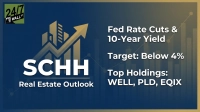
The Schwab U.S. REIT ETF (NYSEARCA:SCHH) has spent the last year treading water, down roughly 2% while investors waited for interest rates to cooperate. With the 10-year Treasury hovering around 4.2% in mid-December and the Federal Reserve signaling a gradual path toward lower rates in 2026, SCHH sits at the inflection point where real estate transforms from defensive survival mode to offensive expansion.
The Rate Reset That Changes Everything
The single biggest macro force shaping SCHH’s 2026 trajectory is the direction of the 10-year Treasury yield. Real estate investment trusts compete directly with risk-free government bonds for income-seeking capital. When Treasuries yield 4% or more, a REIT paying 3.5% looks unattractive. But if rates drift toward the 3.0% to 3.5% range that BlackRock and other forecasters expect by late 2026, that same REIT dividend becomes compelling.
Lower long-term rates trigger cap rate compression. Property values move inversely to interest rates because the discount rate used to value future cash flows declines. A warehouse generating steady rental income becomes worth more when buyers can finance acquisitions at 4% instead of 6%. For SCHH, which holds industrial REITs like Prologis (NYSE:PLD) at nearly 9% of the portfolio, this valuation lift flows directly through to net asset value.
The commercial real estate maturity wall is equally critical. Roughly $162 billion in CRE loans mature in 2026, up 56% from 2025’s $104 billion. Much of this debt was originated at 3% to 4% rates and needs refinancing. If rates stay elevated near 6%, refinancing becomes punishing and dividends get cut. If rates fall toward 4%, the crisis becomes manageable. SCHH’s fate hinges on this refinancing environment because its holdings must either roll over debt or tap equity markets at reasonable costs.

What Matters Inside the Portfolio
Beyond macro rates, SCHH’s micro story centers on sector allocation within its 165 holdings. The fund’s largest position, Welltower (NYSE:WELL) at 9.84%, has surged over 50% year-to-date, demonstrating that healthcare REITs can thrive even in tough rate environments due to demographic tailwinds. But data center REITs like Digital Realty (NYSE:DLR), representing 4.1% of SCHH, have fallen 14% this year as AI infrastructure euphoria faded and financing costs bit harder.
This divergence matters because SCHH’s 2026 performance depends on which subsectors catch momentum. Infrastructure REITs including cell towers and data centers comprise roughly 18% of the portfolio. Industrial and logistics properties add another 15%. Residential REITs account for 12%.
Consider This Lower-Cost Alternative
The Fidelity MSCI Real Estate Index ETF (NYSEARCA:FREL) offers a similar portfolio at an expense ratio of 0.084% versus SCHH’s 0.07%. FREL holds $1.1 billion in assets with nearly identical top holdings including Welltower, Prologis, and American Tower. The key difference is FREL includes real estate services companies like CBRE Group (NYSE:CBRE | CBRE Price Prediction) at 3.26% and CoStar Group (NASDAQ:CSGP) at 1.98%, which aren’t REITs but benefit from real estate transaction volumes. If the rate environment improves and property sales accelerate in 2026, FREL captures that upside through its services exposure while SCHH remains pure-play property ownership.
The most important signal for SCHH over the next 12 months is whether the 10-year Treasury yield breaks below 4% and stays there, combined with whether the fund’s industrial and healthcare REIT holdings maintain occupancy and rental growth despite the refinancing wave.
Contact [email protected] for any questions or corrections.
I am a long time investor and student of business, and believe finding good companies that can become great investments is the best game on earth. After 20 years of writing and researching the public markets it is clear that individuals have never had more tools and information to take control of their financial lives. From ETFs and $0 commissions to cryptos and prediction markets there has never been a greater democratization of access to investing.
I write to help people understand the investments available to them so they can make the best choice for their portfolio, whether they're starting out or looking for income in retirement.