Small Cap Investors Should Watch This One Number Before Buying SCHA Right Now
The Schwab U.S. Small-Cap ETF (NYSEARCA:SCHA) has delivered a 5.5% return YTD, tracking the broader small-cap market’s trajectory. The fund’s defining advantage is cost efficiency, at a scant 0.04% annual expense ratio ranks among the lowest in the small-cap category,…

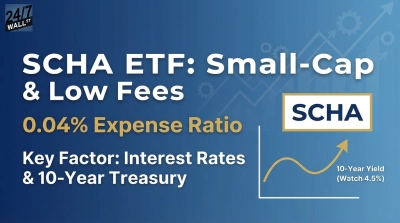
The Schwab U.S. Small-Cap ETF (NYSEARCA:SCHA) has delivered a 5.5% return YTD, tracking the broader small-cap market’s trajectory. The fund’s defining advantage is cost efficiency, at a scant 0.04% annual expense ratio ranks among the lowest in the small-cap category, allowing investors to compound returns without significant fee drag eating into performance over time.
Recent coverage has been mixed. MSN positioned SCHA as an “attractive option” given its low costs and past performance, while Seeking Alpha downgraded the fund to Hold in October, arguing current conditions favor large caps over small companies. The tension reflects a broader reality: small-cap performance depends less on stock selection and more on whether the macro environment cooperates.
The Interest Rate Question
Small-cap stocks live or die by borrowing costs. Unlike large companies with cash-rich balance sheets, smaller firms rely heavily on debt to fund growth. The 10-year Treasury yield currently sits at 4.24%, creating a challenging environment for debt-dependent small companies. When yields push toward 4.5% or higher, the increased cost of capital compresses small-cap valuations faster than large caps, making rate direction the single most important variable for SCHA’s near-term performance.
Watch the monthly Treasury auctions and Federal Reserve meeting minutes for signals about rate direction. If yields push back toward recent peaks, SCHA’s holdings will face renewed pressure regardless of individual company fundamentals.
What’s Inside the Portfolio
SCHA spreads capital across over 500 positions with no single holding exceeding 0.50% of assets. This extreme diversification shifts performance drivers away from individual stock picks toward sector allocation decisions. The portfolio concentrates in three areas—Industrials, Financials, and Information Technology—which together represent roughly half of all assets and determine whether the fund outperforms or lags its benchmark.
More interesting is what’s underneath: meaningful exposure to quantum computing through Rigetti Computing (NASDAQ:RGTI), renewable energy infrastructure, and cryptocurrency mining operations. Rocket Companies (NYSE:RKT | RKT Price Prediction), one of the top holdings, exemplifies the small-cap reality—higher volatility and growth potential from businesses that haven’t yet proven their models at scale.
The most important thing to watch: whether the 10-year Treasury yield stays below 4.5% and whether SCHA’s concentrated sector bets in cyclical areas can deliver earnings growth that justifies current valuations.
Contact [email protected] for any questions or corrections.
I am a long time investor and student of business, and believe finding good companies that can become great investments is the best game on earth. After 20 years of writing and researching the public markets it is clear that individuals have never had more tools and information to take control of their financial lives. From ETFs and $0 commissions to cryptos and prediction markets there has never been a greater democratization of access to investing.
I write to help people understand the investments available to them so they can make the best choice for their portfolio, whether they're starting out or looking for income in retirement.