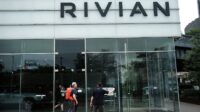
Rivian’s R2 Reveal Is the Moment of Truth for the EV Maker’s Survival
On March 12, 2026, Rivian (NASDAQ: RIVN | RIVN Price Prediction) holds its full R2 product reveal, and few single events in the company’s history carry more weight. The R1T and R1S built Rivian’s brand, but at premium price points…


On March 12, 2026, Rivian (NASDAQ: RIVN | RIVN Price Prediction) holds its full R2 product reveal, and few single events in the company’s history carry more weight. The R1T and R1S built Rivian’s brand, but at premium price points they were never going to drive the volume needed to reach profitability. The R2, a mid-size SUV starting at just over $50,000 but with a $45,000 version later, is the mass-market bet the entire business model depends on.
The Financial Foundation Heading Into the Reveal
Rivian closed 2025 with its first full year of positive gross profit, posting $144 million compared to a $1.2 billion gross loss in 2024. That turnaround reflects more than $7,200 in cost-per-vehicle improvements year-over-year. Still, the company posted an $804 million net loss in Q4 alone, and free cash flow hit −$1.144 billion in the quarter. The R2 is what needs to bend those curves.
Rivian enters the launch window with $6.08 billion in total liquidity, bolstered significantly by the Volkswagen Group joint venture. That partnership, which drove 109% year-over-year growth in Rivian’s Software and Services segment to $447 million in Q4, also provides shared electrical architecture and software development resources that should reduce per-unit R2 costs over time. It is the financial and strategic backstop that gives Rivian room to execute.
Manufacturing and the Autonomy Wildcard
Manufacturing validation builds were completed mid-January 2026, and Rivian’s Normal, Illinois, facility now includes a 1.1 million square foot R2 body shop and general assembly facility with paint shop capacity for 215,000 units annually. First customer deliveries are targeted for Q2 2026, with a planned Georgia facility eventually adding 400,000 units of annual capacity.
The autonomy angle adds a software revenue dimension that could meaningfully shift unit economics. Rivian’s RAP1 processor, featuring 11 cameras, 5 radars, and 1 LiDAR, is in final validation for a late 2026 R2 launch. A subscription autonomy service is planned alongside it. If that model gains traction, the R2 becomes more than a vehicle sale.
Bull and Bear Cases
Bulls point to the gross profit inflection, the VW backstop, an analyst consensus price target of $18.04, and autonomy optionality as reasons the stock, currently near $15, has a credible path higher. The loss of the federal $7,500 credit already contributed to a $270 million decline in regulatory credit sales in Q4.
Bears note the stock is down 24.3% year-to-date, cash burn remains severe, and tariff uncertainty (a theme we explored in today’s Daily Profit newsletter) adds cost risk to a launch that cannot afford execution stumbles. Prediction markets currently place an 11.5% probability on Rivian declaring bankruptcy before 2027, modest but not negligible. The March 12 reveal will not resolve all of those questions, but it will set the tone for everything that follows.
Contact [email protected] for any questions or corrections.
Trey has been an editor and author at 24/7 Wall St. for more than a decade, where he has published thousands of articles analyzing corporate earnings, dividend stocks, short interest, insider buying, private equity, and market trends. His comprehensive coverage spans the full spectrum of financial markets, from blue-chip stalwarts to emerging growth companies.
Beyond 24/7 Wall St., Trey has created and edited financial content for Benzinga and AOL's BloggingStocks, contributing additional hundreds of articles to the investment community.
Trey's editorial expertise extends across multiple publishing environments. He served as production editor at Dearborn Financial Publishing and development editor at Kaplan, where he helped shape financial education materials. Earlier in his career, he worked as a writer-producer at SVE. His freelance editing portfolio includes work for prestigious clients such as Sage Publications, Rand McNally, the Institute for Supply Management, the American Library Association, Eggplant Literary Productions, and Spiegel.
Outside of financial journalism, Trey writes fiction and has been an active member of the writing community for years, moderating workshop sessions at regional conventions.