





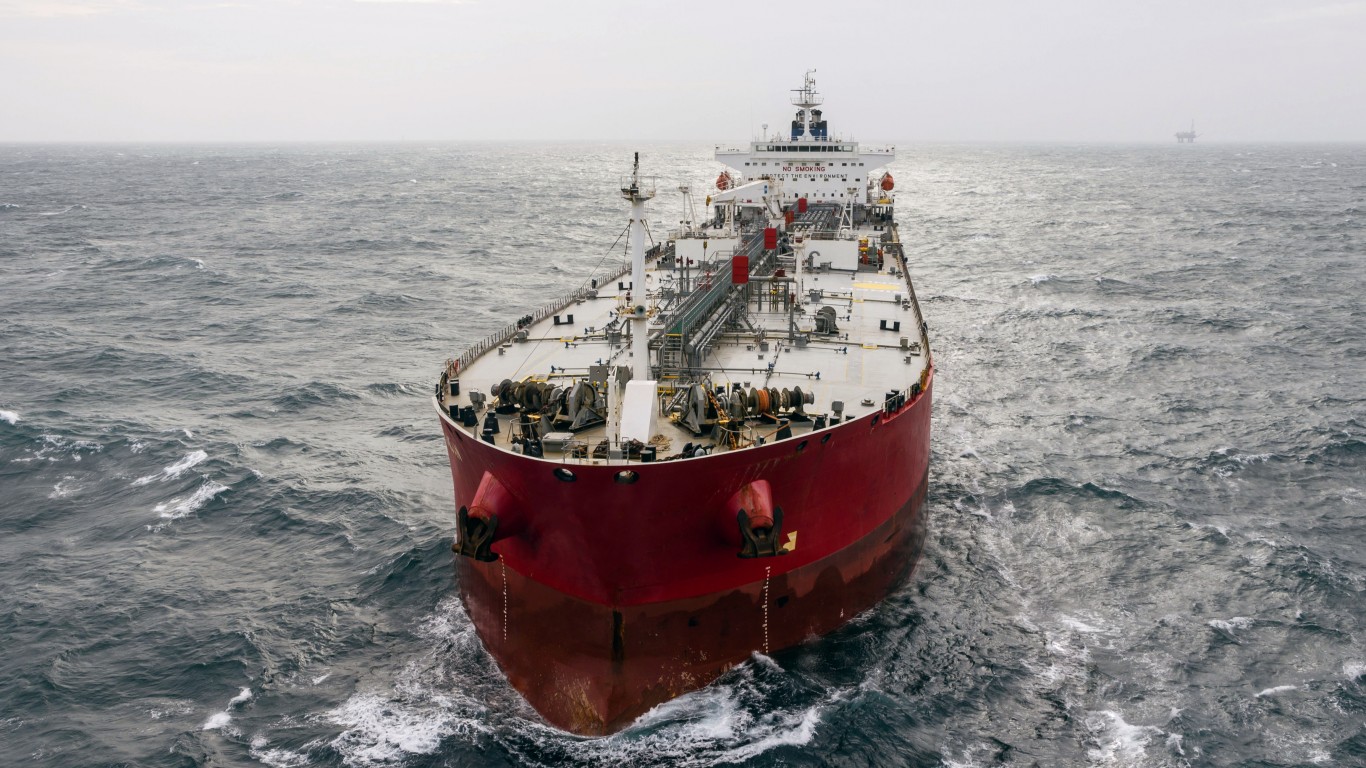
Oil prices are jumping 7% as President Trump orders a blockade of the Strait of Hormuz, tightening global supply. At the same time, empty tankers originally bound for the Middle East have rerouted to U.S. Gulf Coast ports, snapping up domestic crude and giving American producers an extra lift. Brent crude jumped to $96 per barrel, according to Hyperliquid futures, while West Texas Intermediate (WTI) surged to $97.
Trump said on Truth Social that the U.S. will eventually open the Strait to all ships, though he also vowed to stop any ship in international waters that previously paid the “extortion” toll Iran charged for safe passage. If Iran fires on any ship, it will be “BLOWN TO HELL!”
This twin development means higher realized prices plus stronger U.S. export demand. For retail investors, ConocoPhillips (NYSE:COP | COP Price Prediction), Chevron (NYSE:CVX), and Exxon Mobil (NYSE:XOM) stand out because they combine low-cost domestic production with direct ties to Gulf infrastructure. Let’s walk through them.
ConocoPhillips (COP)
ConocoPhillips operates as a focused upstream producer with minimal refining drag, so every dollar of higher oil prices flows straight to the bottom line. Its 2026 production guidance calls for 2.33 million to 2.36 million barrels of oil equivalent per day. Much of that comes from low-cost Permian and Gulf of America assets that feed directly into the export terminals now seeing tanker traffic.
Here’s what the numbers tell us. ConocoPhillips generated $13.86 billion in revenue for the fourth quarter of 2025, with adjusted earnings of $1.02 per share. Its trailing price-to-earnings ratio sits at 19.30. The forward annual dividend yield lands at 2.74%, backed by a quarterly payout of $0.84 per share. Peer comparison shows ConocoPhillips offers higher oil-price sensitivity than integrated majors while still returning capital at a 45% cash-flow payout ratio. Simply put, the Gulf rerouting tightens domestic realizations, and ConocoPhillips’ U.S.-heavy footprint positions it to capture that premium first.
Chevron (CVX)
Chevron brings integrated scale plus heavy Gulf of America deepwater and Permian exposure. The company expects Q1 net oil-equivalent production of 3.8 million to 3.9 million barrels per day, even after Middle East downtime. That U.S. output heads straight to the same Gulf terminals welcoming rerouted tankers.
Numbers back the edge. Chevron reported adjusted earnings per share of $1.52 for Q4, beating estimates by 5.56%. The forward annual dividend reaches $7.12 per share for a 3.39% yield, outpacing ConocoPhillips. Trailing P/E stands at 29.3, higher than peers, but the company’s 3.8% dividend growth streak (39 consecutive years) and Gulf infrastructure ownership deliver steadier cash flows.
When oil rises and U.S. exports spike, Chevron’s downstream balance cushions volatility while its upstream assets capture the price pop. Granted, Middle East exposure trimmed output by roughly 6% in the quarter, yet the Gulf rerouting more than offsets that for domestic-focused barrels.
Exxon Mobil (XOM)
Exxon Mobil delivers the largest production footprint of the three, with 4.7 million oil-equivalent barrels per day in 2025 — its highest annual total in more than 40 years. Permian output alone hit 1.6 million barrels per day, and the company targets 1.8 million in 2026. Those volumes flow through Gulf Coast terminals positioned to load tankers now detouring from Hormuz.
The data shows Exxon’s enduring strength. Full-year 2025 earnings reached $28.8 billion with $52 billion in cash flow from operations and $26.1 billion in free cash flow. Shareholder distributions totaled $37.2 billion, split between $17.2 billion in dividends and $20 billion in repurchases. The quarterly dividend rose 4% to $1.03 per share for Q1, yielding 2.70% on a trailing basis with 43 consecutive years of increases. Its trailing P/E of 22.76 sits between ConocoPhillips’ lower multiple and Chevron’s higher one, reflecting scale advantages. In short, Exxon Mobil’s advantaged Permian and Gulf assets turn the blockade’s price surge and the tanker rerouting into higher volumes and stronger margins at the same time.
Key Takeaway
When all is said and done, these three stocks — ConocoPhillips, Chevron, and Exxon Mobil — give everyday investors a balanced way to play both the global oil-price lift from the Hormuz blockade and the U.S. Gulf export boom. They trade at reasonable valuations relative to their cash-flow generation, pay reliable dividends backed by strong balance sheets, and hold the exact U.S. production and infrastructure that benefit most from current events.
That said, energy stocks remain volatile; a quick ceasefire, the Strait reopening, or a demand slowdown could reverse gains. Consider starting small and holding for the long term. The numbers show these names have the assets and the track record to reward patient shareholders in the months ahead.











 Top Gaining Stocks
 Top Losing Stocks