The Fed Rate Path Will Make or Break PCY in 2026: Here’s What to Watch
The Invesco Emerging Markets Sovereign Debt ETF (NYSEARCA:PCY) has quietly become one of the better-performing fixed income vehicles of the past year, returning 16% over the trailing twelve months as the Federal Reserve cut its policy rate by 75 basis…


The Invesco Emerging Markets Sovereign Debt ETF (NYSEARCA:PCY) has quietly become one of the better-performing fixed income vehicles of the past year, returning 16% over the trailing twelve months as the Federal Reserve cut its policy rate by 75 basis points and risk appetite returned. PCY now trades around $22 and is up 3% over the past month alone. With the rate cycle pivoting and the dollar softening from last year’s highs, PCY sits at a genuine inflection point that warrants close monitoring.
What the fund actually owns
PCY tracks the DBIQ Emerging Market USD Liquid Balanced Index, holding roughly equal-weighted exposure to US dollar-denominated sovereign and quasi-sovereign bonds from a basket of emerging market issuers across Latin America, Eastern Europe, the Middle East, Africa, and parts of Asia. Because the bonds are dollar-denominated, holders avoid direct local-currency risk, but they take on duration risk (the portfolio’s average maturity sits in the long-intermediate range) and EM credit risk. The fund’s monthly distribution is what most retail buyers come for, and the yield-to-maturity on the underlying basket has historically run several hundred basis points wide of comparable US Treasuries.
The macro factor that matters most: the US rate path
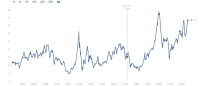
Nothing influences PCY’s twelve-month outlook more than where the Fed and the 10-year Treasury go from here. The 10-year currently sits at 4.4%, in the 77th percentile of its trailing twelve-month range, while the Fed funds rate has been parked at 3.75% since December 2025. That combination is the entire story: PCY rallied as the policy rate fell from 4.5% last September, and it will struggle if either the long end backs up toward 5% or the Fed pauses cuts in response to sticky inflation.
Inflation is the wildcard. Headline CPI sits in the 90th percentile of its twelve-month range, with the latest March print up 1.1% month-over-month. Watch the BLS CPI release on the second Tuesday of each month and the CME FedWatch tool for shifts in cut probabilities. Two consecutive hot prints would likely push the 10-year above 4.6% and pressure PCY’s NAV by 2% to 4%, a pattern that played out in May 2025 when yields touched 4.58%.
The fund-specific factor: country concentration risk
PCY’s roughly equal-weight methodology is its most underappreciated feature. Single-country exposure is typically capped in the low single digits, which means a default or restructuring in any one issuer rarely cracks the fund. The flip side is that the index includes weaker credits (lower BB and B-rated names) alongside investment grade sovereigns, so the spread to Treasuries is the real engine of return. With the 10Y-2Y curve at 0.5%, in only the 9.6th percentile of the past year, the cushion against a risk-off move has thinned. The signal to watch is the JPMorgan EMBI Global spread, published daily. A widening of 75 basis points or more, of the kind that hit EM debt during the March 2026 VIX spike to 31, would likely shave 3% to 5% off NAV and put the distribution under pressure as managers roll into lower-coupon paper.
Investors who want similar yield with shorter duration should compare PCY to its short-duration EM debt cousin, the VanEck Emerging Markets High Yield Bond ETF (NYSEARCA:EMSH), which trades a chunk of total return for far less rate sensitivity.
The bottom line for the next twelve months
If the Fed delivers another two cuts before year end and CPI cools back below 3%, PCY’s distribution holds and the NAV grinds higher. The signal that flips the thesis is a 10-year Treasury push above 4.75% paired with EMBI spreads widening past 400 basis points. Either condition, and especially both together, would be the cue to reassess.
Contact [email protected] for any questions or corrections.
Marc Guberti is a personal finance writer who has written for US News & World Report, Business Insider, Newsweek and other publications. He also hosts the Breakthrough Success Podcast which teaches listeners how to use content marketing to grow their businesses.