Why Buy the Vanguard Value ETF When You Can Buy This Instead?
If you own the Vanguard Value ETF (NYSEARCA:VTV) for income, you are getting a roughly 1.9% trailing yield on a portfolio that calls itself value. The Schwab U.S. Dividend Equity ETF (NYSEARCA:SCHD) pays roughly 4.1% on a portfolio that screens…


If you own the Vanguard Value ETF (NYSEARCA:VTV) for income, you are getting a roughly 1.9% trailing yield on a portfolio that calls itself value. The Schwab U.S. Dividend Equity ETF (NYSEARCA:SCHD) pays roughly 4.1% on a portfolio that screens for the same unloved, cash-generative businesses VTV is supposed to capture. SCHD kept up with VTV on total return over the long haul, which makes the case for choosing SCHD over VTV come down to what each fund actually puts in your pocket.
What each fund is actually buying
VTV tracks the CRSP US Large Cap Value Index, a wide net cast across hundreds of large-cap U.S. stocks that screen as cheap on price-to-book, forward earnings, and a few other ratios. The fund charges 3 basis points, which is about as close to free as a fund gets. You get diversification, low cost, and a yield that reflects the index average.
SCHD does something narrower. It tracks the Dow Jones U.S. Dividend 100, which starts with companies that have paid dividends for at least a decade, then ranks them on cash flow to debt, return on equity, dividend yield, and dividend growth. The result is a 100-stock portfolio that costs 6 basis points and concentrates in businesses that print cash and send a chunk back to shareholders. The top ten holdings, including Bristol-Myers Squibb, Merck, ConocoPhillips, and Lockheed Martin each near 4%, account for roughly 41% of the fund. That is concentration by index-fund standards, and it is the point.
Does SCHD actually deliver more than VTV?
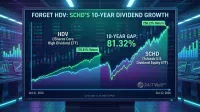
Over the longest window where both funds have lived together, the answer is yes, slightly. From October 2011 through May 2026, SCHD returned roughly 499% versus VTV’s 490%, an exponential trend of about 12% annually for SCHD against 11% for VTV. Close, but the dividend-screened portfolio compounded faster despite holding a fraction of the stocks.
The shorter windows tell a more useful story. Year-to-date in 2026, SCHD is up roughly 16% against VTV’s roughly 8%. Over one year, SCHD returned roughly 28% versus roughly 25% for VTV. SCHD also held up better in the 2020 crash. It drew down roughly 33% at the March bottom versus VTV’s 37%. The income premium came with shallower drawdowns, the opposite of the trade most income strategies actually make.
The five-year picture is the asterisk. VTV’s 65% gain beat SCHD’s 46%, because the stretch from 2021 through 2024 favored broader value baskets that included more cyclical and financial exposure. SCHD’s quality screen kept it out of some rebound trades. Then 2026 happened, and the gap narrowed sharply.
The tradeoffs you accept with SCHD
Three things to know before you swap. First, SCHD owns 100 stocks versus VTV’s several hundred, so a single sector reweighting at the annual reconstitution can shift performance materially. Second, the dividend screen excludes most mega-cap technology, which means SCHD will lag whenever the largest value-classified tech names lead. Third, the income is taxable as qualified dividends, so SCHD is more tax-efficient inside a retirement account than a brokerage account.
Who each fund actually fits
VTV is the right answer if you want the cheapest possible large-cap value exposure inside a taxable account and you reinvest distributions automatically. The 3 basis point fee is hard to argue with for someone who simply wants the value factor and nothing more.
SCHD fits the investor who wants value plus a real income stream, particularly retirees or anyone within a decade of needing cash flow. Discussion threads in r/investing and r/dividendinvesting through early May 2026 ran consistently bullish; sentiment scores held between 68 and 75 across the period, and the fund now manages $71.6 billion, which suggests the retail crowd has already done this comparison. Same value bucket, more income, similar long-term return, and a portfolio that has not historically punished you for owning it during downturns. If you already own SCHD, the case for switching to VTV is weak. If you own VTV for the dividend, the case for switching to SCHD is harder to argue against.
Contact [email protected] for any questions or corrections.
Omor Ibne Ehsan is a writer at 24/7 Wall St. He is a self-taught investor with a focus on growth, cyclical, and dividend equities that have strong fundamentals, value, and long-term potential. He also has an interest in high-risk, high-reward investments such as penny stocks.