Bitcoin News: Strategy Moved 411 BTC to Coinbase. Is the Largest Corporate Holder Ready to Sell?

This post may contain links from our sponsors and affiliates, and Flywheel Publishing may receive compensation for actions taken through them.

Michael Saylor’s Strategy moved 411 Bitcoin (CRYPTO: BTC) to Coinbase today. For a company that holds 843,738 BTC, that is a rounding error, as 411 coins are about 0.05% of its position. Yet Polymarket traders have already pushed the odds that Strategy sells Bitcoin before year-end to 91%, jumping 68 points since the deposit appeared on-chain.
The question Bitcoin holders are asking is the same one: Is the biggest corporate buyer in the market finally about to sell BTC? The honest answer depends on something Saylor said three weeks agoT.
Strategy’s 411 BTC Deposit, In Context

On-chain analytics firm Lookonchain flagged the move on May 29. Strategy sent 411.48 Bitcoin, worth about $30.3 million, into a Coinbase Prime wallet. Arkham’s data showed two main transfers of 205.3 BTC and 206.2 BTC, preceded by a small test transaction of 0.0241 BTC.
The deposit is tiny by size, but what makes it news is the pattern. Strategy’s last direct transfer to an exchange was nearly two years ago. For a company that has spent five years buying Bitcoin and almost never moving any of it, sending coins to an exchange at all is unusual.
Polymarket reacted before any official statement. Within hours, traders had pushed the odds that Strategy would sell Bitcoin before December 31, 2026, up to 91%, a 68-point jump in a single session. The near-term odds are lower. Sale by May 31 is at 31%, sale by June 30 at 74%. Traders see a sale as nearly certain by year-end, but not in the next 48 hours.
The 411 BTC is closer to spare change than a sell-off. If this were any other Bitcoin treasury, the deposit would barely register. However, Strategy is not any other treasury, and the market is not really reacting to 411 coins, but reacting to what Saylor said on May 5.
The May 5 Earnings Call That Ended “Never Sell”

On May 5, on Strategy’s Q1 earnings call, Saylor said something he had refused to say for four years. “We will probably sell some bitcoin to pay a dividend just to inoculate the market and send the message that we did it.”
For four years, Saylor’s position had been that Strategy’s Bitcoin was forever. He told followers to sell their kidneys before selling BTC. Strategy would borrow against the position, issue equity against it, lever against it, but never sell it. Saylor walked back four years of messaging in a single sentence.
The shift was driven by the same balance sheet that triggered the call. Strategy posted a $12.54 billion net loss for the first quarter, dragged down by a $14.46 billion unrealized hit on its Bitcoin position after BTC fell to $60,000 during February’s market crash. The company also carries roughly $1.5 billion in annual dividend obligations on its STRC preferred stock, which pays 11.5% a year. Bitcoin does not generate cash, but the dividends still need to be paid.
Saylor was not warning of a fire sale. Instead, he was telling preferred shareholders that Strategy could use Bitcoin to cover dividends if it needed to. And now, barely three weeks later, 411 BTC moved to Coinbase.
What Saylor Means When He Says Sell
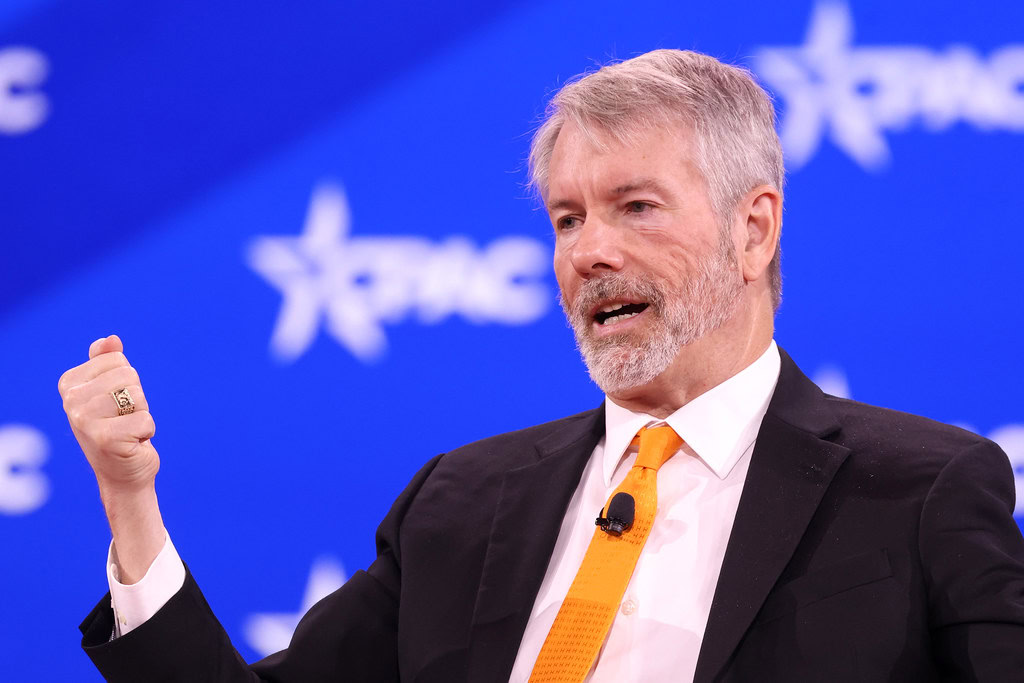
In interviews after the call, Saylor explained what “sell” actually meant. He told CoinDesk on May 11 that for every one Bitcoin Strategy might sell, the company would buy 20. The net impact, he said, would be “immeasurable.” He called the controversy “a big nothing burger.”
The point of any sale, in Saylor’s framing, would not be to reduce Bitcoin holdings. It would be to prove Strategy could convert Bitcoin to cash if it needed to, and to undermine the bears who argued Strategy was structurally stuck in its position.
The numbers explain why Saylor sounds relaxed. At 843,738 Bitcoin, a 1% sale would mean roughly 8,437 coins. At Bitcoin’s current price near $73,600, that is about $621 million, enough to cover years of the $1.5 billion annual STRC dividend if Strategy executed it carefully. A 1% sale would solve a multi-year cash problem in a single transaction. Saylor does not need to sell aggressively.
The 411 Bitcoin that moved today is roughly 5% of what a 1% sale would look like. If Strategy is testing what it can do after Saylor’s May 5 comments, this is the size of move that fits a signaling sale rather than a panic exit. Whether the coins actually get sold or held at Coinbase for other purposes, the market has already responded.
Has Strategy’s “Never Sell” Era Ended?
Saylor said on a recorded call that Strategy may sell Bitcoin to cover dividends. The four-year “never sell” position is now functionally over. A company that may sell BTC to fund dividend payments is a different company than the one that told followers to sell their kidneys first.
But Strategy is still buying far more than it might ever sell. Two weeks before the deposit, the company added 24,869 Bitcoin for about $2 billion. So, Saylor’s “buy 20 for every 1 sold” framing is consistent with that. Even if Strategy now occasionally sells, it remains a net accumulator.
The signals to watch from here are whether the 411 Bitcoin actually leaves Coinbase as a sale, whether Strategy files an 8-K disclosing one, and whether deposits like today’s become a regular feature or stay a one-off. For now, the deposit is not the sale itself, but the signal Saylor said he would send.
Contact [email protected] for any questions or corrections.
Sam Daodu is a crypto analyst and the editor of 24/7 Wall St.'s Crypto Desk, where he covers Bitcoin, XRP, Ethereum, Solana and the altcoins investors search for most. His work focuses on price levels, spot ETF flows, on-chain data and the regulatory decisions that move crypto markets, written so a first-time buyer and a seasoned trader can both use it.
Sam has written about crypto professionally since 2019 and has published more than 2,000 articles. Before joining 24/7 Wall St., he wrote for crypto media outlets and Web3 companies and ghostwrote for crypto founders and token launches. His analysis is syndicated on Yahoo Finance, MSN and AOL and has been cited by other crypto news sites. He also founded MacLabs Marketing, a content and personal branding agency for crypto founders and executives.
When he isn't reading charts, Sam is usually at the gym or watching One Piece, a series he maintains has better tokenomics than most altcoins.