Why I Keep Buying This Monthly Dividend Powerhouse
My order history shows another buy on Realty Income (NYSE:O | O Price Prediction) last month, and I already know the next paycheck will fund another one. I keep coming back to this stock because it pays me every single…

This post may contain links from our sponsors and affiliates, and Flywheel Publishing may receive compensation for actions taken through them.

My order history shows another buy on Realty Income (NYSE:O | O Price Prediction) last month, and I already know the next paycheck will fund another one. I keep coming back to this stock because it pays me every single month, raises that payment on a schedule I can almost set my watch to, and treats the monthly dividend as the actual product.
The pitch I make to myself is simple. I own a slice of a global landlord collecting rent from single-tenant commercial properties, sending a check on the 15th of every month. The company just declared its 674th consecutive monthly dividend. That cadence maps directly onto how bills arrive in retirement, and matching income to expenses is the entire reason I started this position.
A reliable yield
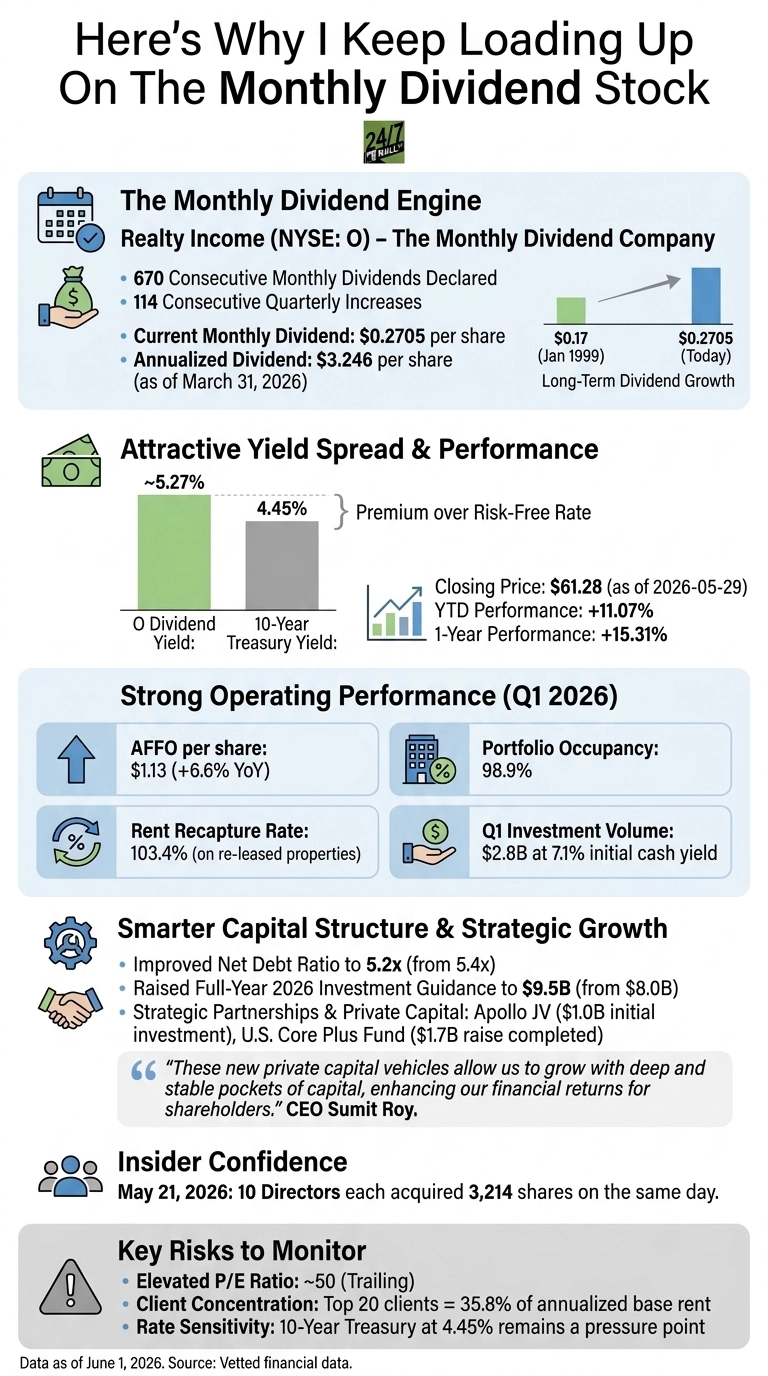
The first data point that keeps the buy button warm is the spread. Shares closed at $61.28 carrying a dividend yield around 5.27%, against a 10-year Treasury that now sits near 4.68%. That remains a real premium over the risk-free rate, even as the long end has pushed notably higher since spring on persistent inflation concerns and growing fiscal worries. Bond market surveys published in August 2026 show a majority of respondents expecting the 10-year to breach 5% before year-end, which would compress REIT yields further. For now, the spread still compensates for the difference in risk profile.
That spread is earned by a company that has lifted the dividend 115 consecutive quarters and pushed the monthly check from $0.17 in January 1999 to $0.2710 today, representing 135 increases since the NYSE listing in 1994. The stock was also up 11.07% year to date and 15.31% over the trailing year as of late May 2026, showing that income and capital appreciation are not mutually exclusive here.
Impressive fundamentals
The operating engine has continued expanding through mid-2026. In Q1 2026, AFFO per share reached $1.13, up 6.6% year over year, with the portfolio at 98.9% occupancy and CEO Sumit Roy recapturing 103.4% of prior rent on re-leased space across more than 15,500 properties. Q2 results, reported August 5, 2026, delivered AFFO per share of $1.09, up 3.8% year over year, as portfolio occupancy held at 98.8%.
The full picture year to date is equally constructive. AFFO per share through the first half of 2026 totaled $2.22, reflecting 5.2% growth over the same period in 2025. Management translated that momentum into another guidance lift, tightening the full-year AFFO range to $4.44 to $4.45 per share, approximately 4% growth at the midpoint. A landlord consistently producing accelerating cash flow, with guidance moving in one direction, is the profile income investors are chasing.

Several funding lanes
The capital structure keeps getting stronger on multiple fronts. Net Debt to Annualized Pro Forma Adjusted EBITDAre improved to 5.2x from 5.4x. Roy also stood up a $1 billion joint venture with Apollo across 492 retail properties, closed a $1.7 billion cornerstone raise for the U.S. Core Plus Fund, and grew third-party private capital AUM to $3.1 billion. In July 2026, the company recast and expanded its unsecured revolving credit facility to $5.5 billion, widening the liquidity buffer further. Then, on August 3, 2026, Fitch Ratings assigned Realty Income a Long-Term Issuer Default Rating of ‘A’ with a Stable Outlook, making it the first net lease REIT and only the fourth U.S. REIT to earn at least one ‘A’ equivalent rating from a major agency. Fitch cited the company’s long operating history, cycle-tested performance, and strong access to multiple capital sources.
Then came the headline from June 30, 2026: Realty Income formed a programmatic joint venture with Cloud Capital and a global institutional investor to acquire hyperscale data centers in Northern Virginia. The three-asset portfolio is valued at over $6 billion and is fully leased or pre-leased to investment-grade hyperscale tenants under triple-net leases ranging from 15 to 20 years. Realty Income plans to invest up to $1.4 billion for a 45% equity stake, with an initial commitment of roughly $700 million expected between Q2 and Q3 2026. The move signals that Roy is diversifying beyond traditional retail into digital infrastructure, adding a durable new capital lane to support the dividend.
As Roy put it, “Today’s announcement affirms the strength of our business model and its ability to translate across sectors, including digital infrastructure.” The dividend now has more funding lanes behind it than at any point in the company’s history, and the Fitch ‘A’ rating directly reduces the cost of accessing those lanes.
The risks I respect are concentration and rate sensitivity. The trailing P/E sits near 50, the top 20 clients represent 35.8% of annualized base rent, and full-year 2025 impairment provisions reached $471.3 million. A 10-year Treasury at 4.68% and rising keeps relative-yield pressure on every REIT in the sector, and bond market surveys suggest more pressure could be coming if 10-year yields approach 5%.
I sit with that risk because the company is still acquiring real estate at yields well above its cost of debt, the portfolio is nearly fully leased, and the dividend has compounded through 2008, 2020, and every rate cycle since the NYSE listing. One more receipt for the file: on May 21, 2026, ten directors each acquired 3,214 shares on the same day. The people who see the rent rolls first are aligning their own capital alongside mine. I will keep clicking buy as long as that check shows up on the 15th.

Editor’s note: This article has been updated to reflect Realty Income’s 674th consecutive monthly dividend (September 2026 payment of $0.2710 per share), Q2 2026 AFFO per share of $1.09 growing 3.8% year over year with year-to-date growth of 5.2%, full-year 2026 investment volume guidance raised to $10 billion from $9.5 billion, the 10-year Treasury yield rising to approximately 4.68%, Fitch Ratings assigning Realty Income a Long-Term Issuer Default Rating of ‘A’ with Stable Outlook in August 2026, and the July 2026 expansion of the company’s revolving credit facility to $5.5 billion.
Contact [email protected] for any questions or corrections.
Vandita Jadeja is a financial publisher with over a decade of experience writing about financial topics, including investment, savings, retirement, insurance and banking. Vandita is a Chartered Accountant who loves to debunk financial concepts for readers.
Her work has appeared on sites that include The Motley Fool, InvestorPlace, and Benzinga. She covers investing and focuses on stock picks and price prediction for 24/7 Wall St.
When not looking for the next stock investment opportunity, she can be found traveling, reading, chasing sunsets and enjoying her iced latte.