This 2x Nvidia ETF Is Up 31% YTD and 121% Over the Last Year
A leveraged NVIDIA ETF turned a $10,000 stake into thousands more over the past year, but the same mechanism that built those gains just wiped out nearly half of them in a single week. Understanding why requires a close look…


A $10,000 stake in GraniteShares 2x Long NVDA Daily ETF (NASDAQ:NVDL) at the start of 2026 is worth about $11,266 as of the June 8 close, a 12.66% year-to-date gain that still beats the 8.4% return on the SPDR S&P 500 ETF over the same stretch. The same $10,000 a year ago is worth roughly $17,286 today, a 72.86% one-year return. Those are the honest numbers as of this week. The headline framing of 31% YTD and 121% over twelve months was true earlier in the spring, before NVDL gave back 14.07% in the past week alone, falling from $115.38 on June 1 to $99.15 on June 8.
What The Fund Actually Does
NVDL is a single-stock leveraged ETF designed to deliver twice the daily price move of NVIDIA (NASDAQ:NVDA | NVDA Price Prediction). If NVIDIA rises 2% on a given day, NVDL targets 4%. If NVIDIA falls 2%, NVDL targets a 4% loss. The word that matters in that sentence is "daily." The fund resets its leverage every session, which means returns over any period longer than one day are path dependent rather than a clean 2x multiple of the underlying stock’s return over the same window.
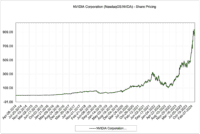
You can see the math working in both directions inside the current data. NVIDIA itself is up 12.01% YTD and 47.42% over the past year. A naive 2x calculation would put NVDL at roughly 24% YTD and 95% over one year. The actual figures, 12.66% and 72.86%, sit below those benchmarks because the daily reset bleeds value during choppy stretches. That bleed is volatility decay, and it is the structure functioning exactly as the prospectus describes.
The Mechanism Behind The Run
The reason NVDL exists at a meaningful AUM is that NVIDIA has been the cleanest single trade in public markets for almost three years. The hyperscaler capex cycle, the GPU replacement cadence, and the AI training and inference buildout have made NVIDIA’s data center segment the largest line item in semiconductors. Industry commentary on the scale is blunt. Every gigawatt of data center capacity translates to roughly $40 to $50 billion of revenue to NVIDIA, and competitors building alternatives are openly framing themselves as catching up to a company already looking at $150 billion in AI revenue.
When the underlying stock trends in one direction with limited intraday whipsaw, NVDL’s daily reset compounds favorably. NVIDIA hit fresh all-time highs in May 2026 on the back of a China breakthrough, and that kind of grinding uptrend is exactly the regime where leveraged daily funds shine. The flip side showed up in early 2025, when NVDL lost roughly 67% from peak to trough while NVIDIA itself fell about 35%. The daily rebalancing did most of the extra damage, a pattern ETF.com flagged again in late May 2026 as the reason NVDL is suitable primarily for short-term traders.
Why The Past Week Matters More Than The Past Year
The recent 14.07% one-week drawdown in NVDL came against just a 6.9% pullback in NVIDIA. The leverage worked exactly as advertised on the way down, and the daily reset added a small additional tax on top. For a holder who bought near the YTD peak, the slippage from 31% YTD to 12.66% YTD in a matter of weeks is the lived experience of the math the prospectus warns about.
Short interest tells you traders are positioning for exactly this kind of volatility. As of December 2025, 14.34 million shares were sold short, representing 29.90% of public float, a 32.88% increase from the prior report. This reflects a vehicle being actively traded around earnings, capex announcements, and macro data releases, with options traders pricing as much as a $260 billion swing in NVIDIA’s market cap around earnings.
What To Watch From Here
The forward read on NVDL is a forward read on three things. First, whether NVIDIA’s AI revenue continues to compound at the pace the past two years set, which depends on hyperscaler capex guidance from the largest customers and the cadence of new GPU architectures. Second, whether the realized volatility of NVIDIA stays low enough that the daily reset compounds favorably rather than decaying. The early 2025 episode is the warning label. Third, whether the regulatory framing around single-stock leveraged ETFs shifts, because new leveraged ETF launches tripled in 2025 compared to 2024, and that kind of issuance growth usually attracts attention from the SEC.
The honest read is that NVDL has done what it was designed to do during a sustained NVIDIA uptrend, and the YTD outperformance versus the S&P 500 is real even after the recent pullback. The same structure that produced the 72.86% one-year return is what produced the 14.07% one-week loss, and a holder needs to be comfortable with both outcomes. If you want NVIDIA exposure for the AI thesis and you plan to hold through a full cycle, owning the underlying stock avoids the decay drag entirely. If you want amplified exposure for a defined trade with a defined exit, NVDL is the instrument the issuer built for that purpose. The vehicle is doing its job. The question is whether the holder’s time horizon matches the daily reset the fund was engineered around.

Contact [email protected] for any questions or corrections.
Austin Smith is a financial publisher with over two decades of experience as an investor, analyst, and advisor. He covers stocks, ETFs, Artificial intelligence and personal finance for 24/7 Wall St. Previously, he spent over a decade at The Motley Fool as a senior editor for Fool.com, portfolio advisor for Millionacres, and launched The Ascent to help reader take control of their personal finances.
His work has been featured on Fool.com, NPR, CNBC, USA Today, Yahoo Finance, MSN, AOL, Marketwatch, and many other publications. He is as an advisor to private companies, and co-hosts The AI Investor Podcast with Eric Bleeker.
When not looking for investment opportunities, he can be found skiing, running, or playing soccer with his children. Learn more about Austin's investment approach here.