Dividend Safety Check: International Developed Equity Income with AVDE
AVDE has more than doubled its annual payout in five years, but currency swings and European bank exposure can quietly undercut every dollar of that growth before it reaches your account.

Avantis International Equity ETF (NYSEARCA:AVDE) is a popular vehicle for international dividend income. AVDE pays semi-annually, distributes dividends from non-U.S. developed-market stocks, and tilts toward smaller, cheaper, more profitable companies than passive peers. Investors using AVDE for income need to know whether distributions can sustain their growth and whether the portfolio withstands currency swings and global earnings volatility.
How AVDE generates income
AVDE is actively managed, holding more than 3,000 international stocks, sub-advised by Avantis Investors. Income comes from straightforward dividends paid by companies headquartered outside the U.S. in developed markets like the UK, Japan, France, Switzerland, and Germany. Top holdings recently included HSBC Holdings, Shell, and Novartis, all mature businesses with deep dividend histories.
The fund’s value and profitability tilt matters. By design, it overweights companies trading at lower multiples while screening for cash-generative balance sheets. That structural bias favors businesses funding dividends from earnings rather than borrowed money.
Distribution record
Distribution growth has been AVDE’s strongest argument as an income holding. Full-year payouts moved from $0.93 in 2020 to $1.82 in 2023, $2.02 in 2024, and $2.19 in 2025. That more-than-doubling in five years reflects rising payouts at underlying holdings and the fund’s growing asset base.
The June 2026 distribution of $1.1657 continued that trend, ahead of the $1.25 paid in June 2025 when combined with the March interim of $0.0972. Trailing yield sits around 2.2%, modest by absolute standards but supported by real cash earnings rather than return of capital.
Three risks to watch
Currency is the biggest threat. AVDE holds securities denominated in euros, yen, pounds, and Swiss francs, and distributions are paid in dollars. A stronger U.S. dollar mechanically reduces the dollar value of foreign dividends, even when underlying companies raise payouts in local currency. Franklin Templeton’s 2026 outlook expects the dollar to remain weak, which would be a tailwind, but currency is the single largest swing factor for international income.
Second, sector concentration in European banks and energy. 2025’s outperformance leaned heavily on European banks and defense contractors benefiting from higher rates and geopolitical tension. Bank dividends are cyclical. Sharp rate declines would compress payouts at HSBC and peers.
Third, the value tilt can lag in growth-led rallies, though that affects total return more than the distribution stream.
Total return and asset base
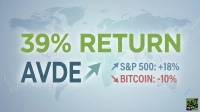
Income matters only if principal holds up. AVDE has delivered a one-year total return of roughly 26% and about 11% year to date in 2026, with shares around $90. The fund’s growing asset base also saw $408 million of inflows in a single week in February 2026, reducing forced-selling risk that could erode the income-generating portfolio.
Passive alternative
Investors seeking similar exposure with lower active risk often compare Vanguard FTSE Developed Markets ETF (NYSEARCA:VEA). VEA carries a lower expense ratio and market-cap weighting; AVDE charges 23 basis points for value and profitability screens. If those factor tilts add durable income quality, AVDE earns its fee. Otherwise, VEA is the cleaner passive choice.
The verdict
AVDE’s distribution looks safe. It is funded by real dividends from thousands of cash-generative international companies, the payout has grown every full year since launch, asset flows are strong, and underlying holdings are not stretched. Currency and European bank dividend cyclicality can dent dollar-denominated income in any given year. For investors wanting diversified international equity income without yield engineering, AVDE remains one of the cleaner options.
Contact [email protected] for any questions or corrections.
After 15 years on Wall Street with 7 of them as Director of Corporate and Municipal Bond Trading for a NYSE member firm, I started my own project and corporate finance consultancy. Much of the work involves writing business plans, presentations, white papers and marketing materials for companies seeking budgetary allocations for spinoffs and new initiatives or for raising capital for expansion or startup companies and entrepreneurs. On financial topics, I have been published under my own byline at The Motley Fool, 247wallst.com, DealFlow Events’ Healthcare Services Investment Newsletter and The Microcap Newsletter, among others. Additionally, I have done freelance ghostwriting writing and editing for several financial websites, such as Seeking Alpha and Shmoop Financial. I have also written and been published on a variety of other topics from music, audiophile sound and film to musical instrument history, martial arts, and current events. Publications include Copper Magazine, Fidelity (Germany), Blasting News, Inside Kung-Fu, and other periodicals.