Why I Can’t Stop Buying This Unstoppable, 49% Growth Juggernaut Even as a Warsh “Rate Shock” Threatens to Tank The Market
I have been adding to MercadoLibre on every leg down this June, and my finger is still on the buy button. MercadoLibre (NASDAQ:MELI | MELI Price Prediction) is down 31.71% over the past year and 18.99% year to date, while…

I have been adding to MercadoLibre on every leg down this June, and my finger is still on the buy button. MercadoLibre (NASDAQ:MELI | MELI Price Prediction) is down 31.71% over the past year and 18.99% year to date, while the business it runs just posted 49% revenue growth. That gap is the entire reason I keep buying.
The thesis is simple. Latin America’s dominant e-commerce and fintech operator is widening its lead while the share price contracts. The average Latin American shopper makes 7 online purchases a year versus 41 in the US. Less than 20% of Mexicans and only 40% of Argentines have a credit card, and 85% of Mexicans still pay cash for purchases under $30. MercadoLibre owns the rails that will carry that catch-up. The runway is what I keep paying for.
Now the receipts.
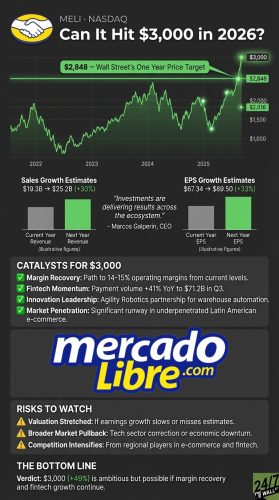
First, the growth is accelerating. Q1 2026 revenue hit $8.85 billion, beating consensus by 6.27%. Commerce grew 47% YoY and fintech 51% YoY. Brazil revenue jumped 55%, Mexico 62%. Brazil’s unique buyer count grew 32% YoY, the fastest pace in five years. The credit card portfolio more than doubled to $6.6 billion, up 104% YoY, advertising revenue rose 73% YoY, and fintech AUM is closing in on $20 billion, up 77% YoY. This is the flywheel maturing in real time.
Second, the balance sheet finally earned its grown-up rating. S&P upgraded MercadoLibre to investment grade (BBB-) in July 2025. Operating cash flow in Q1 reached $2.075 billion, up 119.81% YoY. The company holds $3.677 billion in cash against a market cap near $83 billion, with analysts carrying an average target of $2,216.96 and 20 Buy or Strong Buy ratings against 4 Holds and zero Sells. Forward earnings sit near 32x, a price I am willing to pay for a business compounding revenue at this clip.
Third, the smart money is leaning in. Institutional ownership stands at 83.15%, with Brown Advisory, Russell Investments, and Capital Research adding shares. Insiders are writing personal checks too: SVP Marcelo Melamud purchased roughly $200,000 worth at $1,604.62 on June 11, 2026, and Director Aguzin bought 600 shares. When operators buy at these prices, I pay attention.
Now the risk. Operating margin compressed 600 basis points YoY to 6.9%, operating income fell 19.92%, and adjusted free cash flow turned negative $56 million. Provisions for doubtful accounts doubled to $1.244 billion from $603 million. Add a rate-shock crowd worrying that newly appointed Federal Reserve Chairman Kevin Warsh will keep monetary policy locked down to fight stubborn 4.2% inflation, and you get a stock down more than 30% from its previous highs. The risk is real. My answer is that management told us this was coming. They are deliberately funding free shipping, first-party commerce, credit card issuance, and a fulfillment network already running 50+ facilities handling 55% of shipments. Engineering productivity KPIs are growing 7 to 10 times faster than 8% headcount growth. Spend now, harvest later.
Forward conviction. New CEO Ariel Szarfsztejn inherits a business with 27 consecutive quarters of 30%+ revenue growth, an investment-grade balance sheet, and a region barely halfway to its e-commerce destiny. Every panic sale of MELI this June funds another tranche of mine.
Contact [email protected] for any questions or corrections.
Alex Sirois is a financial writer with experience spanning both retail and institutional investing. He has written for InvestorPlace and held roles at BNY Mellon and Bernstein, giving him a perspective that bridges Main Street portfolios and Wall Street analysis.
Alex holds an MBA from George Washington University and has built his career across multiple industries, including e-commerce, education, and translation — a breadth of experience that informs how he breaks down complex financial topics for everyday investors. His writing is conversational, actionable, and grounded in long-term, buy-and-hold investing principles.
At 247 Wall St., Alex focuses on delivering analysis that is both accessible and useful, with a clear emphasis on helping readers make more informed decisions with their money.