1 Rare Dividend Stock Built to Survive Any Recession
Lockheed Martin (NYSE:LMT | LMT Price Prediction) is a stock worth owning for decades because its revenue is effectively underwritten by the U.S. government and a global alliance system that does not negotiate down its threat environment to suit a…

This post may contain links from our sponsors and affiliates, and Flywheel Publishing may receive compensation for actions taken through them.

Lockheed Martin (NYSE:LMT | LMT Price Prediction) is a stock worth owning for decades because its revenue is effectively underwritten by the U.S. government and a global alliance system that does not negotiate down its threat environment to suit a recession. For a retirement investor who has already paid tuition chasing momentum, it fits the profile of a long-duration anchor position to research for reinvestment and patience.
Pillar 1: A Business Built Like Infrastructure
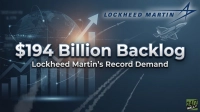
Lockheed ended 2025 with a record $194 billion backlog, more than 2.5 years of sales, anchored by sole-source and duopoly franchises: the F-35, PAC-3, THAAD, Aegis, Sikorsky rotorcraft, and the Orion spacecraft. Customers are locked into these platforms for decades. CEO Jim Taiclet noted on the Q1 2026 call that factory production is already up more than 60% from just two years ago, supported by seven-year framework agreements on Patriot and PrSM that aim to lift munitions output three to four times current rates. The Pentagon’s FY 2027 budget request totals $756.8 billion for procurement and RDT&E, with $52.9 billion earmarked for critical munitions. That is the demand stream feeding the backlog.
Pillar 2: Income That Compounds Without Drama
Lockheed has now raised the dividend for 23 consecutive years, with the quarterly payout climbing from $0.22 in 1999 to $3.45 in 2026 and zero cuts through the 2008 crisis, COVID, or the 2022 rate shock. The current yield sits near 2.64%, and management returned $3.0 billion in buybacks during 2025 with $9.1 billion of repurchase authorization in place. FY2025 free cash flow reached $6.908 billion, and 2026 guidance calls for $6.5 billion to $6.8 billion. That cash funds the payout, the buyback, and roughly $2.5 billion to $2.8 billion in capital expenditures without straining the balance sheet.
Pillar 3: It Survives Cycles Other Stocks Do Not
Defense outlays are tied to geopolitics, not GDP. The beta of 0.106 reflects that decoupling. Allied procurement is structural: Goldman Sachs flagged the +€800 billion ReArm Europe Plan 2030 as a megatrend, and Lockheed is positioned as lead integrator for the Golden Dome missile defense initiative. The F-35 is, as Taiclet put it, “superior to every other airplane in the world today that we face”, and the Pentagon’s request includes 855 F-35 aircraft over the program horizon.
The Scenario Where It Underperforms
Fixed-price classified programs can blow up. Q2 2025 was the proof: EPS came in at $1.46 against a $6.57 estimate after $1.6 billion in pre-tax program losses, including a $950 million reach-forward charge on a classified Aeronautics program. Yet revenue barely moved, the backlog still grew to a record by year-end, the dividend was raised anyway, and Q3 and Q4 returned to beats. Program charges are episodic. The Department of War demand cycle is structural, and that asymmetry is the entire point.
Lockheed Martin’s rising dividend and the structural geopolitical demand cycle frame it as a long-duration anchor position for investors prioritizing income compounding over trading.
Contact [email protected] for any questions or corrections.
Alex Sirois is a financial writer with experience spanning both retail and institutional investing. He has written for InvestorPlace and held roles at BNY Mellon and Bernstein, giving him a perspective that bridges Main Street portfolios and Wall Street analysis.
Alex holds an MBA from George Washington University and has built his career across multiple industries, including e-commerce, education, and translation — a breadth of experience that informs how he breaks down complex financial topics for everyday investors. His writing is conversational, actionable, and grounded in long-term, buy-and-hold investing principles.
At 247 Wall St., Alex focuses on delivering analysis that is both accessible and useful, with a clear emphasis on helping readers make more informed decisions with their money.