The Analyst Who Loved Bank Stocks for 15 Years Just Flipped. Here’s What He’s Buying Instead
For most of the post-2008 era, Oppenheimer’s Chris Kotowski was the guy telling you to keep buying the big banks. He waved off the 2011 eurozone panic, the 2016 energy blowup, COVID, and the 2022 rate hikes. On June 30,…

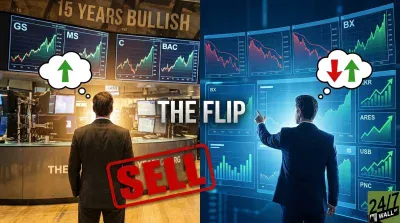
For most of the post-2008 era, Oppenheimer’s Chris Kotowski was the guy telling you to keep buying the big banks. He waved off the 2011 eurozone panic, the 2016 energy blowup, COVID, and the 2022 rate hikes. On June 30, 2026, he flipped.
Kotowski cut Goldman Sachs (NYSE:GS | GS Price Prediction), Morgan Stanley (NYSE:MS), Bank of America, and Citigroup (NYSE:C) in a single note, with Goldman moving to Underperform from Perform. Oppenheimer simultaneously nudged investors toward Ares, Blackstone, and KKR, plus commercial names US Bancorp and PNC.
The math is what changed his mind. “I thought they were systematically undervalued. Now I think the opposite is the case, quite honestly,” Kotowski told CNBC. “The banks historically would trade around 70 to 75% relative P/E… the investment banks are 107%. So like a 50% premium to their historic valuations.” Commercial banks sit at 78%, which is closer to normal but still not cheap.
The price action confirms it. Goldman is up 16.16% year to date and 45.75% over the past year. Morgan Stanley is up 51.97% over twelve months. Citigroup has ripped 68.13%. The fundamentals justified some of that. Goldman posted Q1 2026 EPS of $17.55 with investment banking fees up 48% year over year to $2.84 billion, per its first-quarter release. Citi crossed $7 billion in Markets revenue for the first time. Great numbers. Priced in.
Why the yield curve argument is a red herring
Bulls have leaned on a steepening curve as the next leg for bank NII. Kotowski is not buying it. His point: banks like Bank of America are still enjoying tailwinds from ultra-low-coupon securities they bought five or six years ago rolling off and getting reinvested at higher yields. That mechanical benefit runs regardless of what the two-year does next.
The risk cuts the other way. BofA CEO Brian Moynihan warned that a 100 basis point decline in rates could shave $2 billion off net interest income. Meanwhile, Goldman’s CET1 ratio slipped to 12.5% from 14.3% as capital got returned and put to work. That is a lot of operating leverage right when the cycle looks late.
The Blackstone and KKR pitch on sale
Blackstone (NYSE:BX) is down 22.07% year to date. KKR (NYSE:KKR) is down 27.52%. Kotowski’s phrasing: “In the banks, you can, for the most part, take your money and run with impunity. And the alts are on sale.”
The drawdowns look painful until you look under the hood. Blackstone reported Q1 2026 AUM of $1.3 trillion, up 12% year over year, with $68.5 billion in quarterly inflows and fee related earnings up 23% to $1.55 billion. Perpetual capital, the long-duration base that pays fees regardless of exit windows, is now $539.7 billion, or 48% of Fee-Earning AUM.
KKR looks similar. Q1 adjusted EPS of $1.39 beat by 10.28%, management fees rose 30% to $1.19 billion, and LTM capital deployed hit a record $97.4 billion. The K-Series wealth vehicles nearly doubled AUM to $38 billion, which is the retail-access flywheel every alt manager is chasing.
Valuation reflects the beating. KKR now trades at a forward P/E of 15x versus a trailing 31x. Blackstone’s forward multiple sits at 19x. Both remain expensive in absolute terms, but if you believe fee-based, perpetual-capital compounders should trade at a premium to cyclical intermediaries, the spread just narrowed dramatically.
What Kotowski is really saying
The bear case on alts, private credit redemption caps at Apollo and Ares, the Bank of England’s stress test of 46 firms, Elizabeth Warren’s data-center inquiries, is real. But Kotowski is arguing that the market has already discounted those risks in the alt names while pricing the banks for perfection. He was right for 15 years about undervaluation, and now he sees it inverted.
Contact [email protected] for any questions or corrections.
Omor Ibne Ehsan is a writer at 24/7 Wall St. He is a self-taught investor with a focus on growth, cyclical, and dividend equities that have strong fundamentals, value, and long-term potential. He also has an interest in high-risk, high-reward investments such as penny stocks.