American Airlines or Lockheed Martin: Wall Street Expects One to Soar on Earnings, One to Stumble
Two companies report earnings on the same morning, but retirement investors only have room for one. Before the opening bell on July 23, the gap between these two stocks tells a story worth understanding.

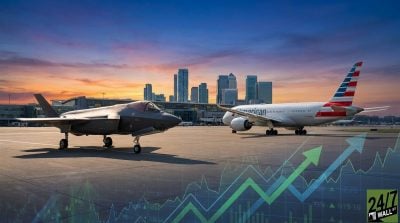
Both American Airlines (NASDAQ:AAL | AAL Price Prediction) and Lockheed Martin (NYSE:LMT) report Q2 2026 results before the open on Thursday, July 23, 2026. Retirement-focused investors face one plain question: which one deserves the portfolio slot right now? One is a $10.1 billion airline still climbing out of losses, while the other is a defense prime with a record backlog and 23 consecutive years of dividend increases. Here is what the data says heading into the same-session double-header.
Dimension 1: Earnings Track Record and Predictability
Lockheed Martin’s most recent quarter delivered diluted EPS of $6.44, a miss of 3.9% versus the $6.70 estimate, on revenue of $18.02 billion (+0.32% year over year). That followed FY 2025 diluted EPS of $21.49 on revenue of $75.05 billion (+5.64%), with free cash flow of $6.91 billion (+30.66%). Management reaffirmed FY 2026 diluted EPS guidance of $29.35 to $30.25 and free cash flow of $6.5 billion to $6.8 billion.

American Airlines topped expectations last quarter: Q1 2026 adjusted EPS of −$0.40 versus a −$0.46 estimate (+13.04%) on record revenue of $13.91 billion (+10.84% year over year). But the full-year picture is far wider: FY 2026 adjusted EPS guidance runs from −$0.40 to $1.10, with more than $4 billion in incremental fuel expense weighing on results. FY 2025 delivered adjusted EPS of just $0.36 and free cash flow of −$83 million.

Winner: Lockheed Martin. A $29 to $30 EPS band paired with about 25% segment operating profit growth beats a range that spans a loss to a slim profit.
Dimension 2: Analyst Consensus, Price Target, and Implied Upside
At $507.09, Lockheed Martin trades well below the consensus analyst target of $606.68, but analysts have a consensus Hold rating. The trailing P/E is 25, and applied to the FY 2026 EPS midpoint, the forward multiple lands in the high teens. That is a reasonable price to pay for defense-grade cash flow.

American Airlines closed the Q1 2026 filing at $11.45 on a market cap near $7.6 billion. With FY 2026 EPS potentially negative, there is no clean forward earnings multiple to anchor upside, and the bullish analyst tilt seen on Lockheed Martin is absent on the airline side.

Winner: Lockheed Martin. A defined analyst target with room to run beats a speculative bet on a barely profitable carrier carrying −$4.08 billion in shareholders’ equity.
Dimension 3: Sentiment Momentum and Beat Odds
Polymarket’s Q2 beat market on Lockheed Martin puts odds at 57% Yes (Beat) and 43% No (Miss), and a companion market prices 97.1% odds that Q2 2026 backlog exceeds $170 billion—year-end 2025 backlog was already $194 billion. The composite sentiment index reads 67.11 (bullish, medium confidence), with social at 72 and news at 62.23. Insider activity leans to selling with three recent transactions.
American Airlines lacks that prediction-market coverage, and its social read is outright bearish at 38.6, with the loudest recent threads focused on shorting the stock ahead of potential oil shocks. Q2 2026 guidance already frames adjusted EPS between −$0.20 and $0.20, which is effectively a coin flip on printing a loss.
Winner: Lockheed Martin.
The Verdict
Three dimensions, three wins for Lockheed Martin. For a retirement-focused portfolio, Jim Taiclet’s defense prime offers visible EPS, a $3.45 quarterly dividend with 23 consecutive years of raises, a $9.1 billion buyback authorization, and roughly 2.5 years of sales in contracted backlog. American Airlines belongs in a speculative trading account: $34.7 billion in total debt, negative equity, no dividend, and an earnings range held hostage to the fuel curve make it a bet on the airline cycle rather than a retirement holding. Wall Street is leaning into Lockheed Martin ahead of Thursday’s dual report, and the data supports the tilt.
There are key risks worth watching. For Lockheed, they include more fixed-price contract charges (the F-16 program already absorbed a $125 million unfavorable adjustment in Q1) plus working capital timing that swung operating cash flow to $220 million. For American, the risks are jet fuel volatility and the sensitivity of any 2026 profit to that $4 billion incremental fuel bill.
Contact [email protected] for any questions or corrections.
Trey has been an editor and author at 24/7 Wall St. for more than a decade, where he has published thousands of articles analyzing corporate earnings, dividend stocks, short interest, insider buying, private equity, and market trends. His comprehensive coverage spans the full spectrum of financial markets, from blue-chip stalwarts to emerging growth companies.
Beyond 24/7 Wall St., Trey has created and edited financial content for Benzinga and AOL's BloggingStocks, contributing additional hundreds of articles to the investment community.
Trey's editorial expertise extends across multiple publishing environments. He served as production editor at Dearborn Financial Publishing and development editor at Kaplan, where he helped shape financial education materials. Earlier in his career, he worked as a writer-producer at SVE. His freelance editing portfolio includes work for prestigious clients such as Sage Publications, Rand McNally, the Institute for Supply Management, the American Library Association, Eggplant Literary Productions, and Spiegel.
Outside of financial journalism, Trey writes fiction and has been an active member of the writing community for years, moderating workshop sessions at regional conventions.