Beyond GPUs: As Hyperscalers Flex Their Own Chips, a New Kind of “AI Premium” Is in the Cards.
Hyperscalers are quietly building custom silicon that could shift the AI infrastructure power balance in ways most investors have not yet priced in. The question is not whether this threatens Nvidia, but who captures the next wave of AI premium…


Nvidia (NASDAQ:NVDA | NVDA Price Prediction) stock seems to be on its way higher again following news that Elon Musk’s Space Exploration Technologies (NASDAQ:SPCX) will be exclusive to the GPU maker, rather than looking to shop around and mix it up as some other tech firms might be doing with their AI data centers.
Nvidia might have less to worry about with its GPU rivals, but, in my view, that doesn’t mean investors should forget about the rise of hyperscalers’ custom silicon ambitions, especially as more of that towering CapEx goes towards securing the hardware layer. Any way you look at it, tech firms have all the incentives to get into the hardware game as they look to find a way to quit the latest and greatest GPUs from the great Nvidia.
Indeed, the company’s sales growth and high margins are unprecedented for a hardware company. But with great economic profits comes a wave of competition as other firms look to disrupt moats with innovation to get a piece of that glorious generational opportunity to be had in chips.
As an increasing amount of AI compute goes from training to inference, the case for custom silicon will get louder with time. But, at the end of the day, it’s hard to tell which firms will dominate in AI hardware in a decade from now.
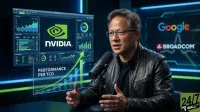
Nvidia seems like a great choice as Jensen Huang pivots the firm for the inference inflection point by doubling down on LPUs, CPUs, and other innovations to bolster the software side of its AI moat. At the same time, though, some of the hyperscalers might also be in for a multiple re-rating, especially once they go from using custom hardware to power their own data centers to selling to third parties to put in their own facilities.
Yes, Google TPUs are still worth keeping tabs on
Undoubtedly, Alphabet‘s (NASDAQ:GOOG) Google TPUs have come a long way in recent years, and with the optimization for its own cloud and product suite (Gemini, YouTube, Search and beyond), perhaps TPUs don’t need to be head and shoulders above competing hardware products to gain share in the global AI chip market.
In my view, Google TPUs are set for success, given the cost efficiency focus and the kinds of share gains to be had in a “good enough” kind of environment where affordability matters more than extra capability. As Google eats its own cooking (using TPUs to power next-generation applications), it has every incentive in the world to optimize for lower costs.
And, all the while, other firms are bound to get hungry for a technology that might help make AI inference cheap enough to pave the way for what could be another wave of “tokenmaxxing.” When tokens are so cheap and abundant, maybe it makes more sense for next-generation applications to use first and bring up questions about utility later.
Custom silicon and the age of token abundance?
In my view, Google’s I/O 2026 was rich with AI applications that you could consider to be quite token-expensive, especially compared to a simple Gemini prompt. Whether we’re talking about Genative UX, which generates interfaces on the fly, or kicking off some agents to do tasks in the background, it feels like Google might be nudging the industry into an era where users need not worry about token bills.
Whether it’s Google TPUs or another hyperscaler’s custom silicon (Meta Platforms‘ (NASDAQ:META) MTIA hardware also shows plenty of promise, I do think that an inference explosion stands to benefit the hyperscalers more than the likes of Nvidia, despite its efforts to ready itself for the shift.
Any way you look at it, token-heavy applications are coming and, with them, some much more efficient custom silicon is going to be needed for the vast inference spike. Of course, it’s going to take time for hyperscalers to scale up, especially since we’re in the early days of this buildout. Over time, though, I certainly wouldn’t bet against the custom silicon shift as the hyperscalers look to command a bit more of that AI premium for controlling the AI infrastructure all the way down the stack.
Contact [email protected] for any questions or corrections.
Joey is a 24/7 Wall St. contributor and seasoned investment writer whose work can also be found in publications such as The Motley Fool and TipRanks. Holding a B.A.Sc in Computer Engineering from the University of British Columbia (UBC), Joey has leveraged his technical background to provide insightful stock analyses to readers.
Joey's investment philosophy is heavily influenced by Warren Buffett's value investing principles. As a dedicated Buffett disciple, Joey is committed to unearthing value in the tech sector and beyond.