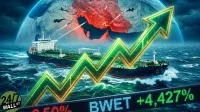
Shipping Oil Now Costs $1 Million a Day and One Tiny ETF Is Up Over 4,000%
A single supertanker charter out of the Gulf now costs more per day than most people earn in a lifetime, and one obscure ETF has turned that freight crisis into the most extreme return on any US exchange this year.

Chartering a modern supertanker out of the Gulf now runs roughly $1 million a day. That figure sits at the center of a recent CNBC segment from Brian Sullivan on what has happened to crude freight since the de facto closure of the Strait of Hormuz. The Breakwave Tanker Shipping ETF (NYSEARCA:BWET) tracks that corner of the market through freight futures, and it has become one of the strangest performers on any US exchange, up 4,229.08% year to date.
The fund tracks tanker day rates through freight futures and has become one of the strangest performers on any US exchange. The rate, the insurance costs, and the pain at the pump are all real, although the freight rate and the fund tracking it are separate trades, and the condition holding both up can reverse faster than it appeared.
What the Rate Is Actually Pricing
A day rate is what an oil major pays a shipowner to move one cargo, expressed per day the vessel is on hire. A very large crude carrier that leased for a small fraction of that figure a few years ago is now clearing near seven digits per day out of the Gulf.
The binding constraint is the supply of owners willing to send a hull past the strait while the US Navy is convoying traffic and shut-in production has already curtailed flows.
War-risk insurance is the second lever. Underwriters reprice policies during a shooting conflict, and a premium that once cost single-digit basis points of hull value can jump by an order of magnitude on one overnight bulletin.
The percentage move Sullivan cited is measured against a much lower baseline from several years back, capturing a regime change rather than a one-week jump.
How the Cost Reaches Your Pump
Households almost never pay for crude directly. They pay for the refined products that come out of a barrel, and diesel is the most sensitive.
Freight costs land in gasoline slowly and in diesel almost immediately, because product tankers and refinery utilization compete for the same molecules.
Brian Sullivan pointed to pump prices over eight bucks in parts of California as the visible edge of that pass-through.
The EIA’s Short Term Energy Outlook framed the mechanism plainly: nearly 20% of global oil supply flowed through the Strait of Hormuz before military action that began on February 28, and Brent averaged $117 per barrel in April as physical barrels went scarce.
Why the Fund’s Return Is a Rear-View Mirror
Breakwave holds a rolling basket of tanker freight futures, so its price reflects expected day rates over the next several months.
That structure works both ways. It captured the full move from $19.26 at the end of 2025 to $833.98 in Monday’s session. Over the past year, the gain sits at 5,556.25%, with no stock splits on record.
The same structure means the fund is a leveraged bet on the geopolitical condition persisting. It closed the most recent session down 4.38% even while the freight story dominated coverage, showing what a single de-escalation headline can do.
Any of three things ends the trade: a durable reopening of the strait, war-risk insurance normalizing back toward peacetime levels, or owners deciding the premium is fat enough to accept transit risk again.
Bull and Bear Case for BWET ETF
The bull case rests on duration. If the strait stays effectively closed into winter, tanker owners keep collecting the risk premium on every ton-mile they move around the disruption, and the freight futures curve stays backwardated in a way that feeds the fund’s roll.
Spot WTI has already reflected the tightness, printing $105.67 per barrel on April 3, 2026 and holding above $100 through mid-May before easing to $91.18 on September 4. Higher crude keeps refiners bidding for cargoes, and every replacement barrel has to move on a hull.
The bear case is mechanical. A fund up this much carries drawdown risk of the same order, and the freight curve can invert on a ceasefire headline before a retail buyer can react.
The deciding variable is whether shipowners return to the Hormuz route. CNBC reported on August 25 that Iran and Oman announced a tentative framework to reopen the strait, sending the Abu Dhabi Murban contract down more than 8% on the day.
The freight rate is a real number attached to a real cargo. The fund tracking it is betting that number will stay elevated, and the market has already shown you how quickly it can price the other side.
Contact [email protected] for any questions or corrections.
Omor Ibne Ehsan is a writer at 24/7 Wall St. He is a self-taught investor with a focus on growth, cyclical, and dividend equities that have strong fundamentals, value, and long-term potential. He also has an interest in high-risk, high-reward investments such as penny stocks.