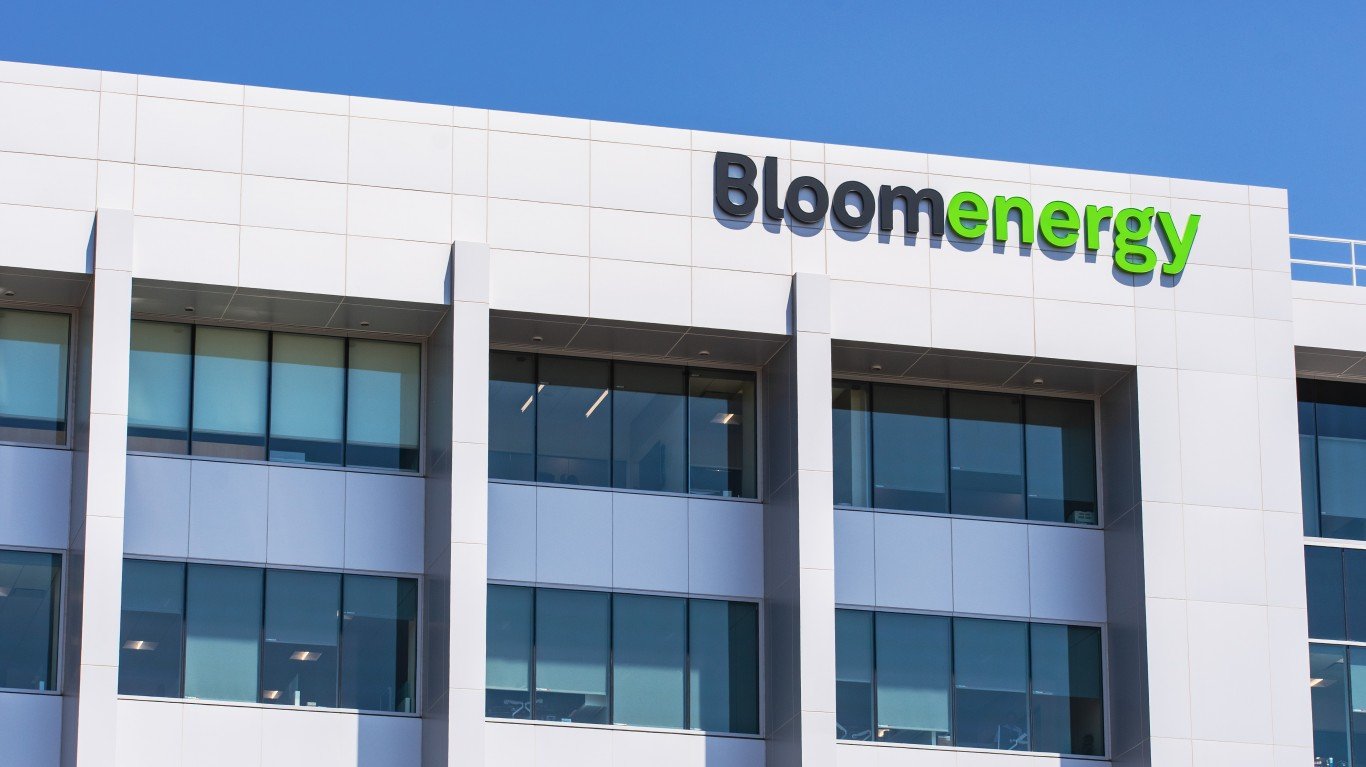
We Said Bloom Energy and Plug Power Had Different Fates. The Gap Has Grown.
Six months ago we called it: two fuel cell stocks, two completely different fates. Since then one has become the go-to power source for AI hyperscalers while the other fights for survival, and the distance between them keeps growing.


Back in March, we indicated that these two fuel cell names were on very different paths, citing Bloom’s full-year revenue of $2.0 billion, up 37.3%. Now Bloom Energy (NYSE:BE) trades near $260 and Plug Power (NASDAQ:PLUG) near $2.03. The gap widened in six months.
Scoreboard: Bloom Ran, Plug Went Sideways
Year to date, Bloom has gained 163.2%, and it is up 275.5% over one year. Plug has retreated 12.2% year to date and is down 22.6% over 12 months. Their market caps are $76.1 billion and $2.7 billion, respectively.
Bloom Became a Standard for AI Onsite Power
Q2 FY26 revenue hit $1.065 billion, up 165.5% year-over-year. Product revenue reached $935.41 million, +215% year over year, driven by hyperscalers and colocation operators. GAAP operating income swung to $182.24 million from a $3.50 million loss, operating cash flow turned positive at $226.43 million, and cash stands at $2.67 billion.

CEO K.R. Sridhar said, “all the major US hyperscalers and over a dozen US neoclouds, AI labs, and co-location data center operators have validated and approved our power solutions.” Brookfield expanded its financing framework from $5 billion to $25 billion. (The power-and-cooling side of the AI buildout is exactly the thesis we laid out in a free report on seven non-chipmaker AI infrastructure names). FY26 revenue guidance was raised to $3.9 billion to $4.2 billion, roughly doubling 2025.
[earnings_quotes symbol=”BE”]
Plug’s Cleaner Quarter Masks the Same Business Model
Plug’s Q2 FY26 revenue landed at $178.30 million, up 2.5% year over year. Gross loss narrowed to −$1.68 million from −$53.47 million year over year. Net loss came in at −$188.21 million, and cash slipped to $161.89 million. GenDrive deployments rose 125% year over year to 1,666 units, with major customers planning to refresh 20,000+ GenDrive units over three years.

Plug CEO Jose Luis Crespo, who took the role in early 2026, said the business is “executing its transformation into a stronger, more efficient and profitable company.” Guidance was lifted to 15% to 16% revenue growth, with a reiterated positive EBITDAS target for Q4 2026. Notably absent is any pivot into the AI data-center power market that Bloom is capturing.
[earnings_quotes symbol=”PLUG”]
Where Each Is Headed From Here
| Lens | Bloom | Plug |
| Core Bet | AI onsite power | Material handling, PEM electrolyzers |
| Liquidity | Operating cash, Brookfield shelf | Asset monetization targeting $275M |
| Key Risk | Valuation, AI capex slowdown | Ongoing losses, dilution |
Bloom has climbed 1,241.8% over five years. Buying today is a different proposition than buying in March. Plug’s improved cost structure matters, but its accumulated deficit of ~$8.2 billion constrains any quick re-rating.
Verdict
The March thesis holds. Bloom generates operating cash; Plug still burns cash. If AI capex softens or hyperscaler validations slow, Bloom loses its engine and, at this multiple, the reaction would be sharp. If Plug reaches Q4 2026 EBITDAS-positive and closes the Graham, Texas, sale plus the staged New York Gateway close for the guided $80 million in near-term liquidity, the survival narrative shifts. Bloom now looks like a smaller position, and Plug like a speculative rebuild.
Contact [email protected] for any questions or corrections.
Trey has been an editor and author at 24/7 Wall St. for more than a decade, where he has published thousands of articles analyzing corporate earnings, dividend stocks, short interest, insider buying, private equity, and market trends. His comprehensive coverage spans the full spectrum of financial markets, from blue-chip stalwarts to emerging growth companies.
Beyond 24/7 Wall St., Trey has created and edited financial content for Benzinga and AOL's BloggingStocks, contributing additional hundreds of articles to the investment community.
Trey's editorial expertise extends across multiple publishing environments. He served as production editor at Dearborn Financial Publishing and development editor at Kaplan, where he helped shape financial education materials. Earlier in his career, he worked as a writer-producer at SVE. His freelance editing portfolio includes work for prestigious clients such as Sage Publications, Rand McNally, the Institute for Supply Management, the American Library Association, Eggplant Literary Productions, and Spiegel.
Outside of financial journalism, Trey writes fiction and has been an active member of the writing community for years, moderating workshop sessions at regional conventions.