4 Dividend Stocks Built Around America’s Irreplaceable Freight Network
Nobody is building a competing transcontinental railroad, and that simple fact has quietly funded decades of rising dividends across four companies most investors never think about.

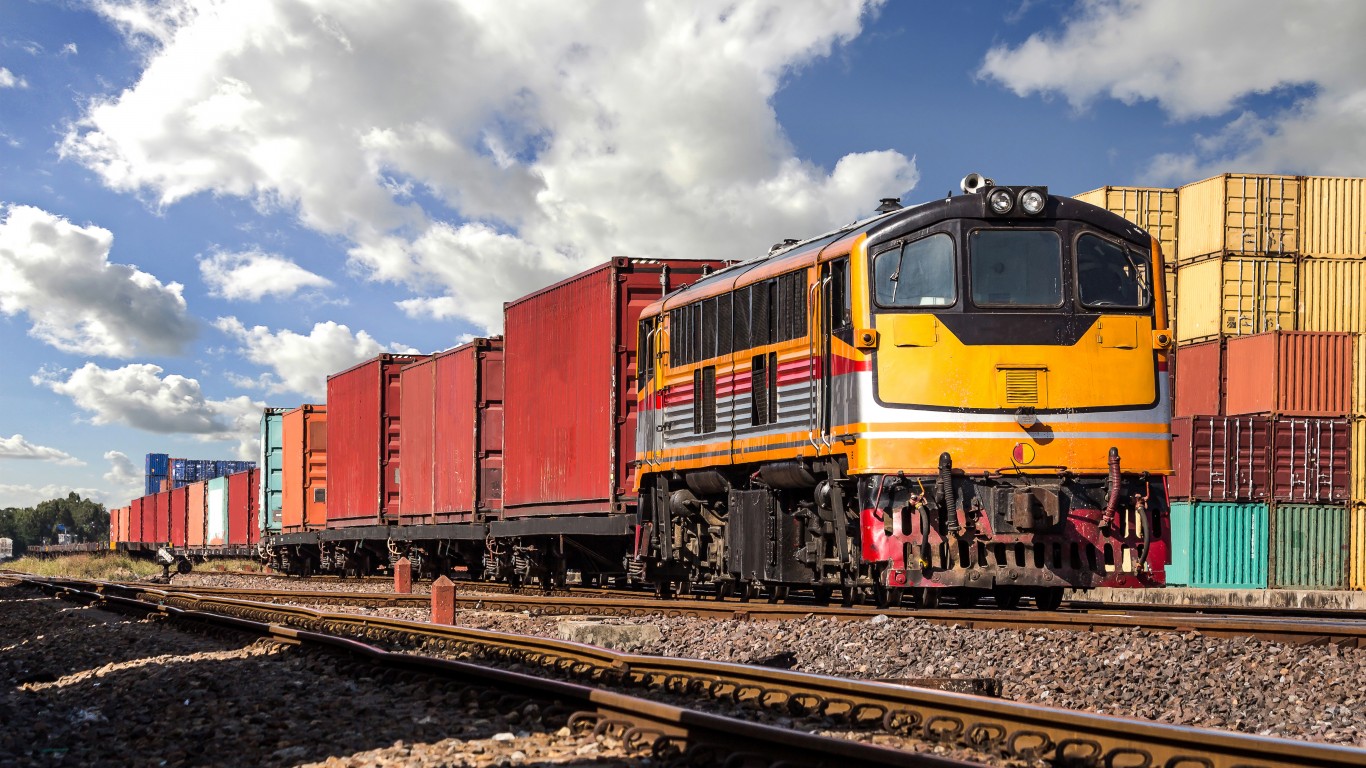
Freight rail is the least glamorous way to move a ton of steel, grain, or a container across a continent, and it is also the hardest network to replicate. Nobody is laying a competing transcontinental railroad. That entrenched position tends to show up in slow, unremarkable places, like a dividend that has been paid every quarter for decades or a lease book that renews at higher rates. As one small data point on how durable the underlying franchise can be: GATX’s railcar renewal success rate ran at 82.6% in the second quarter, with an average renewal term of 54 months. Customers, for the most part, do not have anywhere else to go.
Union Pacific Runs the Western Half of the Country
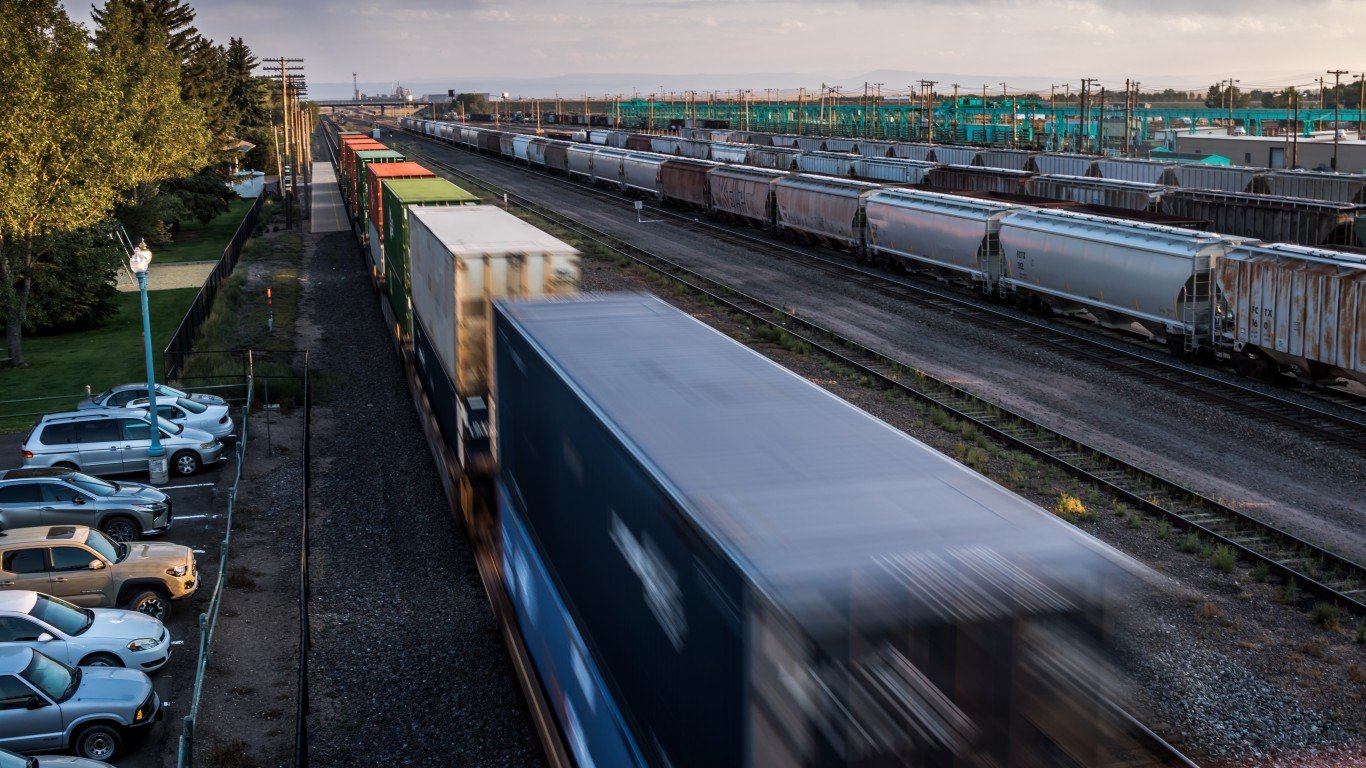
Union Pacific (NYSE:UNP | UNP Price Prediction) is the largest US Class I railroad, with a network covering the western two-thirds of the country. It hauls grain, coal, chemicals, autos, and a growing book of intermodal containers moving between West Coast ports and inland markets. Second-quarter operating revenue reached $6.9 billion, up 12% year over year, with an operating ratio of 59.2%. Demand persists through downturns because the freight itself does. Grain moves whether the S&P is up or down; chemicals move to keep plants running; utilities take coal on multi-year contracts. In the most recent quarter, bulk revenue still rose 7% even as bulk volume slipped 1%, a reminder that pricing does most of the heavy lifting when volumes wobble.
On returns to owners, Union Pacific has paid a quarterly dividend continuously in the record going back to 1999, and it raised the quarterly payout again this year to $1.42 per share, with an ex-dividend date of August 31, 2026. CFO Jennifer Hamann noted on the second-quarter call that “our quarterly pricing dollars continue to exceed inflation dollars as we compete and win business at levels that reflect the value of our rail service.” That is the plainest evidence of pricing power a shipper-facing business can offer: contract renewals priced above input inflation, quarter after quarter. The stock trades at a 22 trailing PE with an operating margin around 41%.
Risk: the pending merger with Norfolk Southern is a genuine variable. Approval, integration, and remedies are all uncertain, and Union Pacific already absorbed $35 million in acquisition expense in the second quarter alone. Regulatory review will run its statutory course, and any deal of this scale carries execution risk that patience is required to sit through.
CSX Owns the Eastern Network
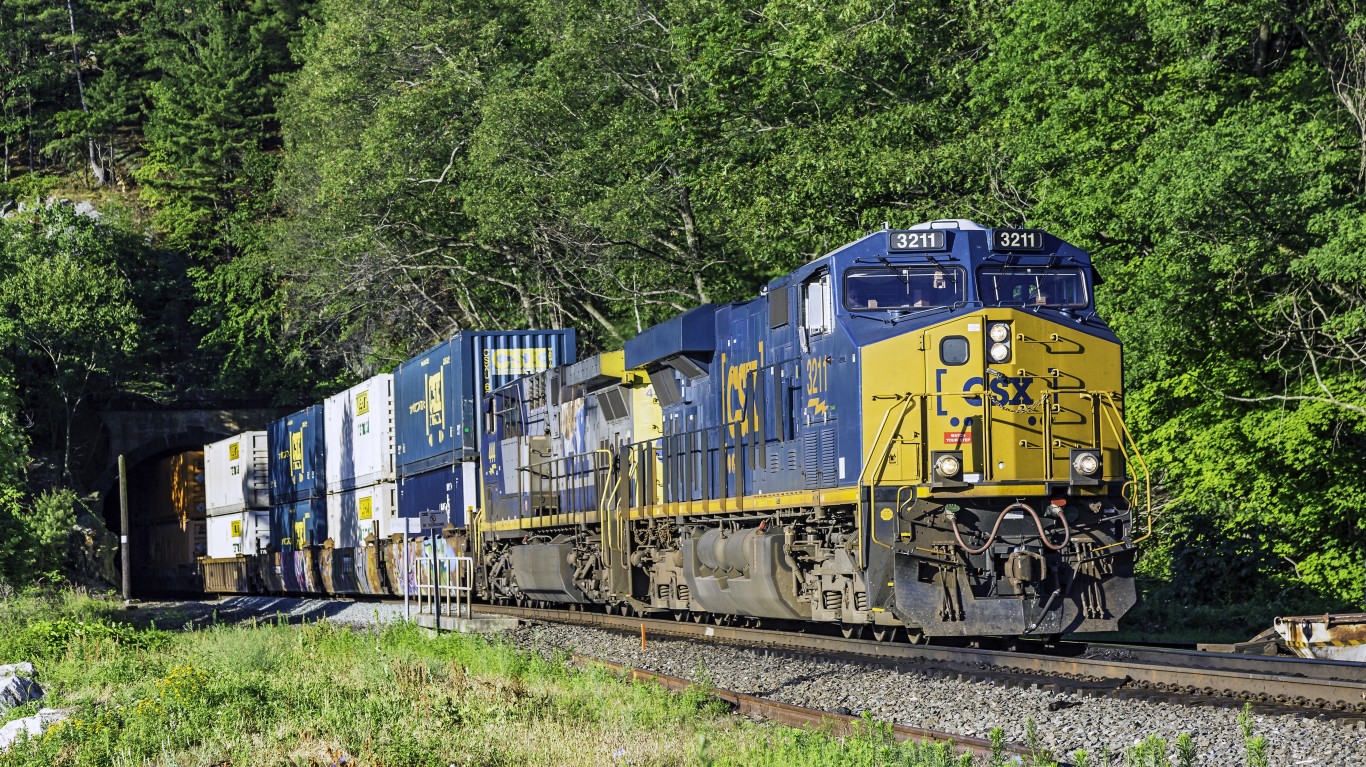
CSX (NASDAQ:CSX) is the mirror image on the eastern side: roughly 20,000 route miles from the Mississippi to the Atlantic, with dense exposure to export coal through Baltimore and Hampton Roads, chemicals in the Gulf and Southeast, and intermodal lanes into the Northeast. Second-quarter revenue hit a record $3.935 billion, and operating margin expanded 240 basis points despite 160 basis points of fuel-price headwinds. Six of CSX’s seven merchandise business units grew or held flat year over year, and coal revenue rose 9% on strong export volumes and domestic contract renewals. Utilities still need baseload fuel; steel mills still need coke; plastics plants still need feedstock. Even in weaker cycles, those flows continue, just at repriced levels.
CSX has paid a quarterly dividend in the record going back to 1999, currently $0.14 per share, with the quarterly amount stepping up from $0.11 in 2023, to $0.12 in 2024, to $0.13 in 2025, to $0.14 in 2026. Buybacks are the larger channel: the company returned $284 million via repurchases in the second quarter and $506 million across the first half. Management framed pricing conservatively on the call: “We’re going to make sure that we continue to price at the value of the service.” With an operating margin near 38% and a trailing PE around 27, the numbers behind that sentence are already visible.
Risk: service execution matters. CSX itself acknowledged terminal dwell and trip-plan performance were below management’s desired levels in the quarter, and fuel-price volatility drove a $54 million unfavorable fuel lag. Rail operations are also volume-sensitive on the way down, and coal exposure, while resilient so far, is a structural question mark tied to power generation policy.
GATX Owns the Railcars Everyone Else Rents
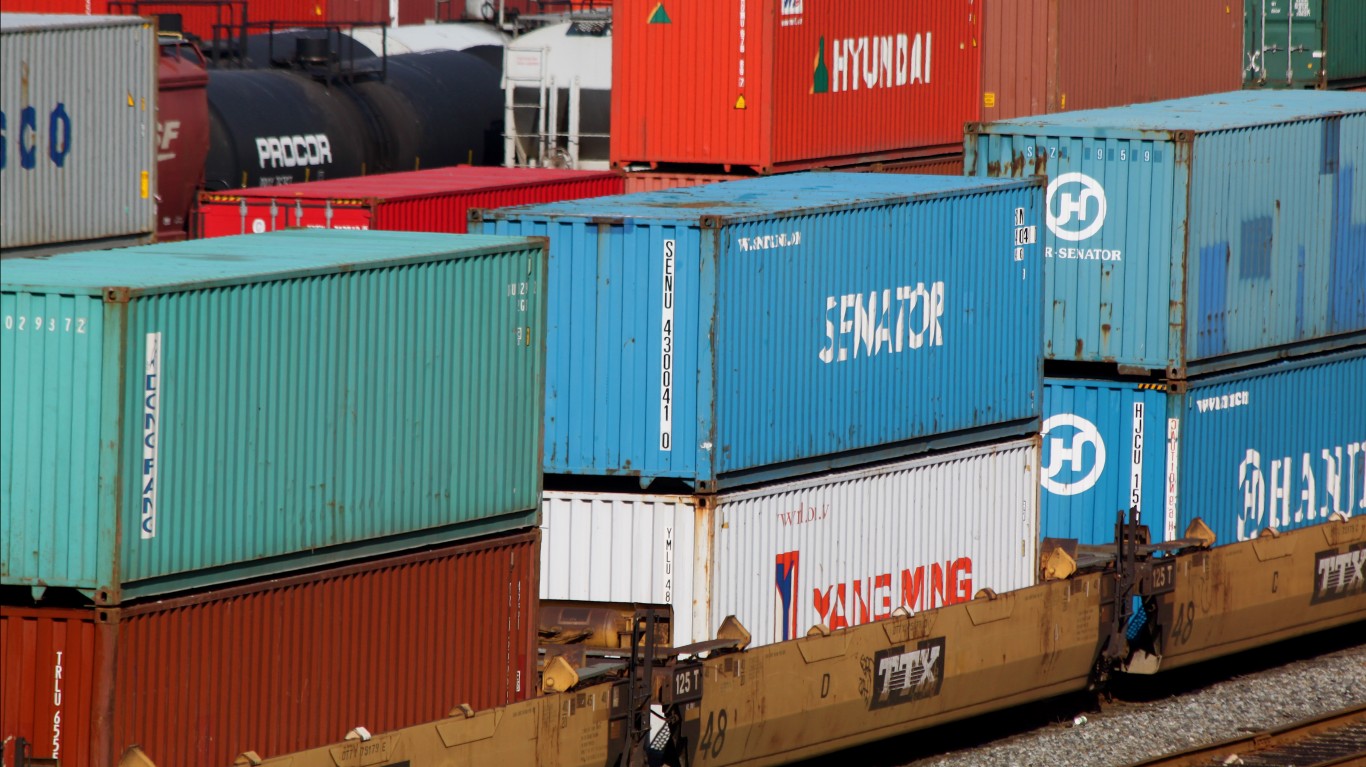
GATX Corporation (NYSE:GATX) is a lessor to the Class I railroads. It owns and leases tank cars and freight cars to the shippers who move product on the Class I networks, with a combined North American fleet of roughly 201,800 railcars after the Wells Fargo Rail acquisition. It also has fleets in Europe and India and a joint venture with Rolls-Royce leasing aircraft spare engines. Customers cannot easily leave: tank cars are highly specified for specific commodities, and there is a multi-year wait to order new equipment, with the earliest available scheduled delivery under GATX’s Trinity supply agreement now in the first quarter of 2027. Fleet utilization sat at 98% in North America, 95.3% in Europe, and fully utilized in India.
The pricing power evidence is unusually clean. GATX’s Lease Price Index renewal rate was 16.8% in the quarter, with an average renewal term of 54 months. The quarterly dividend of $0.66 has been raised in each of the last several years, stepping from $0.48 in 2020, to $0.50 in 2021, $0.52 in 2022, $0.55 in 2023, $0.58 in 2024, $0.61 in 2025, and $0.66 in 2026. CEO Bob Lyons summed up the mindset: “We tend to think in terms of decades. So any performance metric on a quarterly basis or a monthly basis is not going to give us tremendous pause.” Shares trade at a trailing PE of about 18.
Risk: GATX financed the Wells Fargo Rail deal with debt, and interest expense rose to $151 million in the first quarter, up 59%, with recourse leverage at 3.3x. Europe remains a soft economic backdrop, sand-car exposure will weigh on the reported LPI, and the aircraft engine business depends on Rolls-Royce and global travel patterns.
Wabtec Sells the Locomotives and the Brakes
Wabtec (NYSE:WAB) is the picks-and-shovels supplier: locomotives, modernizations, braking systems, positive train control, digital intelligence, and transit components. Second-quarter sales reached $3.18 billion, up 17.5%, and the multi-year backlog exceeded $30 billion, up 42% from the prior year. Wabtec’s demand is durable partly because its installed base is durable: a locomotive delivered today, or an older FDL modernized under the EVO Advantage program, will generate parts and service revenue for decades. Management put it plainly on the call: “Putting these out even at a lower margin than the average allows for us to garner service revenue off those for the next 20 to 30 years and the components and certainly the modernizations that come from that.”
Roughly 60% of Wabtec’s revenue is under long-term contracts, predominantly with price escalators, which is the structural evidence for pricing discipline. The quarterly dividend was raised to $0.31 from $0.25 earlier in the year, and the payout has stepped up steadily from $0.12 in 2018 through 2021, $0.15 in 2022, $0.17 in 2023, and $0.20 in 2024. First-half 2026 buybacks and dividends totaled $563 million. Shares trade at a trailing PE of roughly 39 and a forward PE of about 24.
Risk: North American railcar production is forecast at roughly 25,000 cars in 2026, still down 21% from 2025, and railcar-related business represents about 60% of the components segment. Tariffs, electronics supply shortages, and integration of the Inspection Technologies, Frauscher, and Dellner acquisitions all sit on the execution ledger.
None of these four names will make anyone look clever at a dinner party. They move heavy things, they lease heavy things, and they build heavy things, and they keep doing it whether the cycle is warming up or cooling off. The dividends are modest by design and the buybacks are the larger channel of return in most quarters. If the goal is a durable core that pays you to hold it rather than a trade (we walked through how to build a dividend ladder you never have to sell out of in a free guide here), the freight rail complex is one of the more unglamorous places to look.
Contact [email protected] for any questions or corrections.
Chris Lange is a financial and geopolitical writer with more than a decade of experience covering a myriad of topics. He has published thousands of articles for 24/7 Wall St., with past coverage focused heavily on stocks, IPOs, healthcare, defense, global affairs, and technology.
His work has been quoted, or referenced by a number of outlets including Business Insider, USA Today, Yahoo Finance, MSN, The Motley Fool, and many other publications. A graduate of Southwestern University, he studied business with a focus on investments and has previous experience in banking and startups.
When not reading or writing the news, he is following his passion for Lacrosse, playing chess, or building solar projects with his dad.