Deere, ADM and Bunge: 3 Farm Stocks Giving Investors Dividends For America’s Harvest
Three farm stocks collect income from completely different points in the crop chain, and right now those differences are splitting their fortunes wide open. Knowing which one fits your portfolio comes down to understanding exactly where each sits when harvests…

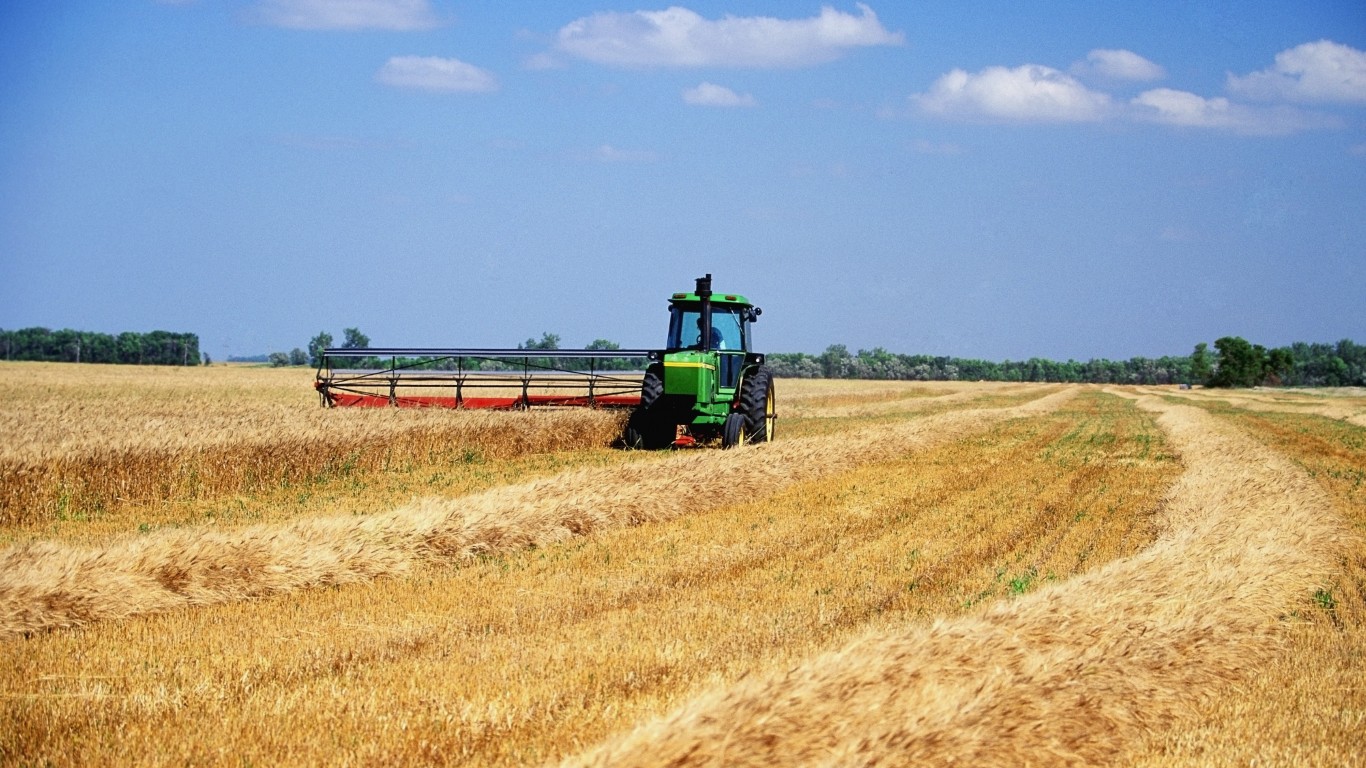
American farm income reaches dividend investors through different doors. Archer-Daniels-Midland (NYSE:ADM | ADM Price Prediction) and Bunge Global (NYSE:BG) get paid to buy, move, crush and refine crops. Deere (NYSE:DE) gets paid when farmers feel confident enough to buy new machinery. That split defines the group right now. Deere expects large ag industry demand in the U.S. and Canada to fall 15% to 20% this fiscal year, while both processors just raised full-year earnings guidance. All three are cyclical income plays tied to crop prices, weather, global demand and trade policy, so the dividend safety read matters more than the yield.
Archer-Daniels-Midland: Collecting a Toll on Every Bushel
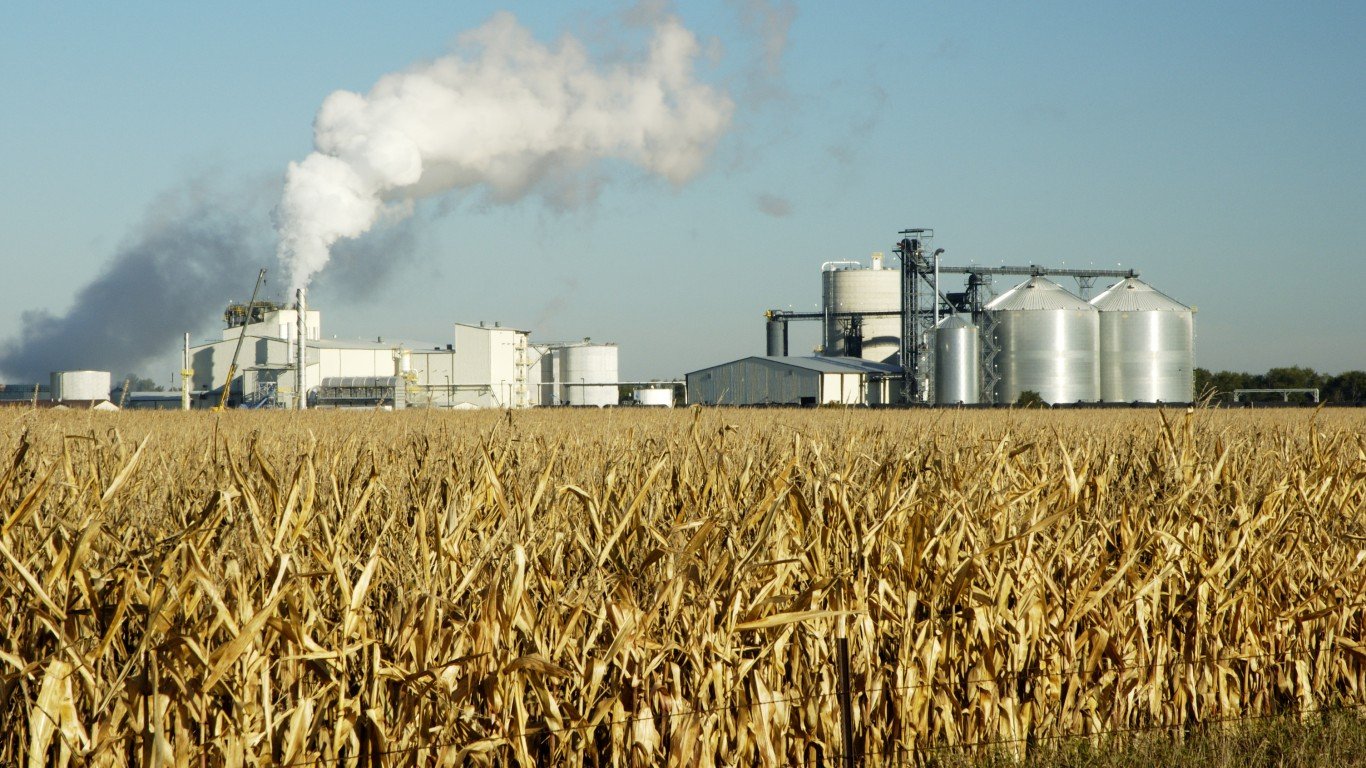
ADM buys grain and oilseeds from farmers. It stores and ships them, and processes them into food ingredients, animal feed and biofuel feedstocks through more than 270 plants and 420 crop procurement facilities. Its profit comes from two things: the volume of crop flowing through that network and the margin earned on processing it. The key processing metric is the crush margin. When ADM crushes soybeans, it produces soybean meal (animal feed) and soybean oil (cooking oil and biodiesel), and the crush margin is the gap between what the beans cost and what the meal and oil sell for. A wide gap pays well whether soybeans are cheap or expensive; a narrow gap pressures earnings even in a big harvest.
At a recent price of $81.13, ADM yields 2.52% on a quarterly dividend of $0.52, or $2.08 annualized.
Dividend safety: Coverage is solid on a full-year view. In fiscal 2025, ADM generated $5.452 billion in operating cash flow against $1.248 billion of capital spending and $987 million in dividends. Quarter to quarter, the picture swings with inventory: first-quarter operating cash flow was just $150 million against $254 million in dividends, before the second quarter delivered $1.149 billion against $272 million of capex and $256 million in dividends. Raised fiscal 2026 adjusted EPS guidance of $5.15 to $5.60 sits well above the payout. Shareholders’ equity stood at $22.81 billion after the first quarter. ADM has a long history of increases: the quarterly rate rose in every year of the record from $0.06 in 2003 to $0.52 today, though recent raises have been small, from $0.50 in 2024 to $0.51 in 2025.
Bull case: An earnings rebound is already underway. Second-quarter adjusted EPS came in at $1.84, up from $0.93 a year earlier, and Ag Services and Oilseeds operating profit rose 129% to $867 million. The driver was a stronger biofuels environment after the 2026/2027 Renewable Volume Obligations under the U.S. Renewable Fuel Standard were finalized. Those obligations set how much biofuel refiners must blend, which supports demand for the soybean oil ADM produces. The stock trades at about 16 times forward earnings. That compares with 22 times trailing, a sign the market expects profits to keep catching up to a share price that has gained 44.05% year to date.
Risk: Much of this rebound leans on government policy. Biofuel mandates and trade rules are set in capitals, and ADM flags tariff exposure as an ongoing risk, so if blending requirements relax or trade flows get disrupted, the margin boost behind the raised guidance can fade quickly.
Bunge Global: A Bigger Crusher After the Viterra Deal
Bunge runs the same basic model as ADM with a heavier tilt toward oilseeds. It crushes soybeans and softseeds such as canola and sunflower into meal and oil, refines tropical and specialty oils, and trades and mills grain. Like ADM, it earns on crush margins and volume, and the completed Viterra acquisition added a lot of volume: second-quarter revenue rose 88.3% year over year to $24.04 billion.
At $108.99, Bunge yields 2.58%, the highest in this group, on a quarterly dividend of $0.72, or $2.88 annualized.
Dividend safety: Earnings coverage looks comfortable. Bunge raised fiscal 2026 adjusted EPS guidance to $9.25 to $9.75, well above its annualized dividend. Cash flow is the weak spot. In fiscal 2025, operating cash flow of $844 million fell short of $1.723 billion in capital spending, with $459 million in dividends on top. Over the past two quarters, operating cash flow was negative at $541 million and $585 million, largely tied to inventory, including a $2.169 billion inventory swing in the first quarter. For now, the company is covering the dividend with its own resources while that inventory clears. The record shows long-term growth, from $0.095 per quarter in 2001 and 2002 to $0.72 now, including a raise from $0.70 this year. It also shows the payout held at $0.50 through the 2018 to 2021 stretch, so increases can pause.
Bull case: Investors get a cheaper multiple on a larger earnings base. Bunge trades at about 10 times forward earnings versus 23 times trailing. Second-quarter adjusted EPS of $2.00 beat the $1.95 estimate, and revenue topped expectations of $22.35 billion. Softseed Processing and Refining segment EBIT jumped to $255 million from $14 million, while Soybean Processing and Refining reached $445 million versus $304 million. Bunge also completed a $2 billion share repurchase program tied to Viterra, reducing the share count the dividend is spread across. The stock sits below its 52-week high of $134.02.
Risk: The bigger footprint carries a bigger fixed cost. Bunge guides to net interest expense of $620 million to $660 million this year, a heavy charge for a business whose operating cash flow can run negative for quarters at a time.
Deere: Paid Only When Farmers Open Their Wallets
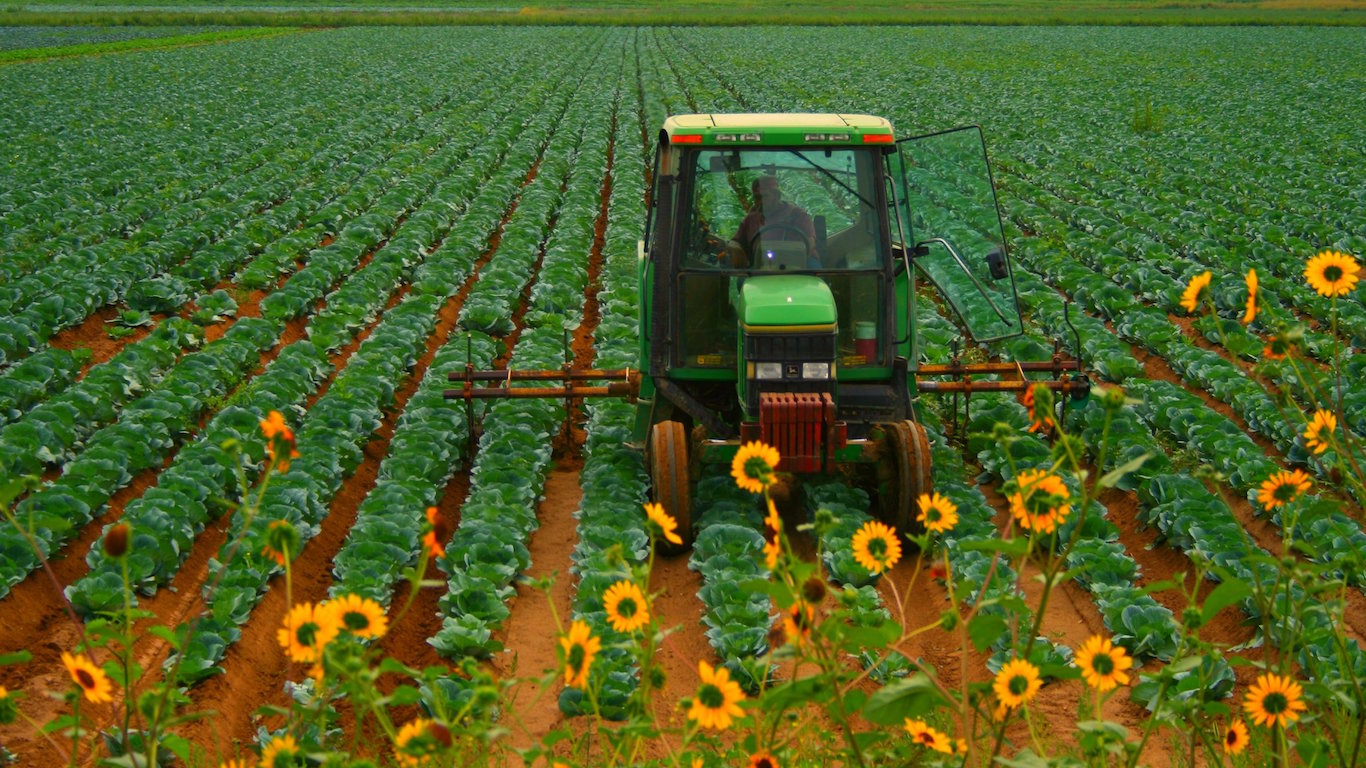
Deere holds a different point in the chain entirely. It builds tractors, combines, sprayers and precision agriculture technology, plus construction and forestry machinery, and runs a financial services arm that lends to buyers. Its revenue depends on farmers choosing to spend capital on equipment, a discretionary purchase that gets pushed back hard when farm income falls.
At $690.05, Deere yields 0.93% on a quarterly dividend of $1.62, or $6.48 annualized. This is the smallest income stream of the three and more of a dividend growth holding.
Dividend safety: Coverage is comfortable. Fiscal 2025 operating cash flow of $7.459 billion exceeded both $4.228 billion in capital spending and $1.72 billion in dividends. For fiscal 2026, Deere guides to equipment operations operating cash flow of $5.0 billion to $5.5 billion and net income of $4.75 billion to $5.00 billion, against quarterly dividend payments near $438 million. It also found room for $697 million in buybacks over the first nine months of the fiscal year. The first fiscal quarter regularly burns cash (operating cash flow was negative $890 million this year) before selling season refills the tank. The quarterly rate rose from $0.76 in 2019 and 2020 to $1.62 by late 2024 and has held there since, a pause that matches the downturn in farm equipment demand.
Bull case: Management says the bottom is here. Chief executive John May said “2026 will mark the bottom of the current ag equipment cycle.” Third-quarter EPS of $5.10 beat the $4.70 estimate, and revenue of $12.61 billion topped the $10.73 billion forecast. Construction and Forestry sales rose 18% to $3.62 billion, with operating margin expanding to 12.1% from 7.7%, evidence the non-farm side can carry weight while ag recovers. Shares are up 49.11% year to date and trade at 29 times forward earnings.
Risk: This is the biggest risk in the group. When farm income drops, farmers delay buying equipment, and Deere feels it immediately. Management expects large ag industry demand in the U.S. and Canada to fall 15% to 20% this fiscal year, with South America also down 15% to 20%. ADM and Bunge still process crops in a weak year. Deere needs farmers to spend.
How These Three Farm Dividends Fit Together
ADM has a long raise history. It also has solid full-year cash coverage, while Bunge pays the highest yield on a cheap forward multiple with a thinner cash buffer, and Deere pays the least today while running the largest cash engine of the three. The processors earn on volume and margins across most harvests, while Deere makes when farmers feel flush enough to reinvest, and for income, ADM anchors this cyclical group, Bunge adds yield, and Deere is the recovery boost.
Contact [email protected] for any questions or corrections.
Chris Lange is a financial and geopolitical writer with more than a decade of experience covering a myriad of topics. He has published thousands of articles for 24/7 Wall St., with past coverage focused heavily on stocks, IPOs, healthcare, defense, global affairs, and technology.
His work has been quoted, or referenced by a number of outlets including Business Insider, USA Today, Yahoo Finance, MSN, The Motley Fool, and many other publications. A graduate of Southwestern University, he studied business with a focus on investments and has previous experience in banking and startups.
When not reading or writing the news, he is following his passion for Lacrosse, playing chess, or building solar projects with his dad.