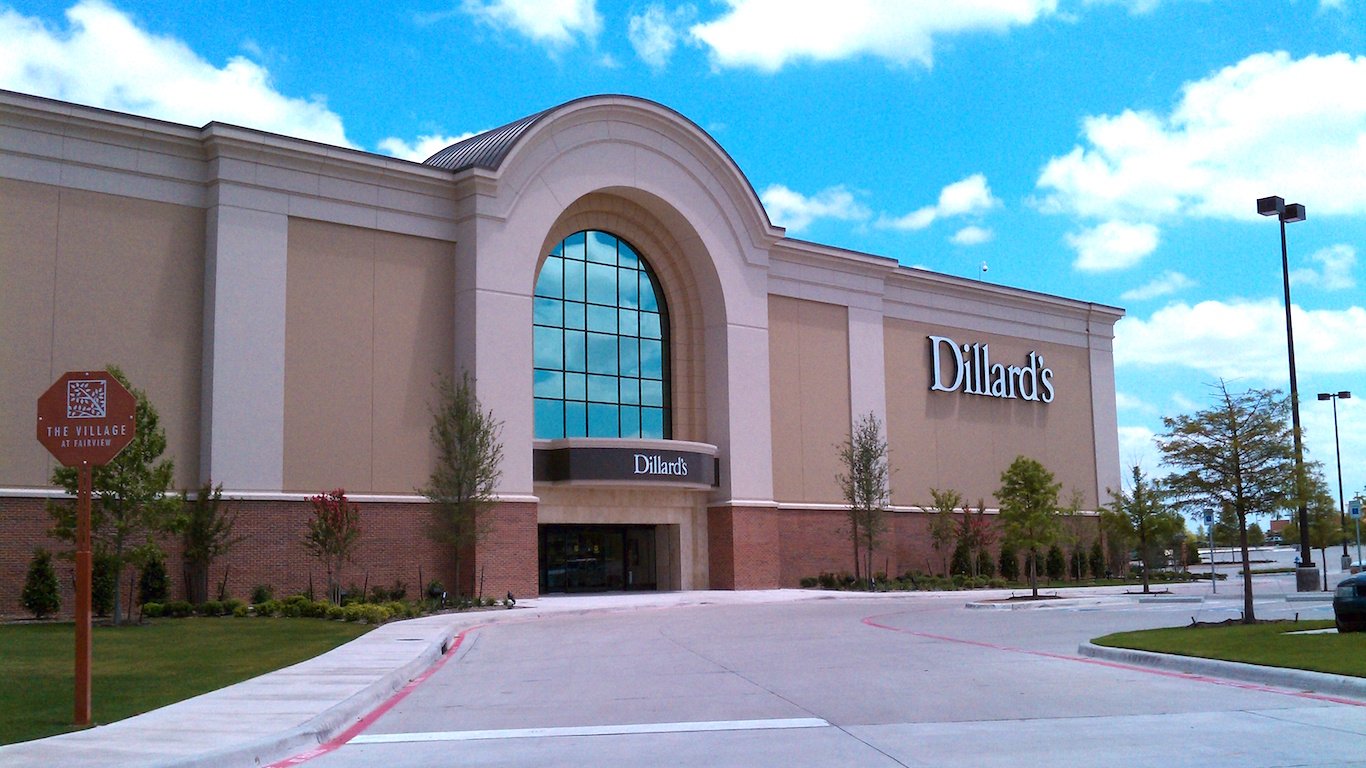
Dillard’s Dividend Looks Small Until It Isn’t. Here’s What Income Investors Should Expect
Dillard's posted a yield that barely registers at 0.18%, yet some shareholders collected over $31 per share in the past year alone. Whether that kind of payout repeats depends on factors most income investors overlook entirely.

Dillard’s (NYSE:DDS | DDS Price Prediction) pays $0.30 per share each quarter, an annualized forward rate of $1.20. With shares at $664.04, that is a regular yield of roughly 0.18%. Over the trailing 12 months, however, shareholders collected $31.20 per share. Income investors need to treat those as two separate streams.

Two Dividends Hiding in One Ticker
The regular payout has rose steadily, from $0.15 in 2020 and 2021 to $0.20, then $0.25, and now $0.30. The next check goes ex-dividend September 30 and pays November 2, 2026.
The specials, declared each November, are where the money lives:
| Payment Date | Special Dividend |
|---|---|
| Jan. 5, 2026 | $30.00 |
| Jan. 6, 2025 | $25.00 |
| Jan. 8, 2024 | $20.00 |
| Jan. 9, 2023 | $15.00 |
| Dec. 15, 2021 | $15.00 |
CEO William T. Dillard, II framed the latest payout in February:
“We rewarded our shareholders with the largest dividend in our history and still held around $1.1 billion in cash and short-term investments at year-end.”
Free Cash Flow Decides the Next Special
In fiscal 2026, Dillard’s generated $717 million in operating cash flow and $623.6 million in free cash flow. Dividends consumed $484.8 million. The regular dividend alone costs about $4.7 million a quarter, a small sum. The special takes most of the surplus.
That makes earnings quality critical. Second-quarter EPS of $6.25 exceeded the $4.21 estimate, but $1.82 per share came from a tariff refund the company does not expect to repeat. Comparable sales rose just 1% while inventory grew 5%.
“Our 1% sales increase points to a somewhat resilient consumer. Retail gross margin of 40.9%, boosted by tariff rebates, helped grow cash flow and the bottom line.”
Buybacks Have Faded as Specials Grew
Repurchases fell from $544.9 million in fiscal 2022 to $107.8 million in fiscal 2026, and the two most recent quarters show zero. About $165.2 million remains authorized, with roughly 15.6 million shares outstanding. Capital return has changed toward cash in hand.
Family Control Shapes How the Stock Trades
Insiders hold 32.004% of shares, and the float is only 7,492,700 shares. Concentrated ownership rewards the family through specials and keeps the balance sheet conservative, but a thin float magnifies swings. The stock is up 13.74% over one year and 311.55% over five. It trades at a trailing P/E of 15 and a forward P/E of 35, above the $545.67 analyst target.

Where Dillard’s Stands Against Macy’s and Kohl’s
Macy’s (NYSE:M) and Kohl’s (NYSE:KSS) are known for higher headline yields but weaker balance sheets. Dillard’s offers the opposite: a tiny stated yield backed by more than $1.2 billion in cash and short-term investments after paying off $96 million in debt.
Verdict: An Opportunistic Holding
Dillard’s is an opportunistic holding. The only income a shareholder can count on is $1.20 a year. The specials depend on discretionary board decisions and on free cash flow that loses its tariff boost going forward. The November declaration and holiday-quarter comparable sales will signal the size of the next check.
Contact [email protected] for any questions or corrections.
Chris Lange is a financial and geopolitical writer with more than a decade of experience covering a myriad of topics. He has published thousands of articles for 24/7 Wall St., with past coverage focused heavily on stocks, IPOs, healthcare, defense, global affairs, and technology.
His work has been quoted, or referenced by a number of outlets including Business Insider, USA Today, Yahoo Finance, MSN, The Motley Fool, and many other publications. A graduate of Southwestern University, he studied business with a focus on investments and has previous experience in banking and startups.
When not reading or writing the news, he is following his passion for Lacrosse, playing chess, or building solar projects with his dad.