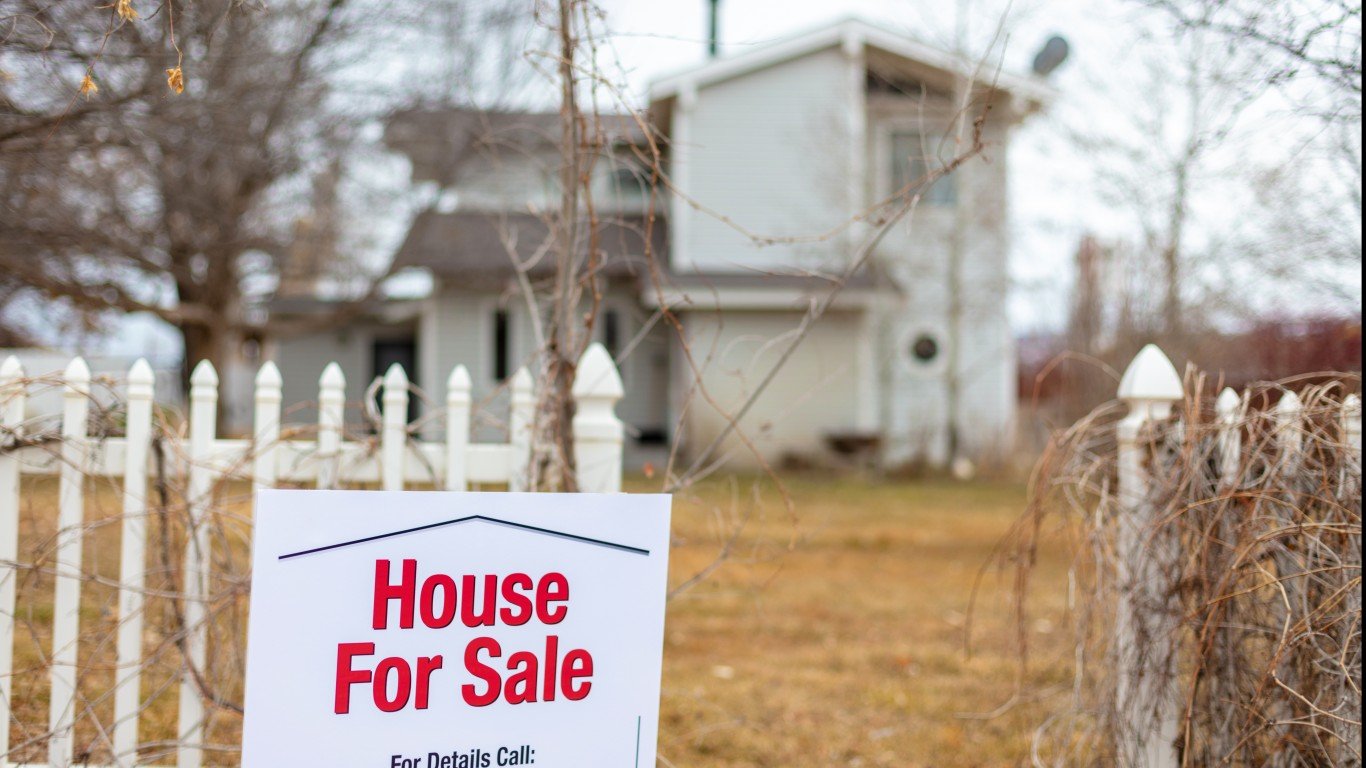
Monthly Mortgage Payment Up 74% In Five Years
A single number explains why the housing market has ground to a near standstill, and it has nothing to do with home prices. Understanding it reveals why millions of homeowners may never sell, no matter how desperate buyers get.

This post may contain links from our sponsors and affiliates, and Flywheel Publishing may receive compensation for actions taken through them.

In 2021, Rocket Mortgage charged 2.65% for a 30-year fixed mortgage on a $450,000 home. That made the one-month mortgage payment $1,450. Today’s mortgage rate is 7.5% on the same house with the same loan duration. The payment for that is $2,517, up 74%. How many people can afford the $1,067 increase? That is the heart of the home market sales slowdown.
Home sales in 2021 were 6.13 million. The 2026 annual run rate is 3.98 million. That is among the reasons median home prices are up 24.5% between the two periods to $434,900.
The locked-up home market isn’t going to unlock. Who wants to leave a home when it could cost them $1,000 a month to own a new one, if they had one of those sub-3% mortgages?
The current opinion is that the market will not unlock until the last of the Silent Generation die. About 35% of people born between 1928 and 1945 are still alive. That is about 15 million people. Some have already moved to smaller homes or assisted living, so many of those homes are “unlocked.” The more important number is Baby Boomers. Sixty-seven million of them are still alive. The last year that qualifies for this group is 1964. They may not sell their homes for decades.
Among the open questions about a housing “unlock” is how fast older Americans will move from homes they bought for much less money than those houses are worth today. One reason they will sell is to tap their home equity, which is likely to be hundreds of thousands of dollars. It is among the futures that are hard to pedict accurately.
Among the last parts of the calculation is whether mortgage rates will move much lower. Based on the direction of interest rates, the answer is “no.” People who want to buy houses need to pay the extra $ 1,000 a month or wait for what could be years.
Contact [email protected] for any questions or corrections.
Douglas A. McIntyre is the co-founder, chief executive officer and editor in chief of 24/7 Wall St. and 24/7 Tempo. He has held these jobs since 2006.
McIntyre has written thousands of articles for 24/7 Wall St. He is an expert on corporate finance, the automotive industry, media companies and international finance. He has edited articles on national demographics, sports, personal income and travel.
His work has been quoted or mentioned in The New York Times, The Wall Street Journal, Los Angeles Times, The Washington Post, NBC News, Time, The New Yorker, HuffPost USA Today, Business Insider, Yahoo, AOL, MarketWatch, The Atlantic, Bloomberg, New York Post, Chicago Tribune, Forbes, The Guardian and many other major publications. McIntyre has been a guest on CNBC, the BBC and television and radio stations across the country.
A magna cum laude graduate of Harvard College, McIntyre also was president of The Harvard Advocate. Founded in 1866, the Advocate is the oldest college publication in the United States.
TheStreet.com, Comps.com and Edgar Online are some of the public companies for which McIntyre served on the board of directors. He was a Vicinity Corporation board member when the company was sold to Microsoft in 2002. He served on the audit committees of some of these companies.
McIntyre has been the CEO of FutureSource, a provider of trading terminals and news to commodities and futures traders. He was president of Switchboard, the online phone directory company. He served as chairman and CEO of On2 Technologies, the video compression company that provided video compression software for Adobe’s Flash. Google bought On2 in 2009.