UnitedHealth is Down Big Over 3 Months: A Big Bank Says 40% Gains to Come After Raising Their Target
UnitedHealth has shed members, slipped 10% in three months, and closed lower on a beat-and-raise quarter. Now a major Wall Street firm is calling for 40% gains, and its argument centers on a business unit most investors are not watching…

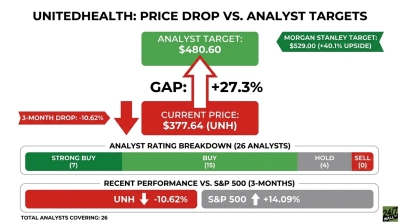
UnitedHealth Group (NYSE:UNH | UNH Price Prediction) currently trades at $377.64. Wall Street’s average price target is $480.60, which puts the shares 27.3% below consensus.
UnitedHealth is the largest managed care company in the country. Its UnitedHealthcare insurance arm produces 80% of group revenue, and Optum runs its health services business. The company just beat third-quarter estimates and raised full-year guidance again. The stock still finished the day lower.
Morgan Stanley (NYSE:MS) raised its target from $468 to $529.00 and kept its Overweight rating. That Street-high target means 40.1% upside.
Shrinking Membership Drags UnitedHealth Through a 10% Three-Month Slide
Over three months, UnitedHealth has fallen 10.62%, slipping from $422.63 to $377.76. Shrinking membership is the biggest reason. UnitedHealthcare’s members fell to 48.3 million from 50.1 million a year earlier. Medicare Advantage alone has lost 935,000 members since the start of the year, and employers pulled another 165,000 commercial members in the third quarter.
On earnings day, the stock opened at $397.26, turned, and closed down 0.23%. Adjusted EPS of $4.69 beat the $4.15 consensus. However, revenue fell 0.4% from a year earlier. The medical care ratio improved to 88.4% from 89.9%, but $610 million of positive prior-period reserve development helped get it there.
This weakness is mostly UnitedHealth’s own. Elevance Health (NYSE:ELV) was flat over the same stretch. The company also faces pressure from CMS Star Ratings, Justice Department legal actions over its Medicare business, and Medicaid redeterminations.
Morgan Stanley’s $529 Target Rests on Margin Repair
Morgan Stanley’s thesis has three parts. First, it says that combining UnitedHealthcare with Optum creates a growth loop rivals cannot replicate. Second, it expects medical costs to normalize so margins can return toward historical targets. Third, it expects an aging population to keep driving Medicare Advantage volume.
The quarter backed up parts of that case. Optum Health’s operating earnings rose to $735 million from just $41 million after it left sub-scale value-based care markets. Total operating income grew 52.1%. Full-year adjusted EPS guidance is now at least $20.50, up from $19.50 to $20.00.
Estimates are rising. The 2027 EPS consensus is $22.6102, compared with $20.9705 90 days ago. On forward earnings, the stock trades at about 17x. The company has also bought back more than $5 billion of stock this year.
Of the 26 analysts covering UnitedHealth, 7 give it a Strong Buy, 15 call it a Buy, and 4 recommend Hold. None rate it Sell. Price targets are opinions, though. Morgan Stanley’s case depends on margin gains outpacing membership losses.
UnitedHealth Fell While Its Rivals Held Steady
Elevance was up 0.06% over three months. At $425.41, it sits 6.2% below its $451.71 target. Analysts give it 2 Strong Buy, 12 Buy, and 8 Hold ratings, so the Street sees far less upside than for UnitedHealth.
Cigna Group (NYSE:CI) slipped 2.59% over the past month. At $282.43, its $342.29 target means 21.2% upside. It has 6 Strong Buy, 12 Buy, and 6 Hold ratings, and it trades near 8x forward earnings.
Humana (NYSE:HUM) gained 3.28% over the past month and is up 64.13% this year. At $420.31, it sits 9.8% below its $461.50 target. Its 12 Hold ratings and 1 Sell make it the most divided name in the group.
UnitedHealth has the most analyst-implied upside in the group, whether you use the consensus target or the Street high. That makes its decline look like a story about the company itself.
UnitedHealth Still Leads the S&P 500 This Year
Despite the slide, UnitedHealth is up 16.64% year to date. The S&P 500 is up 14.09% over the same period. Over one year, the stock has gained 8.09%, compared with 17.48% for the index.
At $377.64, the stock is below its $388.46 50-day average and above its $357.79 200-day average. The price also sits well under its 52-week high of $458.79. Across 26 analysts, the consensus target of $480.60 means 27.3% upside. The dividend yields 2.36%.
Earnings Momentum Gives UnitedHealth the Edge
UnitedHealth looks compelling if Optum keeps improving, cost trends stay stable, and EPS estimates keep rising into next year. That path would support a higher multiple. It looks like a value trap if Medicare Advantage keeps losing members, Star Ratings cut bonus payments, or the Justice Department actions lead to penalties. Reserve releases that flattered this quarter’s results would make each of those risks harder to absorb.
I lean bullish. The company raised full-year guidance again this quarter, analysts keep lifting estimates, and the stock trades at about 17x forward earnings. Together, that suggests the market is overweighting membership losses. Still, the case depends on Medicare Advantage enrollment steadying, so watch for the next membership update.
Contact [email protected] for any questions or corrections.
Alex Sirois is a financial writer with experience spanning both retail and institutional investing. He has written for InvestorPlace and held roles at BNY Mellon and Bernstein, giving him a perspective that bridges Main Street portfolios and Wall Street analysis.
Alex holds an MBA from George Washington University and has built his career across multiple industries, including e-commerce, education, and translation — a breadth of experience that informs how he breaks down complex financial topics for everyday investors. His writing is conversational, actionable, and grounded in long-term, buy-and-hold investing principles.
At 247 Wall St., Alex focuses on delivering analysis that is both accessible and useful, with a clear emphasis on helping readers make more informed decisions with their money.