Roth IRA vs. Taxable Account: The Tax Difference on $25,500 in Annual Dividends
Five high-yield dividend stocks can look identical on paper whether they sit inside a Roth or a taxable account, but the tax treatment hiding inside each ticker quietly determines how much of that income you actually keep over 20 years.

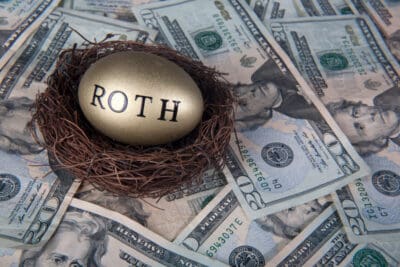
At the 24% bracket, a $400,000 portfolio of five high-yield dividend stocks pays about $25,500 a year. In a taxable account, roughly $5,690 goes to the IRS. In a Roth, qualified distributions are tax-free once the account has passed the five years and the owner has reached age 59½ (IRS Publication 17).
Roth Versus Taxable: A $5,690 Gap Every Year
The model puts $80,000 into each of five names, listed here from best-covered to worst-covered. Yields are forward annualized dividends divided by current share prices.
- Realty Income (NYSE:O): 5.49% yield, about $4,390 a year. The company has paid 673 consecutive monthly dividends, and its 2026 AFFO guidance of $4.44-$4.45 per share sits well above the $3.258 forward dividend. REIT payouts are taxed as ordinary income (non-qualified), so the full bracket rate applies when they are not sheltered.
- Altria (NYSE:MO | MO Price Prediction): 5.98% yield, about $4,780. The August increase was its 61st in 57 years, and 2026 EPS guidance of $5.66-$5.74 covers the $4.44 dividend. Its dividends are qualified, and qualified dividends are taxed at the 0%, 15%, or 20% capital gains rates. That makes Altria the lowest Roth priority in this group.
- STAG Industrial (NYSE:STAG): 4.32% yield, about $3,460. Third-quarter Core FFO of $0.66 per share covers the $0.3875 quarterly payout, and occupancy is 95.9%. As a REIT, it pays ordinary-income distributions.
- Main Street Capital (NYSE:MAIN): 5.82% yield on regular dividends only, about $4,660. Second-quarter adjusted EPS of $1.04 funds the $0.265 monthly payout, with a $0.30 supplemental on top. BDC distributions are ordinary income, so every extra also escapes tax inside a Roth.
- Ares Capital (NASDAQ:ARCC): 10.27% yield, about $8,210. Coverage is the weak spot: third-quarter net investment income of $0.46 per share came in below the $0.48 dividend. Management is counting on the MidCap Financial deal to close that gap. Ares Capital produces the largest ordinary-income stream in the group, so it gets the most out of Roth treatment.
| 24% Bracket | Taxable | Roth |
|---|---|---|
| Gross income | $25,500 | $25,500 |
| Federal tax | $5,690 | $0 |
| Net income | $19,810 | $25,500 |
| 10-year delta (no growth) | $56,900 | |
REIT investors may be able to deduct 20% of qualified REIT dividends under 26 U.S.C. § 199A(b)(1)(B), which would trim the taxable cost of holding Realty Income and STAG. Because the figures above use the full bracket rate, treat them as the upper bound.
Bracket Multiplier: Higher Earners Lose More
In 2026, the 24% rate applies to single filers with income over $105,700, and the 37% rate starts above $640,600. In the table below, Altria’s dividends are taxed at 15% in every bracket except the top one, where the rate is 20%.
| Bracket | Taxable Net Income | Roth Advantage Over Time |
|---|---|---|
| 22% | $20,230 | $5,280 |
| 24% | $19,810 | $5,690 |
| 32% | $18,150 | $7,350 |
| 37% | $16,880 | $8,620 |
Compounding Turns a Tax Bill Into a Six-Figure Gap
Assume the annual tax savings are reinvested at a conservative 4%, with no share-price gains. At 24%, the tax savings reach about $68,300 after 10 years and $169,400 after 20. At 37%, the 20-year figure is about $256,800. That money is what you give up by keeping the same five stocks outside a tax-advantaged account over the long run. A Roth also has no required minimum distributions while the owner is alive (Publication 17), so the income can keep compounding for as long as you choose.
Those low-tax years between a final paycheck and the first required withdrawal are often the cheapest window to move dividend-heavy holdings into a Roth, and we sized up that window in a free guide here: The Roth Window.
Three Moves to Make Before Your Next Filing
- Pull your Form 1099-DIV for any BDC or REIT you hold outside a tax-advantaged account. Multiply the ordinary dividends in box 1a, less the qualified amount in box 1b, by your bracket. That gives you your actual annual cost.
- Run the Roth conversion math on Ares Capital first. At 24%, it costs about $1,970 a year in income taxes when held outside a tax-advantaged account. A $4,780 Altria position at the 15% qualified rate costs about $720.
- Before you allocate limited Roth space, compare each holding’s dividend coverage. Ares Capital’s shortfall between income and dividends is worth tracking alongside its tax benefit.
Contact [email protected] for any questions or corrections.
Chris Lange is a financial and geopolitical writer with more than a decade of experience covering a myriad of topics. He has published thousands of articles for 24/7 Wall St., with past coverage focused heavily on stocks, IPOs, healthcare, defense, global affairs, and technology.
His work has been quoted, or referenced by a number of outlets including Business Insider, USA Today, Yahoo Finance, MSN, The Motley Fool, and many other publications. A graduate of Southwestern University, he studied business with a focus on investments and has previous experience in banking and startups.
When not reading or writing the news, he is following his passion for Lacrosse, playing chess, or building solar projects with his dad.