$250,000 in Merck, Pfizer, UnitedHealth and AbbVie Could Pay $8,000 a Year in Dividends
Dividends keep paying whether you sell or not, and four healthcare giants quietly generate serious retirement income while you sleep. But not every yield here is as safe as it looks.

This post may contain links from our sponsors and affiliates, and Flywheel Publishing may receive compensation for actions taken through them.

When you retire, every share you sell to pay the bills stops earning. Dividends work the other way: the cash comes in, and the shares stay put. Healthcare is a reasonable place to look for that cash, since people keep needing prescription drugs and health coverage whether markets rise or fall.
Below is what $250,000 would produce if split evenly ($62,500 each) across four large healthcare dividend payers: about $8,000 a year in passive income. Every figure uses the current dividend rate and closing prices from October 29, 2026. The stocks are counted down from lowest yield to highest.
UnitedHealth Group Has the Lowest Yield but the Widest Cushion
- Stock #4: UnitedHealth Group (NYSE:UNH | UNH Price Prediction)
- Forward Yield: 2.26%
- Shares for $62,500: 152.10
- Annual Passive Income: ~$1,411.50
UnitedHealth runs two businesses. UnitedHealthcare covers 48.3 million medical members, and Optum handles care delivery, analytics, and pharmacy benefits. The yield is low partly because the stock trades at $410.91, and partly because management also returns cash through buybacks: $5.0 billion so far this year through the third quarter.
Its dividend is the best covered of the four. The $2.32 quarterly payout uses about 45% of the company’s raised forecast of at least $20.50 in adjusted EPS. The medical care ratio improved to 88.4% from 89.9%. The risks: Medicare Advantage membership is down 935K since the end of 2025, and the DOJ is looking into its Medicare business.
Merck Raises Its Outlook as Keytruda’s New Version Gains Ground
- Stock #3: Merck (NYSE:MRK)
- Forward Yield: 2.32%
- Shares for $62,500: 427.12
- Annual Passive Income: ~$1,452.20
Merck sells prescription medicines, vaccines, and animal health products. Its biggest earners are the Keytruda cancer franchise, which brought in $8.60 billion in the third quarter, and Gardasil. Like other mature drugmakers, it pays out much of its cash and still funds a late-stage pipeline, including sac-TMT and a cancer vaccine developed with Moderna.
The dividend safety picture needs some context. Over a full year, the $0.85 quarterly dividend adds up to more than the company’s adjusted (non-GAAP) EPS guidance of $2.77 to $2.82. That guidance, though, includes $6.05 per share of one-time charges from the Cidara, Terns and SciBrunch deals. Third-quarter adjusted EPS of $2.49 beat the $2.09 consensus, and the dividend has risen from $0.77 in 2024. The main drag is generic competition eating into sales of Bridion and Januvia.
AbbVie Gives Shareholders a Fresh Raise
- Stock #2: AbbVie (NYSE:ABBV)
- Forward Yield: 2.50%
- Shares for $62,500: 214.93
- Annual Passive Income: ~$1,564.70
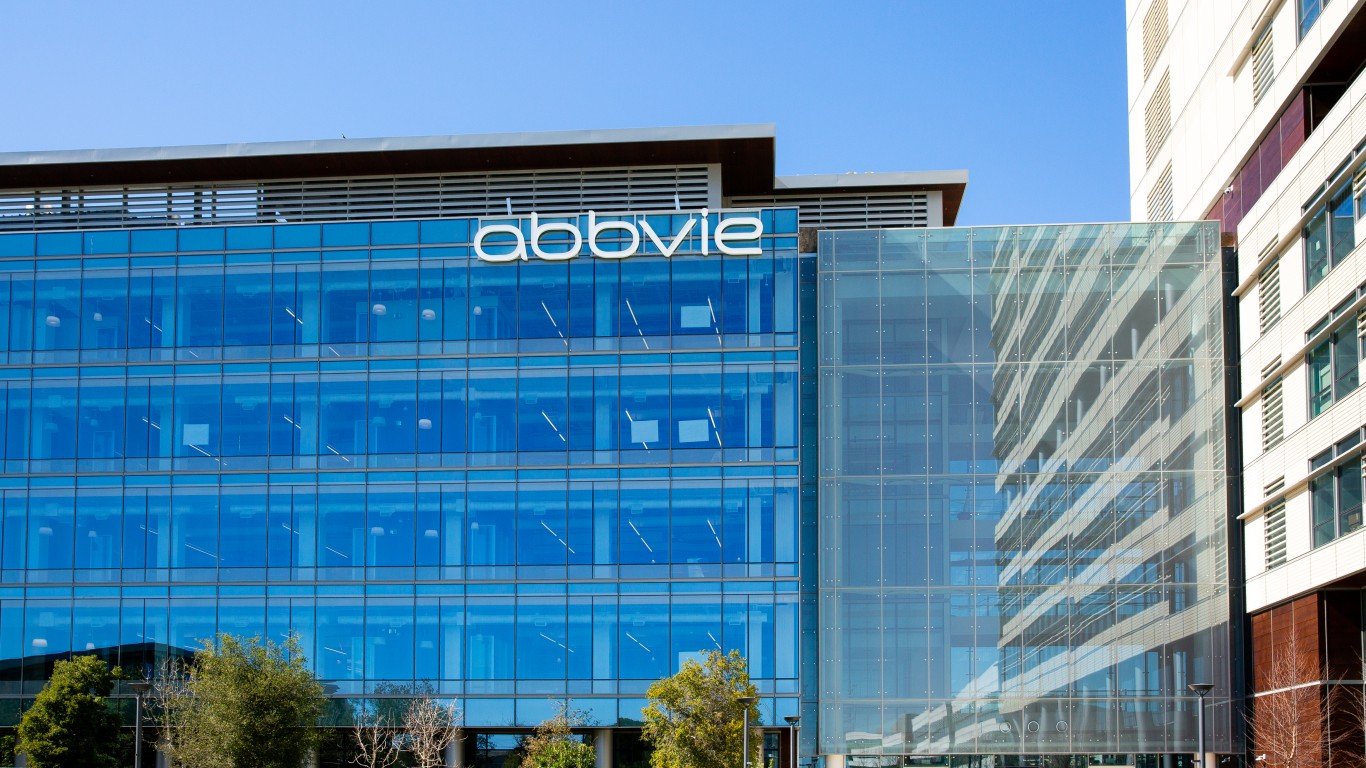
AbbVie sells drugs in immunology, neuroscience, and oncology, plus aesthetics products. Skyrizi and Rinvoq have replaced Humira as its growth drivers. In the third quarter, Skyrizi grew 22.7% to $5.78B, and Rinvoq rose 23.9%, offsetting a 31.2% drop in Humira as cheaper biosimilars took share.
On October 30, 2026, the board raised the quarterly dividend about 5.2%, from $1.73 to $1.82, payable February 16, 2027. The new $7.28 annual rate uses about 52% of the company’s raised adjusted EPS guidance of $13.95 to $13.99. Its spot in the S&P Dividend Aristocrats Index reflects a long record of raising the dividend every year.
Pfizer Supplies the Most Income
- Stock #1: Pfizer (NYSE:PFE)
- Forward Yield: 5.74%
- Shares for $62,500: 2,086.81
- Annual Passive Income: ~$3,589.32
Pfizer sells Eliquis, the Prevnar vaccine, Vyndaqel, and a growing set of cancer drugs. Its yield is the highest of the four because the stock, at $29.95, has lagged as COVID-19 sales faded, while the $0.43 quarterly dividend stayed the same. Paxlovid sales fell 95% on an operational basis in the second quarter.
The $1.72 annual payout uses about 59% of adjusted EPS guidance of $2.80 to $3.00. Second-quarter adjusted EPS of $0.77 beat the $0.68 consensus. The risks are real, though. The dividend has stayed at $0.43 since early 2025; no buybacks are planned for 2026, and competition from generics and biosimilars is expected to cost about $1.1 billion in revenue. The next payment is due December 7, 2026.
Four Healthcare Payers, One Income Total
| Name | Yield | Annual Dividend Income |
|---|---|---|
| UnitedHealth Group | 2.26% | $1,411.50 |
| Merck | 2.32% | $1,452.20 |
| AbbVie | 2.50% | $1,564.70 |
| Pfizer | 5.74% | $3,589.32 |
| Total | 3.21% | $8,017.72 |
Together, these four positions produce $8,017.72 a year in passive income from a $250,000 investment, for a blended yield of 3.21%. Pfizer contributes $3,589.32, AbbVie adds $1,564.70, Merck brings in $1,452.20, and UnitedHealth provides $1,411.50.
Pfizer delivers the most income and also carries the most dividend risk: it has the highest payout ratio of the group and a dividend that hasn’t grown. Merck’s coverage looks thin on paper, but most of the gap comes from one-time deal charges. UnitedHealth and AbbVie have the widest cushions and the most recent raises.
For retirees, part of the appeal is the schedule. Each company pays quarterly, so the checks are spread across the year, and you don’t need to sell shares to get the cash. That is the whole idea behind a dividend ladder, which this article showed how to build in a free guide to income that never touches the principal.
Contact [email protected] for any questions or corrections.
Chris Lange is a financial and geopolitical writer with more than a decade of experience covering a myriad of topics. He has published thousands of articles for 24/7 Wall St., with past coverage focused heavily on stocks, IPOs, healthcare, defense, global affairs, and technology.
His work has been quoted, or referenced by a number of outlets including Business Insider, USA Today, Yahoo Finance, MSN, The Motley Fool, and many other publications. A graduate of Southwestern University, he studied business with a focus on investments and has previous experience in banking and startups.
When not reading or writing the news, he is following his passion for Lacrosse, playing chess, or building solar projects with his dad.