Lockheed Martin Beats General Dynamics on 2 Key Measures. Is It the Better Dividend Stock?
Both defense giants beat earnings estimates and trade at nearly identical valuations, so picking the better retirement dividend stock comes down to three tiebreakers where the two companies split the vote in a surprising way.


Which is the better pick for an investor focused on retirement: Lockheed Martin (NYSE:LMT | LMT Price Prediction) or General Dynamics (NYSE:GD) right now? Both beat third-quarter estimates, and both trade at about 19 times forward earnings, so valuation is a draw. The answer comes down to the dividend check, the backlog, and the balance sheet, with Lockheed ahead on two of the three.


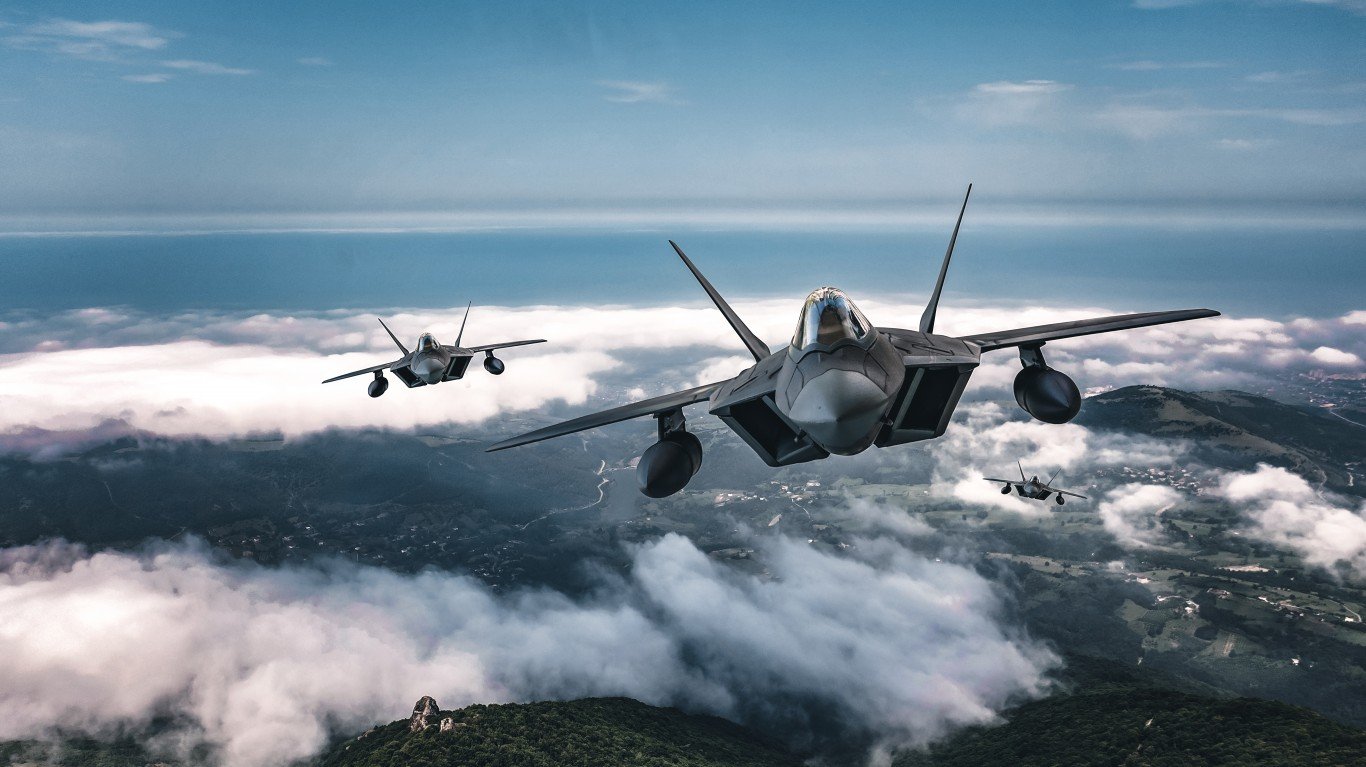
Lockheed makes the F-35 fighter, PAC-3 missile-defense interceptors, Sikorsky helicopters and military satellites. General Dynamics makes Gulfstream business jets, Navy submarines and ships, combat vehicles, and government IT systems. Nearly all of Lockheed’s revenue comes from defense budgets. Gulfstream gives General Dynamics a commercial leg to stand on.
Income: Lockheed Pays More and Has Raised Longer
Lockheed’s board just raised the quarterly dividend by $0.15 to $3.60 per share, its 24th consecutive year of dividend increases. At $641.75, that works out to a forward yield of about 2.24%. General Dynamics pays $1.59 a quarter, or $6.36 annualized, which comes to roughly 1.69% at $375.96.
General Dynamics did raise its dividend faster this year, by 6%, while Lockheed’s increase was 4.3%. Both payouts are well covered. Lockheed pays out about 49% of trailing EPS of $28.16, and it guides to 2026 free cash flow of $7.80 to $8.00 billion. General Dynamics pays out about 38% of earnings. Winner: Lockheed. The bigger check today goes to Lockheed, and it has the longer run behind it.
Growth: Lockheed’s $292 Billion Backlog Sets the Pace
Lockheed ended the quarter with a record $292B backlog. That figure is up $113 billion from a year ago and includes a $52.5B multi-year PAC-3 MSE interceptor award. Revenue rose 11.3%, Missiles and Fire Control grew 24%, and management raised 2026 sales guidance to $80.0 to $82.0B. The CFO said the company projects “clear line of sight to high-single-digit revenue growth next year.” Budget priorities point the same way: the FY2027 request includes $52.9 billion for Critical Munitions.
General Dynamics grew revenue 8.07% to $14.094B on a 1.4x book-to-bill, with backlog at $136.5B. Aerospace grew 15.1%, but Combat Systems grew only 0.3%. Winner: Lockheed. Its backlog is larger.


Risk: General Dynamics Runs the Tighter Ship
Lockheed’s debt of $20.498B is about 2.0 times shareholder equity. General Dynamics carries $9.479B of debt, roughly 0.35 times equity. Lockheed also has a history of charges. It missed first-quarter estimates with EPS of $6.44 vs $6.70, recorded $950M of classified program reach-forward losses in 2025, and F-35 Lot 20 costs now exceed current contractual authorization. On top of that, a pension contribution exceeding $1 billion is due next year.
General Dynamics has posted its 5th consecutive EPS beat, and its operating margin expanded 40 bps to 10.4%. Its stock also moves less with the market, with a beta of 0.329. Business-jet cyclicality is its main exposure. Winner: General Dynamics.


Verdict: Lockheed Martin Earns the Retirement Slot
For a retiree who wants reliable income that keeps growing, Lockheed’s profile lines up more closely with that goal. It offers the higher yield, the 24th straight raise, and a backlog large enough that, in the CFO’s words, “much of next year’s work” is already under contract. The market has noticed: shares are up 35.1% year to date, compared with 13.68% for General Dynamics.
General Dynamics’ profile lines up more closely with a younger saver with a decade or more before retirement, or for anyone who places balance-sheet strength first. That investor takes a smaller check today in exchange for faster dividend growth and much less debt.
One risk could flip this call: a new round of fixed-price charges on the F-35 or classified programs. Charges like that would eat into the free cash flow that pays Lockheed’s dividend. Watch how the Lot 20 contract and next year’s pension funding play out.
Contact [email protected] for any questions or corrections.
Chris Lange is a financial and geopolitical writer with more than a decade of experience covering a myriad of topics. He has published thousands of articles for 24/7 Wall St., with past coverage focused heavily on stocks, IPOs, healthcare, defense, global affairs, and technology.
His work has been quoted, or referenced by a number of outlets including Business Insider, USA Today, Yahoo Finance, MSN, The Motley Fool, and many other publications. A graduate of Southwestern University, he studied business with a focus on investments and has previous experience in banking and startups.
When not reading or writing the news, he is following his passion for Lacrosse, playing chess, or building solar projects with his dad.