5 High-Yield Dividend Stocks Paying Up to 6% With Payouts Built to Last
A fat yield means nothing if the check bounces. Five payers across telecom, tobacco, pharma, real estate and pipelines show how to test coverage, and one of them carries a debt pile that could threaten its raise streak.

This post may contain links from our sponsors and affiliates, and Flywheel Publishing may receive compensation for actions taken through them.
A big yield only matters if the company can keep paying it. The five dividend payers below come from telecom, tobacco, pharma, net-lease real estate and pipelines. Each one supports its payout with measurable coverage, steady cash generation and a long record of raises. At the top of the yield range, Verizon (NYSE:VZ | VZ Price Prediction) pays 6.08% at today’s price. The other four show that putting dividend safety first still leaves plenty of income.
Verizon: Ultra-High Yield With Record Cash Flow Behind It
Verizon is the only ultra-high-yield name in this group. Its forward annual dividend of $2.83 per share works out to a 6.08% yield on the current $46.51 share price.
Dividend safety: Free cash flow was $18 billion in the first nine months of the year, up 14.3%. Dividends over the same stretch reached $8.8 billion, or about 48.9% of free cash flow. Third-quarter free cash flow of $7.8 billion was what management called “our highest quarterly free cash flow since 2020,” and full-year free cash flow growth guidance now approaches 12%. Net unsecured debt to adjusted EBITDA improved to 2.3x. The payout also keeps climbing: the quarterly dividend moved from $0.64 to $0.6525, $0.665, $0.6775, $0.69, and now $0.7075.
Bull case: Verizon added 406,000 postpaid phone customers in the quarter and has signed AI Connect contracts worth roughly $4 billion, with revenue expected to start showing up next year. The CFO said the company remains “committed to growing the dividend and delivering enhanced returns to our shareholders through share repurchases.” For income investors, that means a 6%-plus yield that is still growing.
Risk: The main pressure point is debt. Verizon carries $166.2 billion of debt, and interest expense rose 17.2% year over year. Every extra dollar of interest is a dollar that can’t go toward dividend growth.
Altria: Nearly Six Decades of Raises and Counting
Altria (NYSE:MO) shareholders receive an annualized $4.44 per share, a 5.69% yield at the current $78.01 price.
Dividend safety: Based on 2026 adjusted EPS guidance of $5.66 to $5.74, the dividend uses between 77.4% and 78.4% of earnings. That is high, but it is a measured target for a business with a smokeable adjusted OCI margin of 64.5%. Third-quarter net income of $2.518 billion easily covered $1.7 billion of dividends paid. Years of share buybacks have pushed shareholders’ equity to-$2.225 billion. The track record is hard to match: the CEO noted “our 61st dividend increase in 57 years,” which lifted the quarterly payout from $1.06 to $1.11.
Bull case: Altria still has strong pricing power, and it raised full-year guidance after the quarter. The board added a $1 billion expansion to the buyback, and the company bought back 5.9 million shares for $400 million in the third quarter. A shrinking share count makes each future raise cheaper to fund, and management targets mid-single-digit annual dividend-per-share growth.
Risk: Cigarette demand keeps falling. Industry volume dropped an estimated 5%, and Marlboro’s retail share slid 1.0 point to 39.5% as smokers traded down to discount brands.
AbbVie: Smaller Yield, Fastest-Growing Paycheck
AbbVie (NYSE:ABBV) has the lowest yield in this group: 2.47% on the new annualized rate of $7.28, with shares trading at $294.83. It makes the list because of how fast the payout increases.
Dividend safety: The new annual rate uses roughly 52% of 2026 adjusted EPS guidance of $13.95 to $13.99. AbbVie generated about $14 billion of free cash flow in the first nine months and ended September with $10.8 billion in cash. Management expects to reach a net leverage ratio of 2x over the next 2 to 3 years. The quarterly dividend has gone up every year since the first $0.40 payments, and the latest 5.2% raise takes it to $1.82. The chief executive noted: “Since inception, we have grown our quarterly dividend by more than 350%.”
Bull case: AbbVie has moved past its Humira dependence. Skyrizi brought in nearly $5.8 billion in the quarter, up 22.9% operationally, and Rinvoq added $2.7 billion, up 24.3%. Management lifted the annual immunology outlook to $34.9 billion. For a younger income investor, the payout growth matters as much as today’s yield.
Risk: Drug-pricing pressure is real. Humira sales fell to $683 million, down 30.6% operationally, and the IRA price for Vraylar takes effect next year.
Realty Income: Monthly Checks With Room to Spare
Realty Income (NYSE:O) pays $0.2715 per share every month, an annualized $3.258 that yields 5.50% at the current $59.22 price.
Dividend safety: For a REIT, adjusted funds from operations (AFFO) is the number to check. Third-quarter AFFO came in at $1.12 per share against $0.813 in dividends paid, a payout of about 72.6%. Full-year AFFO guidance moved up to $4.45-$4.46. Rent comes from 15,536 properties leased to 1,842 clients in 96 industries, with occupancy at 98.8%. The REIT has 676 consecutive monthly dividends, 116 consecutive quarterly increases, and membership in the S&P 500 Dividend Aristocrats index.
Bull case: In the quarter, Realty Income committed $2.6 billion at a 6.8% initial cash yield, a spread of about 170 basis points. It confirmed its $10.0 billion investment volume target, and its equity needs are fully prefunded for the rest of the year. Those deals feed the small, regular raises retired people count on.
Risk: Funding costs are rising. Interest expense increased to $333.6 million from $294.5 million, and net debt to EBITDA stands at 5.4x.
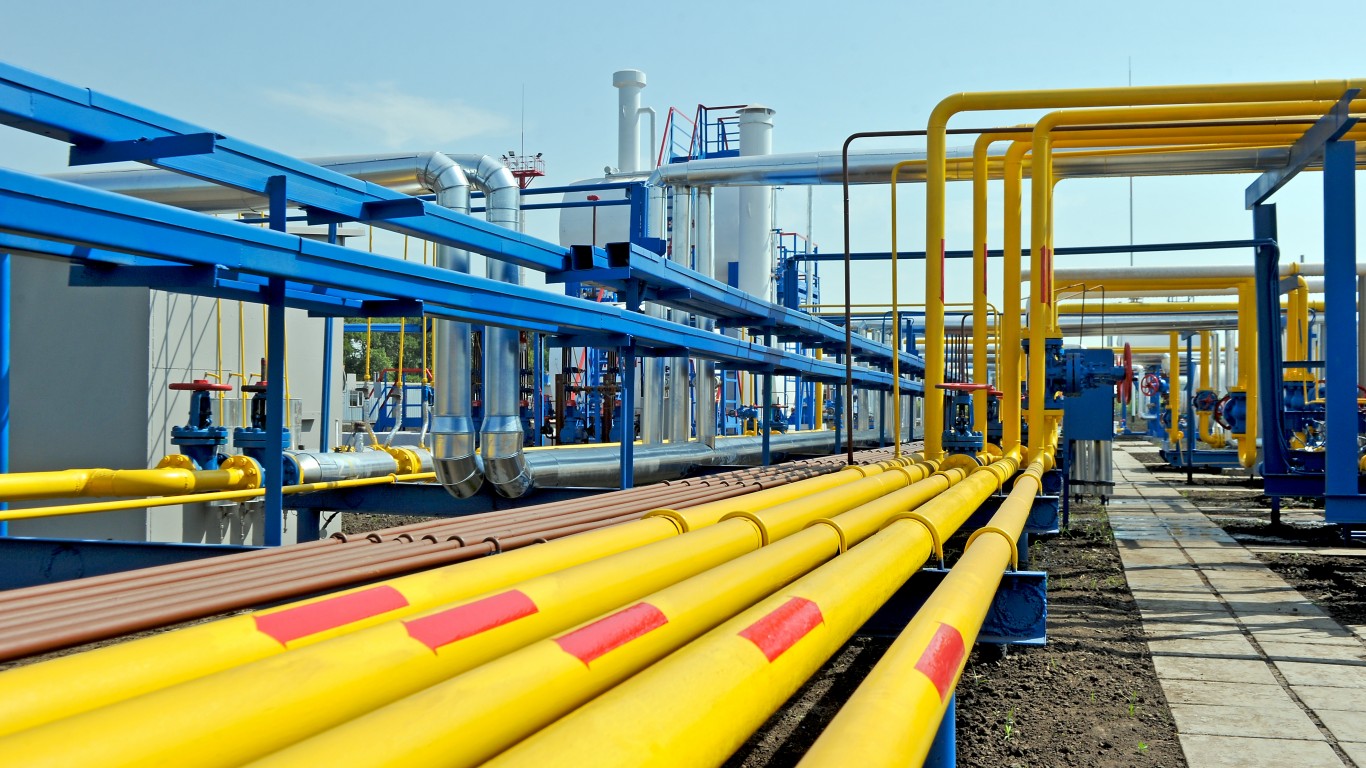
Enbridge: Pipeline Cash Flow With a 31-Year Raise Streak
Enbridge (NYSE:ENB) announces its dividend in Canadian dollars at C$0.97 per quarter, so the U.S.-dollar amount changes with the exchange rate. Its forward annualized U.S. payout of $2.77738 yields 5.69% at the current $48.78 price.
Dividend safety: With second-quarter results, Enbridge confirmed 2026 distributable cash flow (DCF) guidance of C$5.70 to C$6.10 per share. Against the C$3.88 annualized dividend, that is roughly 63.6% to 68.1% of DCF. Second-quarter operating cash flow rose to $4.11 billion, up 26.96%. The CEO pointed to “31 consecutive years of dividend increases,” and the CFO said it continues to “equity self-fund our growth.”
Bull case: A secured backlog of about C$41 billion supports a post-2026 growth outlook of roughly 5% a year for EBITDA, DCF per share, and EPS. Management also expects to return “between $40 billion and $45 billion over the next five years.” Its regulated, utility-like cash flows are what keep a pipeline dividend steady.
Risk: Leverage is extended. Debt to EBITDA ended the second quarter at 5.1x, above the 4.5x to 5x target. Management says the ratio falls within that range once currency effects are stripped out.
Five Income Streams Built on Coverage
Each company keeps its payout comfortably inside its cash generation. Verizon’s dividend uses less than half its free cash flow, Realty Income and Enbridge pay out well under their AFFO and DCF, and AbbVie and Altria back theirs with fat margins and rising guidance. Verizon brings the highest yield, Altria and Realty Income bring decades of raises, AbbVie brings the fastest payout growth, and Enbridge brings 31 years of increases funded by pipelines. Together they offer well-supported high yields; next, watch Enbridge’s third-quarter leverage update and Verizon’s interest costs.
If a quarterly check feels too infrequent, Realty Income isn’t the only option. We rounded up seven stocks and funds that pay every 30 days in a free report.
Contact [email protected] for any questions or corrections.
Chris Lange is a financial and geopolitical writer with more than a decade of experience covering a myriad of topics. He has published thousands of articles for 24/7 Wall St., with past coverage focused heavily on stocks, IPOs, healthcare, defense, global affairs, and technology.
His work has been quoted, or referenced by a number of outlets including Business Insider, USA Today, Yahoo Finance, MSN, The Motley Fool, and many other publications. A graduate of Southwestern University, he studied business with a focus on investments and has previous experience in banking and startups.
When not reading or writing the news, he is following his passion for Lacrosse, playing chess, or building solar projects with his dad.