How to Turn $300,000 Into Passive Income: A 3-Stock Dividend Strategy
A bear market can force retirees to sell shares at the worst possible moment. Three high-yield stocks, from a monthly-paying landlord to a telecom giant and a lender, offer a way to get paid without selling, but one of them…

This post may contain links from our sponsors and affiliates, and Flywheel Publishing may receive compensation for actions taken through them.
Retirement changes what a portfolio has to do. The paycheck that used to arrive every two weeks has to come from somewhere else, and for many retirees Social Security covers only part of it. Selling shares to pay the bills works well enough until a bear market forces those sales at the worst possible prices.
High-yield dividend stocks give retirees another option: cash lands in the account on a schedule and the shares stay put. Below is what a $100,000 stake in three high-yield names would pay out in a year. Across all three, a $300,000 investment returns more than $21,500 of passive income per year at current prices.
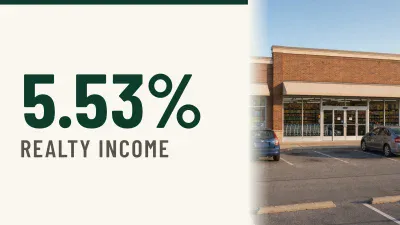
Realty Income
- Stock #3: Realty Income (NYSE:O)
- Forward Yield: 5.53%
- Shares for $100,000: 1,697.8
- Annual Passive Income: ~$5,531.41
Realty Income owns single-tenant net-lease properties, so tenants pay the taxes, insurance and maintenance. It pays its dividend every month, and the latest payment of $0.2715 works out to $3.258 a year. REITs have to distribute 90% of their taxable income, and that rule is why the yield runs this high.
The dividend is well covered on adjusted funds from operations (AFFO), which is the right measure for a REIT. Third-quarter AFFO came in at $1.12 per share, up 3.7% YoY. Management also raised full-year AFFO guidance to $4.45 to $4.46 per share. Occupancy stands at 98.8%, and the September raise was the company’s 116th consecutive quarterly dividend increase. On the upside, Realty Income is moving into data centers, which made up 11.7% of third-quarter new investments, and into Europe. The main risk is rising interest expense alongside larger real estate impairment provisions.
Verizon
- Stock #2: Verizon (NYSE:VZ | VZ Price Prediction)
- Forward Yield: 6.22%
- Shares for $100,000: 2,196.8
- Annual Passive Income: ~$6,217.05
Verizon sells wireless and broadband service across the U.S. A mature network business that needs heavy capital spending has limited room to grow, so it sends cash back to shareholders through an ultra-high-yield dividend of $2.83 per share a year.
Coverage is strong. Full-year adjusted EPS guidance went up to $5.04 to $5.06, and third-quarter free cash flow of $7.8 billion was the highest for any quarter since 2020. Net unsecured debt fell to 2.3x adjusted EBITDA. The CFO said the company is "committed to growing the dividend." The bull case rests on 406,000 postpaid phone net adds in the third quarter and about $4 billion in AI Connect contracts. The clear risk is $166.2B of debt, with interest expense up 17.2% YoY.
Ares Capital
- Stock #1: Ares Capital (NASDAQ:ARCC)
- Forward Yield: 9.92%
- Shares for $100,000: 5,168.0
- Annual Passive Income: ~$9,922.48
Ares Capital is the largest publicly traded business development company. It lends mostly senior secured debt to private middle-market companies. Because it is a regulated investment company, it passes about 90% of its taxable income through to shareholders, which explains the ultra-high yield.
Coverage is tighter here. Third-quarter net investment income came in at $0.46 per share, short of the $0.48 quarterly dividend. Spillover income of $1.37 per share helps fill that gap, and the company has paid stable or rising dividends for 69 consecutive quarters. The CEO said the dividend "appropriately reflects the underlying earnings power of the business." On the bull side, management expects the MidCap Financial acquisition to be slightly accretive to earnings. The risk is credit: non-accruals rose to 2.4% from 1.8%, and NAV dropped to $19.31.
Income Breakdown Across All Three Stocks
| Name | Yield | Annual Dividend Income |
|---|---|---|
| Realty Income | 5.53% | $5,531.41 |
| Verizon | 6.22% | $6,217.05 |
| Ares Capital | 9.92% | $9,922.48 |
| Total | 7.22% | $21,670.94 |
How This Strategy Scales as Capital Grows
Combined, these 3 positions returns $21,670.94 of passive income annual on a $300,000 investment, a blended yield of 7.22%. Ares Capital contributes $9,922.48, Verizon adds $6,217.05, and Realty Income completes the three with $5,531.41.
The same approach works at larger sizes. If the split between the three stays equal, the blended yield stays the same, so income grows in step with each added dollar. The payment calendar also makes the income regular. Realty Income pays monthly, Verizon pays in February, May, August and November, and Ares Capital pays in March, June, September and December. Together, that puts cash in a retiree’s account every month of the year.
Contact [email protected] for any questions or corrections.
Lee Jackson has covered Wall Street analysts' equity and debt research and equity strategy daily for 24/7 Wall St. since 2012. His broad, diverse career, including a stint as creative services director at an NBC affiliate in Austin, Texas, gives him unique insight into the financial industry.
Lee Jackson's journey in the financial industry spans more than 30 years, including nearly two decades as an institutional equity salesperson at Bear Stearns, Lehman Brothers, and Morgan Stanley. His career spanned pivotal sell-side Wall Street events, from the dot-com rise and bubble to the Long-Term Capital Management debacle, 9/11, and the Great Recession of 2008. This reflects his resilience and adaptability amid market volatility.
Lee Jackson’s practical financial industry experience, gained through a career at some of the biggest banks and brokerage firms, is complemented by a lifetime of writing across various platforms. This unique combination allows him to shed light on the intricacies of Wall Street in a way only someone with deep insider experience and knowledge can. Moreover, his extensive network across Wall Street continues to provide direct access for him and 24/7 Wall St., a privilege few firms enjoy.
Since 2012, Jackson’s work for 24/7 Wall St. has been featured in Barron’s, Yahoo Finance, MarketWatch, Business Insider, TradingView, Real Money, The Street, Seeking Alpha, Benzinga, and other media outlets. He attended the prestigious Cranbrook Schools in Bloomfield Hills, Michigan, and has a degree in broadcasting from the Specs Howard School of Media Arts.