4 Dividend Stocks Yielding Over 6% That Fit a Roth IRA

This post may contain links from our sponsors and affiliates, and Flywheel Publishing may receive compensation for actions taken through them.
At the 24% federal bracket, a $500,000 portfolio of four 6%-plus yielders produces about $31,114 a year in dividends and sends roughly $4,995 of it to the IRS if the holdings are not sheltered. For tax year 2026, that 24% rate hits individual taxpayers with income over $105,700 ($211,400 for married couples filing jointly). A Roth IRA lets 26 U.S.C. § 408A(d)(1)[1] exclude qualified distributions from gross income, so the full income stream stays in the account.
Four Stocks Clearing the 6% Floor Today
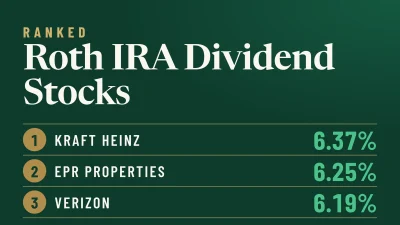
Yields below divide each annualized dividend by the latest share price. The payout from Altria (NYSE:MO | MO Price Prediction) is $4.44 annualized, which works out to 5.77% at $76.91. That falls below the floor, so Kraft Heinz (NASDAQ:KHC) takes its place. The model portfolio puts $125,000 in each stock.
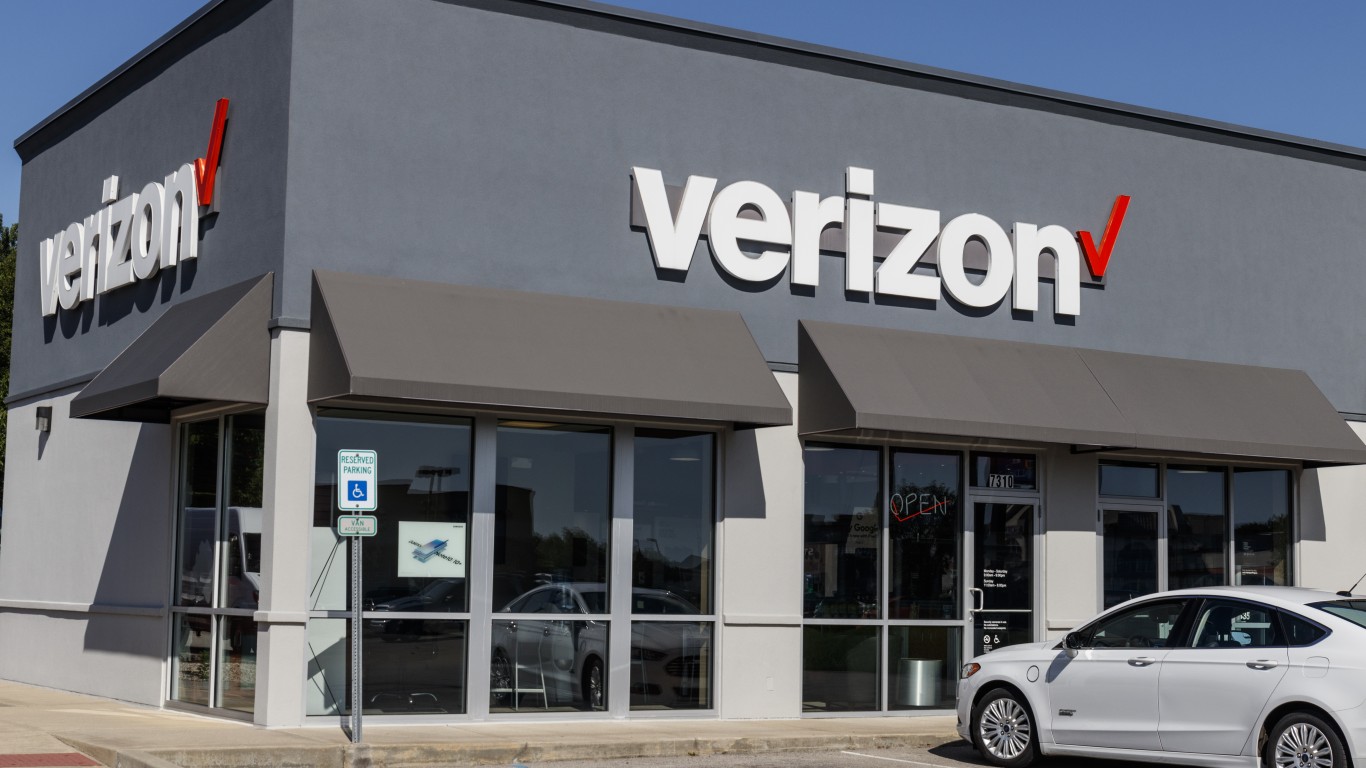
Verizon Communications (NYSE:VZ) yields 6.19% on a $2.83 annualized dividend at $45.74. Its 2026 adjusted EPS guidance of $5.04 to $5.06[2] covers the payout, which rose to $0.7075 quarterly from $0.69. The Roth shields $7,734 of income, saving $1,160 a year at the 15% qualified rate. Risk: up to $4.5 billion[2] in 2026 buybacks competes with the dividend for cash.
The stock, Pfizer (NYSE:PFE), yields 6.08% on $1.72 at $28.30. Adjusted EPS guidance of $2.95 to $3.05[3] covers it, and with no buybacks in 2026, the dividend is the main capital return. Roth savings: $1,140 a year on $7,597. Risk: trailing GAAP EPS of $0.70 stands below the payout, and Pfizer cut its quarterly dividend from $0.32 to $0.16 in 2009.
Kraft Heinz yields 6.37% on $1.60 at $25.11. It raised 2026 adjusted EPS guidance to $2.07 to $2.13, expects free cash flow conversion of about 110%, and has repaid $3,982 million of long-term debt this year. The $0.40 quarterly payout has held since 2019. Roth savings: $1,195 on $7,965. Risk: organic sales are guided down 0.5% to 1.25%.
EPR Properties (NYSE:EPR) yields 6.25% on $3.72 at $59.48, paid monthly. FFOAA guidance of $5.49 to $5.57[4] per share covers it, net debt is at 5.0x adjusted EBITDAre, and the monthly payout has rose from $0.285 to $0.31 since 2024. REIT dividends fall outside the qualified dividend rate and are taxed at ordinary rates, reduced by the 20% deduction in 26 U.S.C. § 199A(b)(1)(B)[5]. At 24%, that leaves a 19.2% effective rate and $1,501 in annual tax, the largest Roth benefit of the four. Risk: theaters make up 34% of rent, and EPR cut its payout after 2020.
Roth Versus Taxable: $500,000 at the 24% Bracket
| Account | Gross Income | Tax | Net Income |
|---|---|---|---|
| Taxable | $31,114 | $4,995 | $26,118 |
| Roth IRA | $31,114 | $0 | $31,114 |
The annual gap is $4,995. Over 10 years, before any growth, it adds up to $49,954.
How the Gap Widens at Higher Brackets
| Bracket | Qualified Rate | EPR Effective Rate | Taxable Net | Roth Advantage |
|---|---|---|---|---|
| 22% | 15% | 17.6% | $26,243 | $4,870 |
| 24% | 15% | 19.2% | $26,118 | $4,995 |
| 32% | 15% | 25.6% | $25,618 | $5,496 |
| 37% | 20% | 29.6% | $24,141 | $6,973 |
Top-bracket taxpayers pay the 20% qualified rate under 26 U.S.C. § 1(h)(1)(D), so the Roth benefit at 37% runs well above the 22% level. EPR drives most of the spread because its rate rises with every bracket.
Compounding Turns $4,995 a Year Into $148,754
If you reinvest the annual tax break at 4%, the 24% bracket gap grows to $59,976 after 10 years and $148,754 after 20. This assumes no price gains. That figure is the long-run cost of holding these four positions without Roth shelter.
Three Moves Before Your Next Filing
- If EPR or another REIT is not in a tax-advantaged account, calculate its 2026 tax cost at your bracket before you file. It is taxed at 17.6% to 29.6%, compared with 15% to 20% for the qualified payers.
- Model a staged Roth conversion that starts with ordinary-income payers, since each dollar of REIT income moved saves more tax than a dollar of Verizon, Pfizer or Kraft Heinz dividends.
- Compare the one-time conversion tax on these positions with the $4,870 to $6,973 annual gap at your bracket.
Contact [email protected] for any questions or corrections.
Lee Jackson has covered Wall Street analysts' equity and debt research and equity strategy daily for 24/7 Wall St. since 2012. His broad, diverse career, including a stint as creative services director at an NBC affiliate in Austin, Texas, gives him unique insight into the financial industry.
Lee Jackson's journey in the financial industry spans more than 30 years, including nearly two decades as an institutional equity salesperson at Bear Stearns, Lehman Brothers, and Morgan Stanley. His career spanned pivotal sell-side Wall Street events, from the dot-com rise and bubble to the Long-Term Capital Management debacle, 9/11, and the Great Recession of 2008. This reflects his resilience and adaptability amid market volatility.
Lee Jackson’s practical financial industry experience, gained through a career at some of the biggest banks and brokerage firms, is complemented by a lifetime of writing across various platforms. This unique combination allows him to shed light on the intricacies of Wall Street in a way only someone with deep insider experience and knowledge can. Moreover, his extensive network across Wall Street continues to provide direct access for him and 24/7 Wall St., a privilege few firms enjoy.
Since 2012, Jackson’s work for 24/7 Wall St. has been featured in Barron’s, Yahoo Finance, MarketWatch, Business Insider, TradingView, Real Money, The Street, Seeking Alpha, Benzinga, and other media outlets. He attended the prestigious Cranbrook Schools in Bloomfield Hills, Michigan, and has a degree in broadcasting from the Specs Howard School of Media Arts.