3 Defense Dividend Stocks to Buy in December With Billions in Backlogged Orders

This post may contain links from our sponsors and affiliates, and Flywheel Publishing may receive compensation for actions taken through them.
Defense contractors suit income investors who care more about steady raises than big headline yields, and the order books behind these three make that case. Lockheed Martin (NYSE:LMT | LMT Price Prediction), General Dynamics (NYSE:GD) and Northrop Grumman (NYSE:NOC) all report record or near-record backlogs. Lockheed’s alone reached $292 billion[1] after a multi-year Patriot interceptor award. All three carry modest yields. Forward yields run from about 1.82% to 2.39%. What they share is years of government-funded work already under contract, conservative payout ratios, and a long record of raising the dividend every year.
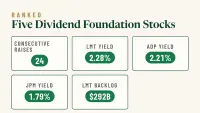
Lockheed Martin: 24 Straight Raises Backed by a $292 Billion Order Book
Yield: Lockheed pays $3.45 a quarter, or $13.80 a year. At $578.51 a share, that works out to about 2.39%, the highest of the three.
Dividend safety: The annual dividend uses about 49% of trailing EPS of $28.16. Management expects 2026 EPS of $30.35 to $30.75[1], so that ratio should come down. Cash flow is the stronger safety signal. Lockheed raised its 2026 free cash flow forecast to $7.8 billion to $8.0 billion[1]. At the current rate, the dividend would use about 41% of the bottom of that range. Third-quarter free cash flow was $2.999 billion[1], and the company held $5.96 billion in cash. In the third-quarter results, the CEO said the company was “allowing us to raise our dividend for the 24th year in a row.” The payment history backs that up, with the quarterly rate rising every year from $0.11 in 2002 to $3.45 in 2026. The last raise shown in the record took the quarterly payment from $3.30 to $3.45. With the ex-dividend date set for December 1, 2026, the yield above, based on the old rate, slightly understates what new buyers will collect.
Bull case: Lockheed builds the F-35 fighter, PAC-3 and THAAD interceptors, Sikorsky helicopters, and satellites. Almost all of that work is paid for by the U.S. government and allied militaries. Demand for missile defense is rising: Missiles and Fire Control sales rose 24%[1] to $4.501 billion, and the company raised its full-year guidance for the second consecutive quarter. The stock trades at about 18x forward earnings, based on a forward P/E of 18. The average analyst price target is $660.86.
Risk: Costs on F-35 Lot 20 have started to exceed what the current contract permits. Those costs could hit future results[1] unless the U.S. government provides more funding.

General Dynamics: Gulfstream Growth Adds a Second Engine
Yield: General Dynamics raised its quarterly payout to $1.59, or $6.36 a year. At $348.01, the forward yield is about 1.83%.
Dividend safety: The forward dividend uses about 38% of trailing EPS of $16.68. Cash flow covers it easily. In the quarter reported July 29, free cash flow was $1.646 billion[2], and one quarter’s dividend at the new rate equals only about 26% of that. Operating cash flow came to 162% of net earnings[2]. At the end of the first quarter, net debt had dropped to $4.36 billion[3] from $5.68 billion. The latest increase lifted the quarterly payment from $1.50 to $1.59, declared on March 4, 2026. Over the long run, the payout has risen from $0.22 per share in 1999 with no cuts along the way.
Bull case: General Dynamics builds Virginia- and Columbia-class submarines, Abrams tanks, and IT systems for the government. It also owns Gulfstream, which gives it a commercial business that runs on a different cycle from defense budgets. Aerospace revenue grew 15.1%[2], and the segment’s margin widened to 14.5% from 13.2%. Gulfstream delivered 41 aircraft[2]. Across the company, the book-to-bill ratio was 1.4x[2], meaning new orders outpaced sales. Backlog stood at $136.5 billion[2].
Risk: Combat Systems revenue grew just 0.3%[2]. In addition, $50.4 billion[2] of the company’s estimated contract value is potential work under open-ended (IDIQ) contracts that may never turn into firm orders.

Northrop Grumman: Lowest Payout Ratio and a Decade of Raises
Yield: Northrop pays $2.47 a quarter, or $9.88 a year. At $543.54, the yield is about 1.82%.
Dividend safety: Northrop has the most room to keep raising. The dividend uses about 31% of trailing EPS. Measured against the bottom of 2026 EPS guidance, which management raised to $29.35 to $29.75[4], it uses about 34%. The dividend would take about 45% of the bottom of the adjusted free cash flow guidance of $3.1 billion to $3.5 billion[4]. Cash rose to $3.744 billion[4]. The May raise lifted the quarterly payment from $2.31 to $2.47. The payment history shows 10 consecutive years of annual dividend growth through 2026.
Bull case: Northrop builds the B-21 stealth bomber, the Sentinel intercontinental ballistic missile, major sections of the F-35 and space systems. The government funds most of it. Backlog reached a record $109.6 billion[4] on $16.4 billion of net third-quarter awards. Aeronautics Systems sales rose 14%[4]. Even so, the stock is down 3.5% year to date and well below its 52-week high of $767.12. That leaves it at about 18x forward earnings, based on a forward P/E of 18.
Risk: Fixed-price development work keeps costing Northrop money. Unfavorable estimate adjustments of $68 million[5] on SiAW and $91 million on GEM 63XL show the exposure. Third-quarter EPS also got help from a lower tax rate, 13.4% versus 16.9%[4], which makes the underlying operating gains look smaller.

Lockheed Martin Has the Strongest Dividend Case
All three companies have years of contracted government work behind their payouts, and each raised its dividend in 2026. Lockheed Martin has the strongest overall dividend case: the highest yield of the group, a 24-year raise run confirmed by management and by its payment history, and a dividend that uses well under half of forecast free cash flow. Northrop has the most room for future dividend growth given its low payout ratio, and General Dynamics brings the most diversification through Gulfstream. Watch Lockheed’s F-35 Lot 20 funding and its December 1 ex-dividend date, which will show the new payout rate.
Contact [email protected] for any questions or corrections.
Chris Lange is a financial and geopolitical writer with more than a decade of experience covering a myriad of topics. He has published thousands of articles for 24/7 Wall St., with past coverage focused heavily on stocks, IPOs, healthcare, defense, global affairs, and technology.
His work has been quoted, or referenced by a number of outlets including Business Insider, USA Today, Yahoo Finance, MSN, The Motley Fool, and many other publications. A graduate of Southwestern University, he studied business with a focus on investments and has previous experience in banking and startups.
When not reading or writing the news, he is following his passion for Lacrosse, playing chess, or building solar projects with his dad.