Medical Properties Trust Yields 22%, but Its Stock Has Crashed 65%

This post may contain links from our sponsors and affiliates, and Flywheel Publishing may receive compensation for actions taken through them.
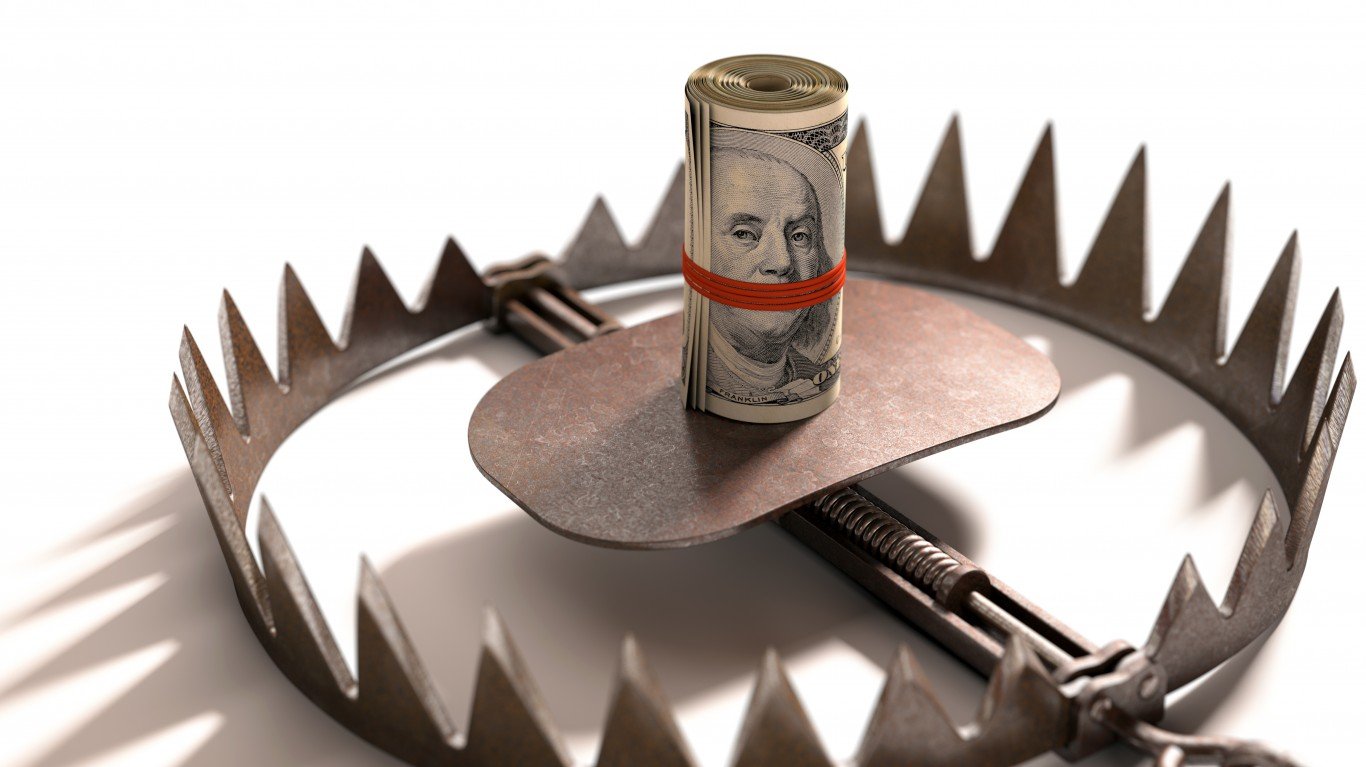
Dividend yield is the annual payout divided by the stock price. A falling stock price lifts the yield even if the business dropped, and the market is often pricing in a cut before management announces one. Medical Properties Trust (NYSE:MPT) shows how far that can go. Its $0.36 annualized dividend now works out to a yield of roughly 22%, because the stock fell 64.78% over the past year.
Quick test: a dividend is at risk when the right earnings measure stops covering it, free cash flow falls short of the payout, or rising debt starts filling the gap.
Medical Properties Trust (MPT): A 22% Yield Riding a Collapsing Stock
Shares of the hospital landlord trade at $1.64. That is down 40.15% in the past month and 88.27% over five years. The quarterly payout has sat at $0.09 since late 2025, so nearly all of that eye-popping yield comes from the stock’s decline.
For a REIT, judge coverage with normalized funds from operations (NFFO), since GAAP earnings get distorted by depreciation and one-time gains. Third-quarter GAAP net income of $202.1 million[1] included a $158 million gain on asset sales. Adjusted NFFO was $0.11 per share[1], which means the dividend used about 82% of it. Tenant HSA missed September rent, which reduced NFFO by 2 cents. Normalized FFO fell to $63.8 million from $77.2 million[1]. Leverage stands at 8.7x[1] adjusted net debt to EBITDAre. Interest coverage was just 1.9x[2], and the company’s new $2.4 billion of secured notes carry a 9.25% coupon, well above its 5.369% weighted average rate.
The payout has already been cut once, then cut again. The quarterly payout went from $0.29 to $0.15 in 2023, then to $0.08 in 2024. For today’s payout to hold, management’s forecast of portfolio cash rents above $1.0 billion in 2027[1] has to come true.
Pfizer (PFE): A Frozen Dividend Carried Through Heavy Stress
Investors in Pfizer (NYSE:PFE | PFE Price Prediction) collect $1.72 a year, a yield of about 6.2% at $27.53. The stock is down 28.92% over five years, even after an 18.1% rebound over the past year. The quarterly dividend has stayed at $0.43 since early 2025.
Trailing GAAP EPS of $0.70 puts the payout near 246% of reported earnings. Impairments drove much of that, including a $3.8 billion charge on sigvotatug vedotin. Against adjusted EPS guidance of $2.95 to $3.05[3], the payout looks manageable at roughly 56% to 58%. Cash is the harder test.
In 2025, operating cash flow minus capex left $9.08 billion, short of $9.77 billion in dividends. Through nine months of 2026, free cash flow of about $7.28 billion again fell short of the $7.35 billion paid out. Pfizer lists “high leverage requiring continued de-levering”[3] as a risk and is skipping buybacks this year.
The CFO says operating cash flow, financial assets and “access to capital markets will give us the ability to continue to invest and maintain the dividend”[4] through patent losses on Ibrance, Xtandi and Eliquis. Planning to tap capital markets to help support a dividend is a yellow flag. Watch 2027 guidance, due in mid-December[4].
Walgreens Boots Alliance (WBA): How a Yield Trap Ends
Walgreens Boots Alliance (NASDAQ:WBA) is a warning from recent history. The stock lost 60.59% over five years. In January 2024, the quarterly dividend was cut from $0.48 to $0.25. Free cash flow later hit negative $418 million in one quarter, and opioid settlements cost $1.4 billion in nine months. Sycamore Partners then took the company private. The high yield flagged the trouble long before the cut.
Walgreens is the textbook version of the setup, and the warning signs showed up well before the cut. We listed the seven that consistently flag a dividend about to be slashed in a free report: Dividend Traps.
Verizon Communications (VZ): Solid Coverage, Heavy Debt
Verizon Communications (NYSE:VZ) yields about 6.2% on a $2.83 annualized payout. An 18.61% one-year gain has already reduced that yield. Coverage is sound: dividends took roughly 49% of nine-month free cash flow of $18 billion.
The pressure point is the balance sheet. Total debt is $166.2 billion[5], interest expense rose 17.2%, and cash fell 41.7% to $4.50 billion. Verizon also spent $4 billion on buybacks this year. Buyers at this yield are taking on leverage risk along with the cash flow.
Franklin Templeton (BEN): Proof That a Price-Driven Yield Can Recover
Franklin Templeton (NYSE:BEN) shows what happens when the blow proves temporary. Shares rose 62.76% in a year, pushing the yield down to about 4.0%. The payout uses roughly 67% of trailing EPS, and long-term net inflows reached $18.4 billion[6]. Some risks remain: Western Asset lost $1.1 billion[6] to outflows, the company booked a $100 million regulatory settlement, and the stock fell 7.22% last week.
What Retirees Should Check Before Buying a Yield That Rose Because the Price Fell
A dividend cut usually pulls the stock down, so a big yield can lead to a double loss. Before buying, check whether the price fell or the payout grew. Use the right coverage measure (FFO for REITs, free cash flow for everyone), look at the debt trend, and review the dividend history for past cuts. A high yield alone should not be your reason to buy.
Contact [email protected] for any questions or corrections.
Chris Lange is a financial and geopolitical writer with more than a decade of experience covering a myriad of topics. He has published thousands of articles for 24/7 Wall St., with past coverage focused heavily on stocks, IPOs, healthcare, defense, global affairs, and technology.
His work has been quoted, or referenced by a number of outlets including Business Insider, USA Today, Yahoo Finance, MSN, The Motley Fool, and many other publications. A graduate of Southwestern University, he studied business with a focus on investments and has previous experience in banking and startups.
When not reading or writing the news, he is following his passion for Lacrosse, playing chess, or building solar projects with his dad.