Suze Orman Says to Leave Home Equity Out of Your Net Worth. For the Typical Household 65 to 74, $431,900 Drops to $140,300

This post may contain links from our sponsors and affiliates, and Flywheel Publishing may receive compensation for actions taken through them.

Suze Orman asks people to run a test most of us skip. “I ask you to look at what your net worth is without the equity in your home,” she told listeners of her “Women & Money” podcast in 2023. Her reason: “You are going to live in that house, hopefully for the rest of your life.”
Picture a 72-year-old widow who did everything right. The mortgage is nearly gone, the roof is new and moving isn’t in the plan. If her finances sit right at the midpoint for people her age, her net worth is $431,900. Run Orman’s test and it drops to $140,300. The house accounts for the $291,600 difference, or 68% of everything she owns.
That smaller number pays for groceries, the property tax bill and the next car. If you own your home and plan to stay, it’s the one to know for yourself too.
The figures come from the Federal Reserve’s 2025 Survey of Consumer Finances and from 24/7 Wall St.’s new research report “The State of the American Household.” The Fed publishes the median net worth with the house counted. The medians without home equity are a 24/7 Wall St. calculation from the Fed’s public data.
How to run Orman’s test on your own balance sheet
You need four numbers and a pen.
1. Your net worth. Add up everything you own: your home at what it would sell for, bank and brokerage accounts, retirement accounts, cars, any business or other property. Subtract everything you owe.
2. What your home would sell for. A recent appraisal or the sale price of a similar place on your street works.
3. What you owe against it. The mortgage balance plus any home equity loan or line of credit.
4. Your equity. Subtract line 3 from line 2. Then take that equity out of your net worth from line 1.
What’s left is your net worth without the house. It still counts your car and anything else you own, so some of it would be slow to turn into cash.
Where you stand without the house, by age
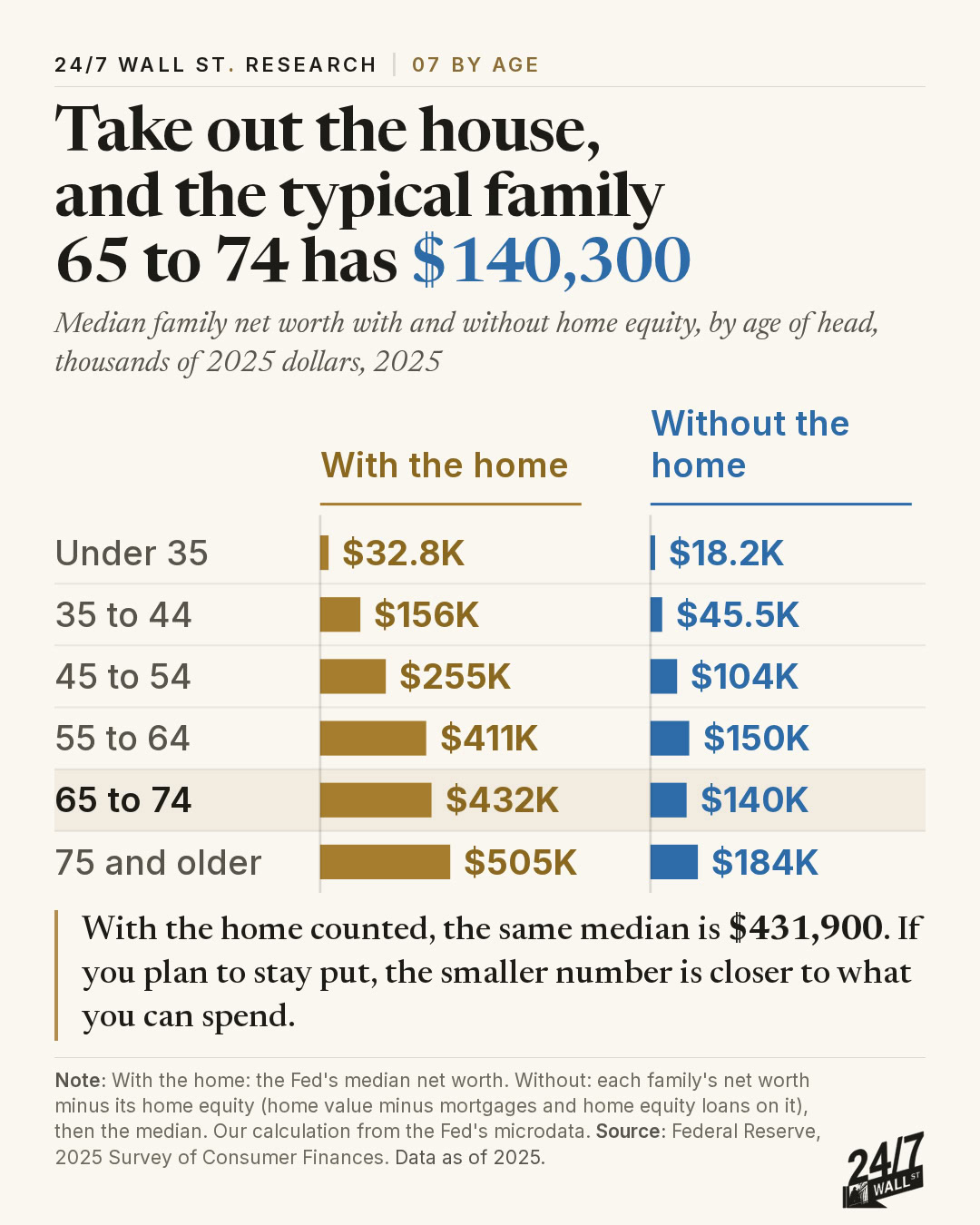
Each figure below is a midpoint: half of households headed by someone that age have more, and half have less.
If you’re under 35, it’s $18,200 without the house and $32,800 with it. The two numbers sit closest together here: the gap between them is 45% of the larger one, the smallest share on the list.
If you’re 35 to 44, it’s $45,500 without the house against $156,000 with it. No decade is more tied up in its home: the with-home figure is 3.4 times the other one, and the gap is 71% of it.
If you’re 45 to 54, you’re at $103,500 without the house, against $254,700 with it. The without-home number more than doubles from the decade before.
If you’re 55 to 64, it’s $150,400 without the house and $411,300 with it. No working-age decade has more outside the house.
If you’re 65 to 74, you’re at $140,300 without the house and $431,900 with it. The without-home figure is $10,100 lower than in the decade before, as people start living on what they saved. The gap between the two numbers is 68% of the larger one.
If you’re 75 or older, it’s $184,000 without the house and $504,600 with it, the highest on both counts.
Read down the without-home figures and they climb until 64, dip in the first decade of retirement, then rise again after 75. The with-home figures rise at every step.
Three moves if you’re staying put
My read of these numbers: if you plan to live in your home for good, the without-home number is the one your retirement income comes from. Equity can’t pay the electric bill unless you sell, borrow against it, or move.
For the widow, and for anyone in her spot, that leads to three moves.
Budget from the smaller number. Plan spending from the $140,300 plus Social Security, and treat the property as a place to live. Even the full $140,300 at a 4% yearly withdrawal would pay about $468 a month, and that assumes the car could be turned into cash too.
Fund the repairs first. When most of your wealth is a building, most of your big bills come from it. A furnace or a roof comes out of the smaller pile, so set part of it aside for upkeep.
Keep the equity as a reserve. It’s real wealth, and it stays put. It covers a move to a smaller place or care later on, and it’s an estate after that. Spending against it now leaves you short at the moment you need it most.
When 24/7 Wall St. wrote about Kevin O’Leary’s $5 million bar on Nov. 21, the couple in that story counted only bank and investment accounts outside the home. The measure here is broader: it keeps cars, businesses and other property, which is why the 65-to-74 figure comes out higher.
Run both of your numbers tonight. If your home is more than two-thirds of your net worth, you’re in the same spot as the typical household 65 to 74, and the smaller number decides how you live. Orman’s test gives you the budget you actually have.
We follow the retirement rules that matter every weekday in The Daily Profit, our free email. Sign up and get our Top 10 stocks report too.
Contact [email protected] for any questions or corrections.
I've spent more than 15 years inside enterprise software, working alongside the finance, sales operations, and HR leaders who run the revenue engines at some of the largest tech companies in the country.
My day job is helping enterprise executives make smarter decisions about retention, compensation, and growth. These are the same operational levers that show up in every earnings report investors actually read. That perspective shapes my writing for 24/7 Wall St.
The headline numbers are easy. The interesting stuff is underneath: how companies make money, what executives are worried about, and what any of it means for the person checking their 401(k) on a Sunday afternoon. I write about personal finance and business as someone who has spent her career inside the rooms where these decisions get made.