3 Cryptos Under $1 to Buy and Hold for the Next 10 Years

This post may contain links from our sponsors and affiliates, and Flywheel Publishing may receive compensation for actions taken through them.
Five of the biggest cryptos under $1, led by XRP (CRYPTO:XRP), are significantly below their previous highs. While a low price may seem appealing, a coin can stay cheap for years. Therefore, long-term investors need to consider more than a falling chart.
Selling pressure has been intense. All five coins have dropped more than 26% in the past month, with four losing over half their value in the past year.
So which three coins have the history, practicality, careful supply management, and investment access to justify holding for the next decade?
Five Big Cryptos Under $1 Trade Deep Below Their All-Time Highs
The five are XRP, Dogecoin (CRYPTO:DOGE), Cardano (CRYPTO:ADA), Stellar (CRYPTO:XLM), and Hedera (CRYPTO:HBAR). Here’s how these coins stood today, November 27, 2026.
| Coin | Price | Market Cap | Below All-Time High | Circulating Supply | Max Supply |
|---|---|---|---|---|---|
| XRP | $0.94 | $59.9 billion | 74.1% | 63.5 billion | 100 billion |
| Dogecoin | $0.057 | $8.9 billion | 92.2% | 156.9 billion | None listed |
| Cardano | $0.15 | $5.5 billion | 95.2% | 37.6 billion | 45 billion |
| Stellar | $0.13 | $4.5 billion | 85.7% | 35.5 billion | None listed |
| Hedera | $0.054 | $2.4 billion | 90.6% | 44.3 billion | 50 billion |
XRP has remained the most resilient, while Cardano has taken the hardest hit. XRP’s dip below $1 is also fresh, as it traded at $1.84 at the end of 2025 and was still at $1.32 on October 28. Since then, it has declined by 28.6%.
XRP Has a Ledger Running Since 2012 and Over $1.7 Billion in ETF Money
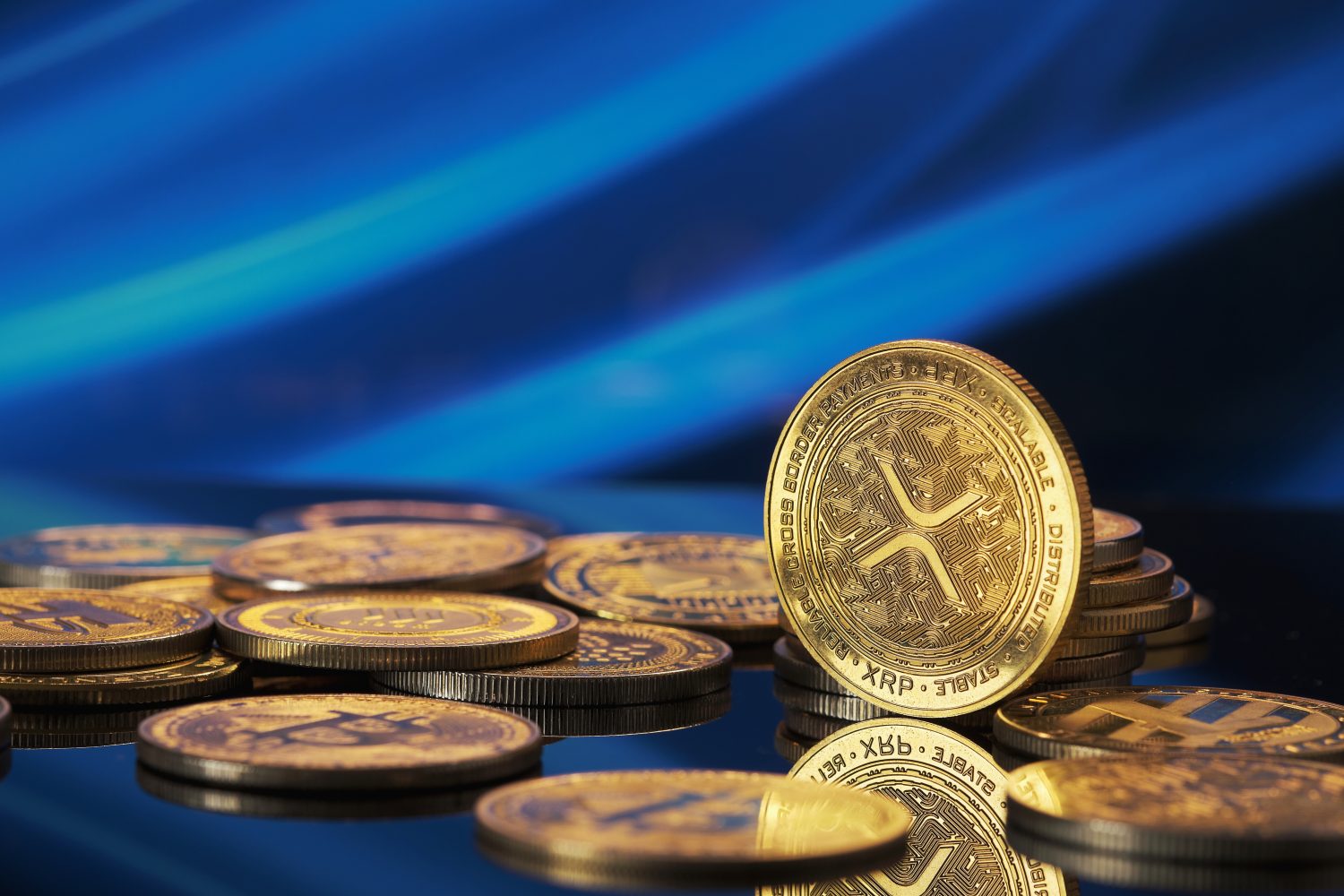
The XRP Ledger, a public blockchain designed for quick payment settlements, has been active since 2012. XRP has risen about 13,853% since trading near $0.0068 on November 29, 2016.
XRP’s biggest advantage is access through U.S. exchange-traded funds (ETFs). These funds, which let investors hold XRP in their brokerage accounts, have attracted over $1.7 billion in cumulative net inflows and boasted $1.04 billion in net assets as of November 25, according to SoSoValue data. However, these ETFs saw a noticeable outflow of $10.4 million on November 9, suggesting a possible slowdown in investment.
XRP’s catch lies in its supply structure. Only 63.5 billion coins from a maximum supply of 100 billion are in circulation, so XRP’s fully diluted valuation, its value if every coin circulated, is about $94.3 billion. This suggests that for XRP to reclaim the $1 mark, it may require significantly more investment than in previous cycles, as our look at XRP’s next 10 years explains.
Stellar Has a Wall Street Fund, and Hedera Has Little Supply Left to Issue
Stellar operates as a payment network supported by the Stellar Development Foundation, a nonprofit established in 2014. A major milestone for Stellar was the launch of the OnChain U.S. Government Money Fund by Franklin Templeton (NYSE:BEN | BEN Price Prediction) in April 2021, making the fund the first U.S.-registered money market fund on a public blockchain. Users of this fund pay transaction fees in Stellar.
Despite a five-year loss of 60.8%, Stellar has held up second-best in this list after XRP. However, with a circulating supply of 35.5 billion coins out of a total supply of 50 billion, dilution could still affect holders.
Hedera operates as a public network governed by a council comprising prominent global organizations. HBAR has traded since at least September 17, 2019. With 44.3 billion out of a maximum supply of 50 billion coins already in circulation, its market cap reflects 89% of its fully diluted valuation, a much higher proportion than XRP’s 64%, so far less new supply lies ahead.
However, Hedera’s ETFs have faced challenges. SoSoValue data shows that U.S. spot HBAR ETFs hold about $115.4 million in cumulative net inflows, but their net assets plummeted by 30% from approximately $60.4 million on October 28 to around $42.3 million by November 25. HBAR has also fallen 83.7% over the past five years.
Dogecoin and Cardano Miss Because of Supply and Drawdown
Dogecoin’s lack of a capped supply is a significant drawback. With 156.9 billion coins now in circulation and new coins continuously produced, demand must grow each year only to maintain its current price. Dogecoin is trading 92.2% below its all-time high of $0.73, reached in May 2021. We ran the same ten-year test on Shiba Inu, another meme coin.
Cardano, while it has a capped supply, has shown the weakest performance over the past five years. It has dropped 90.6% from about $1.60 to its current price of about $0.15, trading 95.2% below its all-time high—the largest drop of the five.
We took a closer look at the cheapest coins when we asked which crypto under 50 cents looks best positioned to reach $1 and which crypto under $1 has the best path to $1 by 2030.
Which Cryptos Under $1 Are Best to Hold for 10 Years?
We’ve ranked our top three picks as XRP, Stellar, and Hedera. XRP takes the top spot due to its long-standing presence in the market, strong demand from funds, and the smallest drop from its all-time high, though unissued XRP could weigh on its price for years. Stellar is second because a major asset manager has used its network consistently for five years, the steady use long-term investors want.
Hedera comes third, mainly due to its limited supply, but its weak price history and shrinking ETF assets make it the riskiest option. For XRP, a positive sign could be a rise above $1.32, 40% higher, alongside cumulative ETF inflows surpassing about $1.81 billion, its October 29 level. If Hedera’s ETF net assets fail to climb back above $60 million, it may not be worth keeping on our list.
Contact [email protected] for any questions or corrections.
Sam Daodu is a crypto analyst and the editor of 24/7 Wall St.'s Crypto Desk, where he covers Bitcoin, XRP, Ethereum, Solana and the altcoins investors search for most. His work focuses on price levels, spot ETF flows, on-chain data and the regulatory decisions that move crypto markets, written so a first-time buyer and a seasoned trader can both use it.
Sam has written about crypto professionally since 2019 and has published more than 2,000 articles. Before joining 24/7 Wall St., he wrote for crypto media outlets and Web3 companies and ghostwrote for crypto founders and token launches. His analysis is syndicated on Yahoo Finance, MSN and AOL and has been cited by other crypto news sites. He also founded MacLabs Marketing, a content and personal branding agency for crypto founders and executives.
When he isn't reading charts, Sam is usually at the gym or watching One Piece, a series he maintains has better tokenomics than most altcoins.