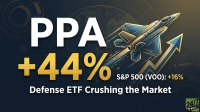
PPA Is a One-Ticker Bet on Rising Defense Spending. Nearly 30% of Holdings Are in Just Four Stocks
Defense budgets are soaring on both sides of the Atlantic, and one ETF promises to capture the entire boom in a single trade. But a closer look at what you actually own when you buy it reveals a far more…

This post may contain links from our sponsors and affiliates, and Flywheel Publishing may receive compensation for actions taken through them.

Defense stocks have moved from a niche corner of the market to one of its clearest long-term investment themes. The United States is spending heavily on new weapons, aircraft, missile defense, and military technology, while NATO members have committed to dramatically increasing defense investment over the next decade. Investors who want exposure without trying to pick individual contractors can get much of the industry in a single trade through the Invesco Aerospace & Defense ETF (NYSEARCA:PPA).
PPA owns 63 stocks involved in aerospace, defense, homeland security, and related technologies. At face value, that sounds diversified. However, the portfolio is more concentrated than the number suggests. Top four holdings — including RTX, GE Aerospace, Boeing, and Lockheed Martin — account for roughly 30% of the fund.
Thesis: Defense Spending Has a Long Runway
The general thesis for PPA starts with government spending. Defense contractors operate differently from most companies because their biggest customer is generally the government, and major purchase programs tend to stretch across decades.
That spending backdrop remains a key driver. The 2025 reconciliation legislation provided the Department of Defense with approximately $156 billion in additional mandatory defense funding available through September 2029. Meanwhile, the Pentagon’s fiscal 2026 plans included approximately $384 billion for acquisition spending, which covers procurement, research, and development.
Furthermore, the trend is not only limited to the United States. NATO members agreed in 2025 to work toward spending 5% of GDP annually on defense and defense-related priorities by 2035. At least 3.5% is intended for core military requirements. European NATO members and Canada had already increased combined defense expenditures by nearly 20% in real terms during 2025.
For defense contractors, like those held by PPD, that potentially means years of orders for aircraft, missiles, ammunition, ships, drones, communications equipment, and other weapons/ defense systems.
Four Stocks Drive Nearly 30% of PPA
PPA spreads investors’ money across dozens of companies, but the largest positions do most of the heavy lifting.
As of September 18, 2026, RTX represented approximately 8.35% of the portfolio, followed by GE Aerospace at 6.91%, Boeing at 6.88%, and Lockheed Martin at 6.66%. Top four positions account for approximately 28.80% of the fund (where the ~30% headline number comes from). General Dynamics and Northrop Grumman add another 9.94%.
That means a hypothetical $100,000 PPA investment puts about $28,800 into the four largest holdings and nearly $38,740 into the top six.
The exposure is not identical across those companies. Lockheed Martin is heavily tied to military programs such as the F-35, while RTX combines major defense operations with commercial aerospace businesses. Boeing similarly brings both defense and commercial aviation exposure, while GE Aerospace is primarily an aircraft-engine business rather than a pure defense contractor. While fund holdings are concentrated in top-names, the actual businesses do provide some diversification.
That mix makes PPA broader than simply buying a basket of weapons manufacturers. Roughly 87% of the portfolio currently falls within industrials, with another 8% in information technology. Smaller positions include newer defense and aerospace names such as Palantir and Rocket Lab alongside established contractors.
The Price of a One-Ticker Defense Portfolio
Like any broad industry ETF, convenience comes with a cost. PPA charges an expense ratio of 0.58%, equivalent to approximately $580 annually on a $100,000 investment. The fund has about $8 billion in assets under management ($7.62 billion) and dates back to 2005, making it a well-established way to invest in the theme.
That said, investors should also recognize that rising government spending does not automatically translate into rising share prices. Defense programs can be delayed or canceled, contractors can experience cost overruns, and valuations still matter. Commercial aerospace exposure introduces another set of risks for companies such as Boeing and GE Aerospace. Boeing has returned -5.39% over the last 5 years.
Recent performance illustrates that distinction. PPA closed September 18 at $159.78, well below its 52-week high above $186. After strong multiyear performance, the fund had fallen roughly 11% over the past month. YTD returns are now just slightly positive at approximately 2%.
A Concentrated Bet on a Long-Term Theme
PPA is ultimately an easy way to make a one-ticker bet that aerospace and defense spending will remain structurally higher than it was before the current global military buildup.
PPA Investors get dozens of companies rather than having to determine whether RTX, Lockheed Martin, Boeing, or another contractor will emerge as the biggest winner. But they are not getting equal exposure to all 63 holdings. Nearly $29 of every $100 invested currently flows into just four companies.
With U.S. acquisition spending elevated and NATO members committed to substantially higher defense investment over the coming decade, PPA has a clear long-term catalyst. The trade-off is equally clear: investors are paying 0.58% annually for a portfolio whose results will still depend heavily on a relatively small group of aerospace and defense giants.
Contact [email protected] for any questions or corrections.
Ryne Mauck is an investment writer covering exchange-traded funds, retirement planning, and portfolio strategy. Through his work at 24/7 Wall St. and other investment platforms, including Seeking Alpha, he aims to provide clear, research-driven insights that help investors make more informed decisions while maintaining a long-term approach to investing.
Ryne holds a B.Sc. in Finance and an M.A. in Political Science. He is a formerly registered Municipal Advisor Representative and has passed the Series 50, Series 63, and Series 65 exams. His articles are not intended to be, nor should they be interpreted as, financial advice.