XLE’s Price Has Surged, but Its Dividend Barely Moved
XLE has handed shareholders a stunning rally, but income investors buying in today are getting a very different deal than those who bought a year ago. The question is whether the fund's payout can keep up with its price.

This post may contain links from our sponsors and affiliates, and Flywheel Publishing may receive compensation for actions taken through them.
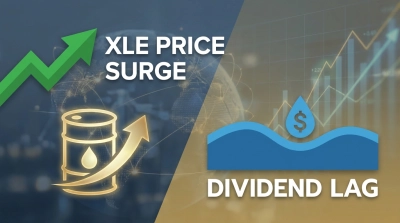
Shares of the Energy Select Sector SPDR Fund (NYSEARCA:XLE) have climbed 57% over the past year. Over the same stretch, the cash the fund pays out grew about 6%. For a retiree, that gap matters more than the rally. XLE holds only energy stocks in the S&P 500, weighted by market value, so its income comes from cash-rich producers.
The trailing yield has fallen to about 2.4%, down from around 3.4% on last year’s payout at last year’s price. The payouts look safe. Each dollar invested today simply buys much less income.
Where XLE’s Quarterly Checks Come From
XLE pays quarterly and passes through ordinary dividends from its holdings. The income comes entirely from what oil producers, refiners, and pipeline companies choose to pay.
Older records can look alarming because XLE completed a 2-for-1 forward split effective December 5, 2025. That explains why the September 2025 distribution of $0.75 looks twice the size of the $0.37 paid in December. On a split-adjusted basis, trailing-year distributions reached $1.52 per share, up from $1.44 the year before.
The fund is concentrated. Its most recent holdings filing is dated June 30, so the weights may have changed since then. That filing shows net assets of $35.7 billion, with Exxon Mobil (NYSE:XOM | XOM Price Prediction) at 23% and Chevron (NYSE:CVX) at 16%. In practice, these two companies largely determine how safe XLE’s income is.
Big Oil Pays the Bills, and Coverage Holds
Exxon Mobil yields 2.2%. Its $4.08 annual dividend uses about 52% of trailing EPS of $7.83. That leaves plenty of room if oil prices fall back.
Chevron is the least certain pick among the oil producers. It yields 3.0%, but its $6.98 dividend takes about 67% of earnings, and those earnings come from a period of high oil prices. Coverage holds today, but a return to weaker crude would test it first.
Carrying a 7% weight, ConocoPhillips (NYSE:COP) yields 2.2%. Its payout uses only about 44% of earnings, the largest buffer in the group.
Williams Companies (NYSE:WMB), a 5% position, yields 2.9%. Its dividend is 79% of GAAP (standard accounting) earnings, which looks tight. GAAP earnings understate a pipeline company’s cash, though, because they subtract large depreciation charges. The better test is distributable cash flow, meaning the cash left after maintenance spending, and the per-share earnings used here are only a conservative stand-in for it. Williams also takes in mostly fee-based revenue for moving gas, which shelters it from swings in commodity prices.
Commodity prices are the real risk to this income. Benchmark West Texas Intermediate (WTI) crude recently traded near $108 a barrel, up 68% from a year ago. The low was $55 as recently as last December.
Why Price Raced Ahead and Who XLE Fits
XLE’s dividend-adjusted price is up 57% this year and 137% over five years. Investors pushed up energy stock valuations as crude rallied. The companies, however, raised dividends at a measured pace and kept their payout ratios conservative. That discipline protects the income, and it is also why the yield has fallen.
Investors who have held XLE for years have pocketed a large price gain and a steady stream of dividends. New buyers pay far more for each dollar of dividends than they would have a year ago. XLE fits retirees who want reliable energy income, some protection against inflation, and payouts supported by earnings at today’s prices. Those seeking a high yield will find that a payout near 2% doesn’t cover much of a retirement budget. Growth-focused income investors should also expect the fund’s value to swing with oil prices.
Contact [email protected] for any questions or corrections.
Trey has been an editor and author at 24/7 Wall St. for more than a decade, where he has published thousands of articles analyzing corporate earnings, dividend stocks, short interest, insider buying, private equity, and market trends. His comprehensive coverage spans the full spectrum of financial markets, from blue-chip stalwarts to emerging growth companies.
Beyond 24/7 Wall St., Trey has created and edited financial content for Benzinga and AOL's BloggingStocks, contributing additional hundreds of articles to the investment community.
Trey's editorial expertise extends across multiple publishing environments. He served as production editor at Dearborn Financial Publishing and development editor at Kaplan, where he helped shape financial education materials. Earlier in his career, he worked as a writer-producer at SVE. His freelance editing portfolio includes work for prestigious clients such as Sage Publications, Rand McNally, the Institute for Supply Management, the American Library Association, Eggplant Literary Productions, and Spiegel.
Outside of financial journalism, Trey writes fiction and has been an active member of the writing community for years, moderating workshop sessions at regional conventions.