This Is Exactly How the IRS Determines Your RMD
Once you reach age 73, the IRS requires you to take Required Minimum Distributions (RMDs) from most tax-deferred retirement accounts, ensuring the government collects taxes on money sheltered from taxation for decades. If you are already past 73, or approaching…

This post may contain links from our sponsors and affiliates, and Flywheel Publishing may receive compensation for actions taken through them.

Once you reach age 73, the IRS requires you to begin taking Required Minimum Distributions (RMDs) from most tax-deferred retirement accounts. These mandatory withdrawals exist so the government can collect taxes on money that has been sheltered from taxation, sometimes for decades. The rules are precise, the deadlines are firm, and the penalties for getting them wrong are steep.
If you are already past 73, or approaching that milestone, understanding exactly how your RMD is calculated is critical. Working through the mechanics with a financial advisor before your first distribution is time well spent.
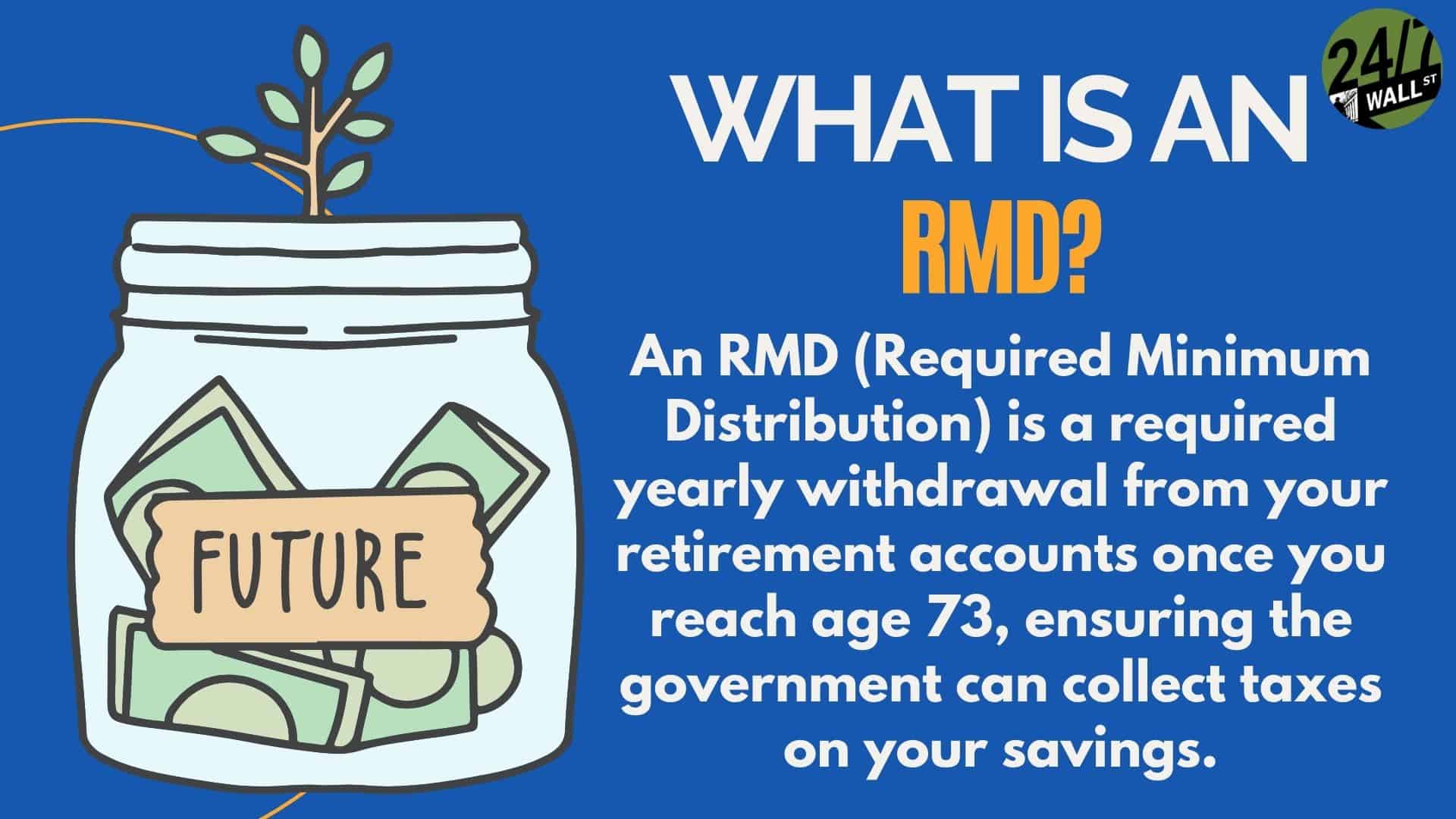
The IRS calculates your RMD with a two-step formula: start with your total account balance as of December 31 of the prior year, then divide by a life expectancy factor drawn from one of the agency’s published tables. That factor represents the number of years the IRS estimates you will live beyond your current age. It shrinks every year as you grow older, which pushes your required withdrawal gradually higher as a percentage of your remaining balance.
Here is a concrete example. At age 73, the IRS Uniform Lifetime Table assigns a life expectancy factor of 26.5. If your account balance as of December 31 of the prior year was $250,000, dividing by 26.5 produces a required distribution of roughly $9,434. For the complete table, see the IRS Uniform Lifetime Table. As a share of your balance, RMDs rise steadily over time: roughly 3.8% at age 73, about 5% by 80, and around 8% by 90. Those percentages are fixed by the table, not by market performance, so a down year does not reduce your required withdrawal percentage.
The IRS Has Extended the IRA Amendment Deadline Again
For anyone managing an inherited retirement account alongside their own RMDs, the regulatory landscape has been unsettled for several years. The IRS issued Notice 2026-09 (published in Internal Revenue Bulletin 2026-07), which extends the deadline for IRA custodians and trustees to amend IRA documents for SECURE Act compliance to December 31, 2027. The extension exists because the IRS is still developing model amendment language, and custodians need time to act once that language is finalized. The longer runway is practical rather than merely bureaucratic.
A separate but consequential development: the 2024 Final Regulations, published in July 2024, resolved a long-running ambiguity about the 10-year distribution rule for inherited IRAs. Those regulations confirmed that non-spouse beneficiaries who inherit from an account owner who had already begun taking RMDs must take annual distributions in each of years one through nine of the 10-year window. Waiting until year ten to empty the account is no longer permitted in that scenario. The annual-distribution requirement took effect with the 2025 distribution year, and taxpayers may apply a reasonable, good-faith interpretation of the existing rules until the IRS finalizes broader guidance.
Different Rules for RMDs Depending on Your Retirement Account
RMD rules span a wide range of retirement vehicles. On the employer plan side, they apply to profit-sharing plans, 401(k) plans, 403(b) plans, and 457(b) plans. On the IRA side, they cover traditional IRAs and IRA-based plans such as SEPs, SARSEPs, and SIMPLE IRAs. Roth IRAs and designated Roth accounts remain exempt from RMDs during the original owner’s lifetime, though beneficiaries of those accounts are still subject to distribution requirements after the owner’s death.
One significant update from SECURE 2.0: starting in 2024, designated Roth accounts inside employer-sponsored plans, including Roth 401(k), Roth 403(b), and governmental Roth 457(b) plans, became exempt from RMDs during the account owner’s lifetime. Before that change, only Roth IRAs held that privilege. If you hold Roth money inside a workplace plan, it no longer figures into your RMD calculation at all.
The aggregation rules differ sharply between account types, and that distinction matters for planning. With a traditional IRA, you must calculate your RMD separately for each account, but you may combine those totals and satisfy the full requirement from a single IRA. The rules for defined contribution plans such as a 401(k) are stricter: each plan requires its own RMD, and you cannot satisfy a 401(k) obligation by pulling funds from an IRA. One additional note applies to anyone still working past age 73. You may generally delay RMDs from your current employer’s plan until you retire, with one exception: that option is unavailable to anyone who owns 5% or more of the sponsoring business.
There is one additional scenario worth knowing about. If your spouse is more than 10 years younger than you and is the sole beneficiary of your account, the IRS requires you to use the Joint Life Expectancy Table rather than the standard Uniform Lifetime Table. That joint calculation incorporates both your age and your spouse’s age, which typically produces a longer combined life expectancy and a smaller required distribution each year.
Consider a Roth Conversion Before RMDs Begin
The years between retirement and age 73 represent one of the most valuable tax-planning windows available to pre-retirees. Earned income is gone, Social Security may not yet have started, and RMDs still lie in the future, leaving taxable income at one of its lowest points. Converting a portion of a traditional IRA to a Roth IRA during this window reduces the pre-tax balance that will ultimately be subject to RMDs, which can keep mandatory distributions in a lower bracket for years afterward.
Every dollar converted to a Roth account is a dollar removed from the annual RMD formula. Roth IRAs carry no lifetime RMD requirement for the original owner, and qualified withdrawals are generally tax-free once the five-year holding period is satisfied. There is no income limit on conversions and no annual dollar cap, though the converted amount is taxed as ordinary income in the year the conversion occurs. A multi-year strategy paced across lower-rate years spreads the tax cost rather than absorbing it all at once. The key caveat here is Medicare: Part B and Part D premiums are based on modified adjusted gross income from two years prior, through a surcharge system called IRMAA. Each conversion amount should be sized carefully to avoid crossing a premium tier and triggering a surprise Medicare bill two years later.
Reduce Your RMD Tax Bill with a QCD
A Qualified Charitable Distribution (QCD) is one of the most effective tools available for satisfying an RMD without pushing yourself into a higher tax bracket. Any IRA owner age 70 1/2 or older can instruct a custodian to transfer funds directly to an eligible charity. For 2026, the annual QCD limit is $111,000 per individual, up from $108,000 in 2025, per IRS Notice 2025-67. The transferred amount counts toward satisfying your RMD for the year and is excluded entirely from your adjusted gross income. The funds must flow directly from the custodian to the charity before December 31 to qualify.
SECURE 2.0 also added a one-time option: a QCD of up to $55,000 in 2026 (up from $54,000 in 2025) to fund a charitable remainder trust or purchase a charitable gift annuity. That one-time election counts against your annual $111,000 QCD limit, not on top of it. Married couples who each hold their own IRA can each make up to $111,000 in regular QCDs annually, for a combined ceiling of $222,000.
QCDs carry particular weight in 2026 because the One Big Beautiful Bill Act, signed into law on July 4, 2025, reshaped how charitable deductions work. For itemizers, only the portion of charitable contributions exceeding 0.5% of adjusted gross income is now deductible. Taxpayers in the top 37% bracket face an additional constraint: the tax benefit of all itemized deductions is capped at 35 cents per dollar. The same law raised the SALT deduction cap from $10,000 to $40,400 for single filers and married couples filing jointly in 2026 (though that cap reverts to $10,000 in 2030), a change that could push more households into itemizing. Even so, a QCD sidesteps the new charitable deduction restrictions entirely because it operates as an income exclusion rather than an itemized deduction. Non-itemizers gained a benefit as well: single filers can now permanently deduct up to $1,000 in cash charitable gifts ($2,000 for married couples filing jointly) without itemizing. That allowance is far smaller than what a properly structured QCD can deliver for most retirees.
The Surviving Spouse RMD Advantage
SECURE 2.0 gave widows and widowers a meaningful new option. If you are a surviving spouse and the sole beneficiary of your late partner’s retirement account, you may elect to be treated as the deceased participant for RMD purposes. When the deceased spouse was younger than you, that election lets you delay mandatory distributions until the year your spouse would have turned 73. When distributions do begin, you may also use the more favorable Uniform Lifetime Table rather than the Single Life Expectancy Table that would otherwise apply to a beneficiary.
Key Rules to Follow with RMDs
First, distributions become mandatory at age 73. Under SECURE 2.0, that threshold rises to 75 beginning in 2033, but only for anyone born in 1960 or later. Those born between 1951 and 1959 remain subject to the age-73 trigger. Those additional two years of tax-deferred compounding can add up meaningfully for younger workers who begin planning now.
Second, your required beginning date is April 1 of the year following the year you turn 73. If you turned 73 in 2025, you have until April 1, 2026, to take your first RMD covering the 2025 tax year. The catch is that delaying until April also means you owe a second RMD for 2026 by December 31 of that same year. Taking two distributions in a single calendar year can bump you into a higher bracket and trigger IRMAA surcharges on Medicare premiums. Many advisors recommend taking the first RMD before December 31 rather than using the April extension for exactly that reason.
Third, missing your RMD deadline carries a stiff penalty. The excise tax is 25% of the amount you failed to withdraw, down from the previous 50% rate under prior law. SECURE 2.0 added a correction window: if you take the missed distribution within two years, the penalty drops to 10%. A corrective distribution resolves the past shortfall but does not count toward the current year’s RMD requirement.
Fourth, watch for common calculation errors. Using the wrong year-end account balance is among the most frequent mistakes, and it can result in a shortfall that triggers the excise tax. Confirm you are applying the correct life expectancy factor for your age and account type, and verify that you have accounted for every qualifying retirement account you hold.
Fifth, before taking any distribution, consult a financial advisor. Applying the wrong life expectancy factor, overlooking an account, or withdrawing less than the required amount can all draw unwanted attention from the IRS. Getting it right the first time is far less painful than correcting an error after the fact.
Editor’s note: This article was updated to reflect that the SALT deduction cap of $40,400 under the One Big Beautiful Bill Act is temporary and reverts to $10,000 in 2030, and to confirm the 2026 QCD figures of $111,000 annual limit and $55,000 one-time split-interest limit per IRS Notice 2025-67.
Contact [email protected] for any questions or corrections.
Ian Cooper is a veteran market analyst and investment strategist with more than 20 years of experience covering stocks, commodities, and macro trends. Since 1999, he has helped investors identify market opportunities using a blend of technical analysis, fundamental research, and market sentiment.
He is the creator of the ADD News Flow Strategy, which focuses on trading market reactions to major news events and investor psychology. Cooper was also among the analysts who warned about the 2008 financial crisis and major financial institution collapses ahead of the broader market.
Before joining 247 Wall St., Cooper wrote extensively for InvestorPlace and other financial publications, covering market trends, trading strategies, and investment opportunities.