How Much Money Do You Need to Retire Early? Here’s What Suze Orman Says
A lot of people dream of being able to retire early and enjoy the freedom of not being bound to a job at a younger-than-average age. But as you might imagine, it takes a lot of money to be able…

This post may contain links from our sponsors and affiliates, and Flywheel Publishing may receive compensation for actions taken through them.

A lot of people dream of being able to retire early and enjoy the freedom of not being bound to a job at a younger-than-average age. But as you might imagine, it takes a lot of money to be able to pull off an early retirement.
How much money? If you’re thinking a $2 million nest egg is enough to buy you that early workforce escape, financial guru Suze Orman has a wakeup call for you. And you’re going to want to pay attention.
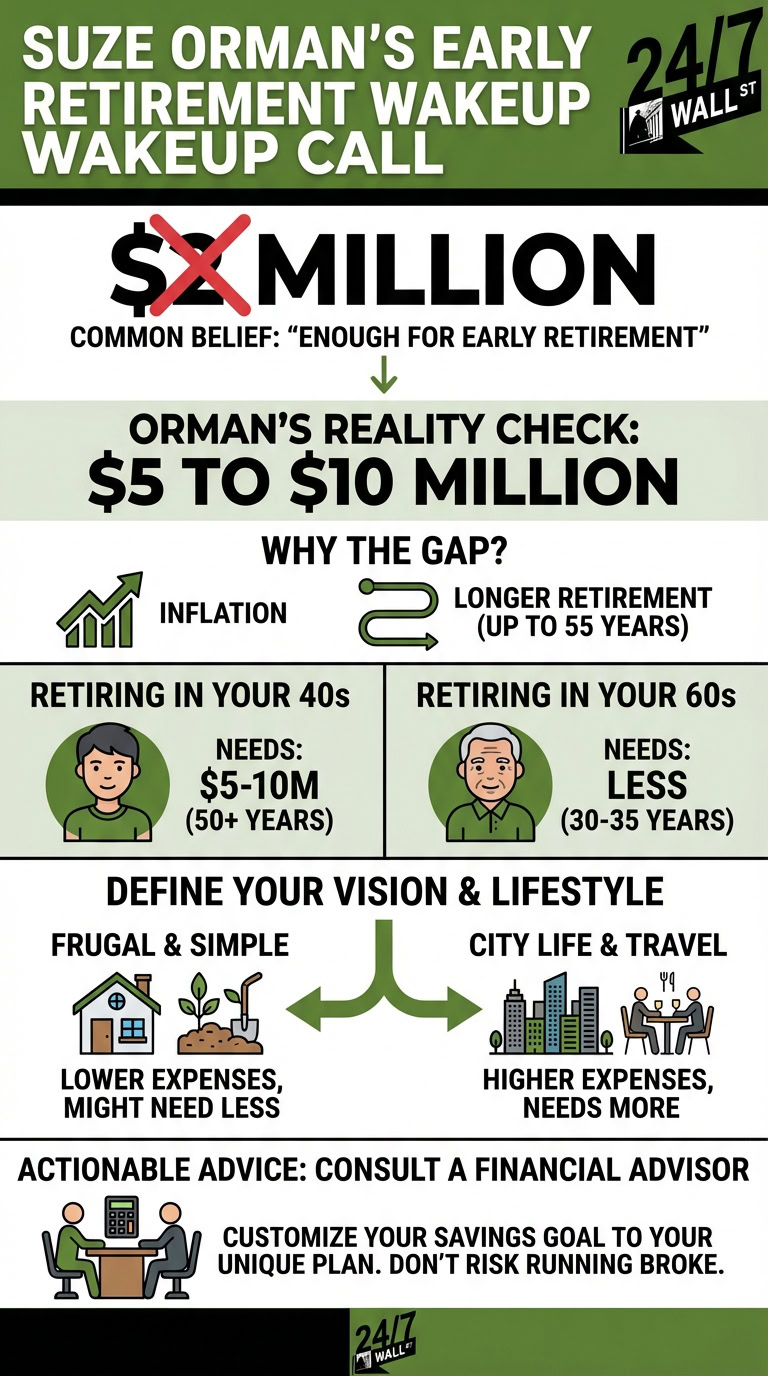
Why $2 million won’t cut it for early retirement
Orman was recently asked how much money it might take to pull off early retirement. And you may find her answer shocking.
First, she said that $2 million isn’t nearly enough to retire early on. She then went on to say that it might take a good $5 to $10 million to retire early without financial worries.
Yep, you read that correctly.
Are you shocked? Well, maybe you shouldn’t be. In the past few years, we’ve seen inflation drive living costs up dramatically. And it’s hard to predict how much havoc inflation will continue to wreak.
Of course, the amount of money you need for early retirement depends on how you define that. For some people, retiring early means ending their careers at 60. For others, it means leaving the workforce behind at 40.
There’s a huge difference between those two ages, though. In one case, you might need your retirement savings to last 50 or 55 years, whereas retiring at 60 could mean savings for 30 or 35 years.
So if you’re looking to retire in your 40s, then yes, $5 to $10 is what you might need. But if you’re looking to retire just a few years early, then you probably don’t need $5 million or more. In that case, you might manage to stretch a $2 million nest egg nicely, depending on your anticipated expenses and lifestyle.
Figure out what you want early retirement to entail
The reality is that it does take extra money to retire early — even if just a few years early. But the amount of money you’ll need should hinge on what you want out of retirement.
If you intend to live in a small, paid-off home with minimal property taxes and maintenance costs, and you plan to spend your days dabbling in hobbies and volunteering locally, then your expenses are going to be quite different from someone who wants to retire in a large city and enjoy the nightlife it offers multiple evening a week.
So if you’re hoping to retire early, get yourself a financial advisor, tell them what vision you have for your post-working years, and then work with them to come up with a savings goal that’s customized to you. You may land on $5 to $10 million. Or you may realize you can pull off early retirement on less.
Orman’s advice is valid no matter what. Retirement might cost you more than expected, and the earlier in life you end your career, the more savings you’re apt to need.
But ultimately, she thinks that everyone should calculate their own savings needs. And it’s a good idea to get help doing that so you’re able to arrive at a goal that helps you pull off your dream retirement without running the risk of ending up broke.
Contact [email protected] for any questions or corrections.
Maurie Backman has more than a decade of experience writing about financial topics, including retirement, investing, Social Security, and real estate. Her work has appeared on sites that include The Motley Fool, USA Today, U.S. News & World Report, The Washington Post, and Kiplinger.
Prior to becoming a full-time financial writer, Maurie worked in the financial industry trading distressed debt. She then changed course and spent a few years designing electronic toys. After a stint in content marketing and UX, she shifted back into writing and has since covered everything from the housing market to estate planning to Medicare.
When she's not busy writing, Maurie can be found hiking, walking her dogs, driving her kids to their various sports practices and games, and curling up with a good book. She cooks on occasion and bakes way too often.