He Chooses Medicaid Home Care Over a Nursing Home to Keep His $350,000 House in the Family. After He Dies, the State Can Bill His Estate for Every Dollar It Paid for His Care

This post may contain links from our sponsors and affiliates, and Flywheel Publishing may receive compensation for actions taken through them.
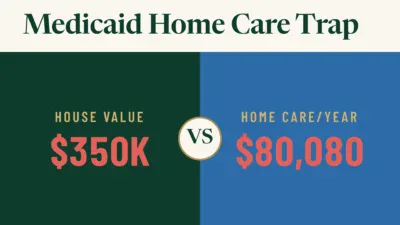
Picture a 78-year-old widower who needs help bathing, dressing and getting to the bathroom. His paid-off house is worth $350,000, and his kids want it to stay in the family. To him, institutional care is where houses go to disappear. So he signs up for a Medicaid home care waiver and keeps sleeping in his own bed.
The aides show up, the title stays in his name, and the plan looks airtight. Then he dies, and the state bills his estate under the Medicaid Estate Recovery Program. For enrollees age 55 or older[1], federal law requires states to seek repayment for nursing facility services, home and community-based services, and related hospital and prescription drug services. Home care aides sit on that list right next to nursing home beds.
Why the $350,000 House Looks Safe While He’s Alive
Medicaid is run jointly by Washington and the states and covers people with limited income and assets. It ignores the home at sign-up as long as the equity remains under a cap. In most states, the 2026 home equity limit is $752,000 or $1,130,000, so his $350,000 house clears it easily.
This tab is not one Medicare will pick up, even though most people enroll in the federal program at 65. Medicare.gov says it doesn’t pay for “24-hour-a-day care at your home”[2] or for “custodial or personal care that helps you with daily living activities (like bathing, dressing, or using the bathroom), when this is the only care you need.” Medicare’s skilled nursing benefit covers short rehab stays, and that carries a $222 daily coinsurance for days 21 through 100 in 2027.
Paying out of pocket hurts. According to CareScout’s Cost of Care Survey, the 2025 national median for a non-medical in-home caregiver reached $35 per hour. At 44 hours a week, that’s $80,080 a year. A private nursing home room ran $129,575 a year. Four years of aides at the home care median comes to $320,320, which is almost the whole value of his house.
Estate Recovery Bills Aide Hours Like Nursing Home Days
The debt builds quietly in the background. Nebraska’s statute shows how it works. A recipient owes “the total amount paid for medical assistance”[3] if he was fifty-five years of age or older when he got the care, and the debt “shall be held in abeyance until the death of the recipient.” Nebraska doesn’t add interest.
The bill may not track the aides’ actual hours. KFF reports that for people in managed care, “estate recovery is based on the premium payments states make rather than on the services people use.” So a man who barely used his plan can still owe for every monthly premium the state paid.
This is where states split. A 2025 Justice in Aging guide counts 36 jurisdictions, including Nebraska, Florida, New York and Washington, D.C., that recover more than the federal minimum. California, Texas and Massachusetts recover only for the services federal law requires. States also decide what counts as the “estate.” Some stop at assets that pass through probate, while others go after jointly owned and transfer-on-death property.
Spouses, Kids Under 21 and Hardship Waivers Stop the Clock
Certain survivors make the state wait. Nebraska collects “only after the death of the recipient’s spouse”[3], and only when no child survives who is “under twenty-one years of age or is blind or totally and permanently disabled.” Those protections come from federal law, so every state applies them.
Justice in Aging notes that states “must establish procedures to waive recovery in situations where pursuit would result in undue hardship” for heirs. Hardship tests vary by state, and some carve out homes of modest value or children who served as caregivers. Recovery remains “limited to the deceased recipient’s estate,” the guide adds, so the claim stops at what he left behind and the children’s own savings stay theirs.
Our widower has no spouse and his children are grown and healthy, so none of the exemptions apply. If Medicaid’s claim tops $350,000, the state can take the full value of the house. If the claim is smaller, his kids inherit the difference. Titling, beneficiary forms, and the order of ownership decide whether the house survives the recovery letter, which is exactly the ground our free estate checklist covers here.
Nebraska’s 2026 Waiver Changes Show How Fast the Math Moves
In November 2026, Nebraska announced changes to the Medicaid waivers that help families care for loved ones at home, including lower provider rates, WOWT reported. The state also plans its first-ever waiting list for the Aged and Disabled Waiver starting in the second quarter of 2027, so a family that picks home care may have to wait for a slot.
Lower rates shrink the amount the state can later claim, though they can also make it harder to find aides willing to take the work. Families choosing between home care and institutional care end up running two sets of numbers: what the care costs now, and what the estate will owe after the funeral.
Contact [email protected] for any questions or corrections.
Gerelyn Terzo is the author of dividend investing handbook "Dividend Investing Strategies: How to Have Your Cake & Eat It Too." A veteran financial journalist, she covers agri-finance for outlets like Global AgInvesting and the broader stock market and personal finance for 24/7 Wall Street. She began at CNBC and later helped launch Fox Business in New York. Gerelyn currently resides in Woodland Park, Colorado and dabbles in nature photography as a hobby.