The Long-Term Costs of the RadioShack Super Bowl Ad
RadioShack is actually ticking up on the admission by the company that it has to shed its very outdated image. But investors should ask what the ultimate cost will be in capital spending to live up to its image rebranding?

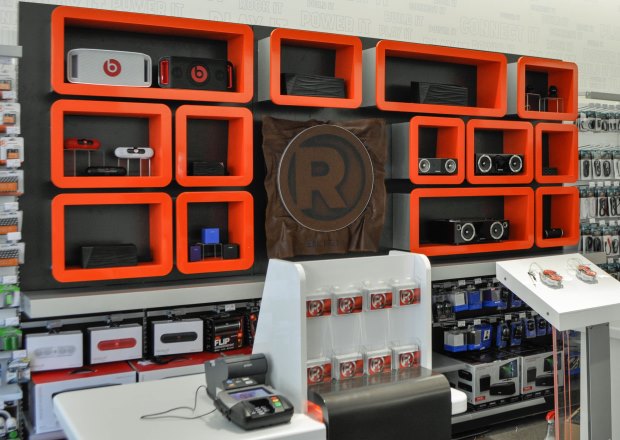 RadioShack Corp. (NYSE: RSH) is actually ticking up on the admission by the company that it has to shed its very outdated image. The admission was a Super Bowl commercial, and RadioShack was not even among our own six stocks looking to benefit from the Super Bowl. What investors and outsiders alike really need to consider is what the ultimate cost will be in capital spending to live up to its image rebranding.
The commercial showed nothing but 1980s entertainment icons being hoisted out, only to have the new concept store unveiled. The ad itself was actually one minute, and spots sold for roughly $4 million per 30-second slot.
RadioShack is still losing money, but the company had $316 million in cash at the end of September. It also had almost $500 million in direct long-term debt as of that time. Where things get interesting is that RadioShack announced in December that it was closing on an $835 million financing pact with GE Capital and two others. That capital is being used to refinance existing debt and was represented as offering an additional $200 million or so in liquidity.
The USA Today Ad Meter showed an average 7.0 vote for the company. That implies that maybe the new store concept will do better, or at least have more eye appeal, hopefully. If RadioShack had 4,300 company-operated stores in America alone, what is a fair cost of fulfilling the new image of that commercial? Assuming RadioShack closes down another 300 of its stores to a raw 4,000, how does one calculate the cost per store on a capital spending basis? Here is a total based on various per store costs, including new point of sales, inventory tracking, buildouts and more:
- $500,000 per store is probably too high, but that is $2 billion.
- $250,000 per store is hopefully too high — that is still $1 billion.
- $100,000 per store may be close, maybe, and that is $400 million.
- Even $50,000 per store is $200 million.
Perhaps the biggest problem is that RadioShack’s liquidity could be consumed entirely in this effort, when you consider that it is expected to keep losing money. The company’s stock also continues to remain in the doldrums. At $2.40, the 52-week trading range is $2.02 to $4.36. And the market cap is a mere $240 million.
It seems hard to imagine that investors would bid this up over a commercial, but the stock was up more than 5% at $2.55 in early Monday trading. RadioShack is just lucky that it had its ad early in the first half, because the interest in the game started to fade even before the end of the first half.
Contact [email protected] for any questions or corrections.
Jon Ogg has been a financial news analyst since 1997. Mr. Ogg set up one of the first audio squawk box services for traders called TTN, which he sold in 2003. He has previously worked as a licensed broker to some of the top U.S. and E.U. financial institutions, managed capital, and has raised private capital at the seed and venture stage. He has lived in Copenhagen, Denmark, as well as New York and Chicago, and he now lives in Houston, Texas. Jon received a Bachelor of Business Administration in finance at University of Houston in 1992. www.247wallst.com.