





Personal finance guru Dave Ramsey recently weighed in on the retirement planning debate between traditional 401(k) plans and a newer alternative called a Roth 401(k). His explanation stands out for its clarity.
Rarely have I seen any concept explained more clearly in 45 seconds than Ramsey managed in this video.
Here’s the full text of what Ramsey said:
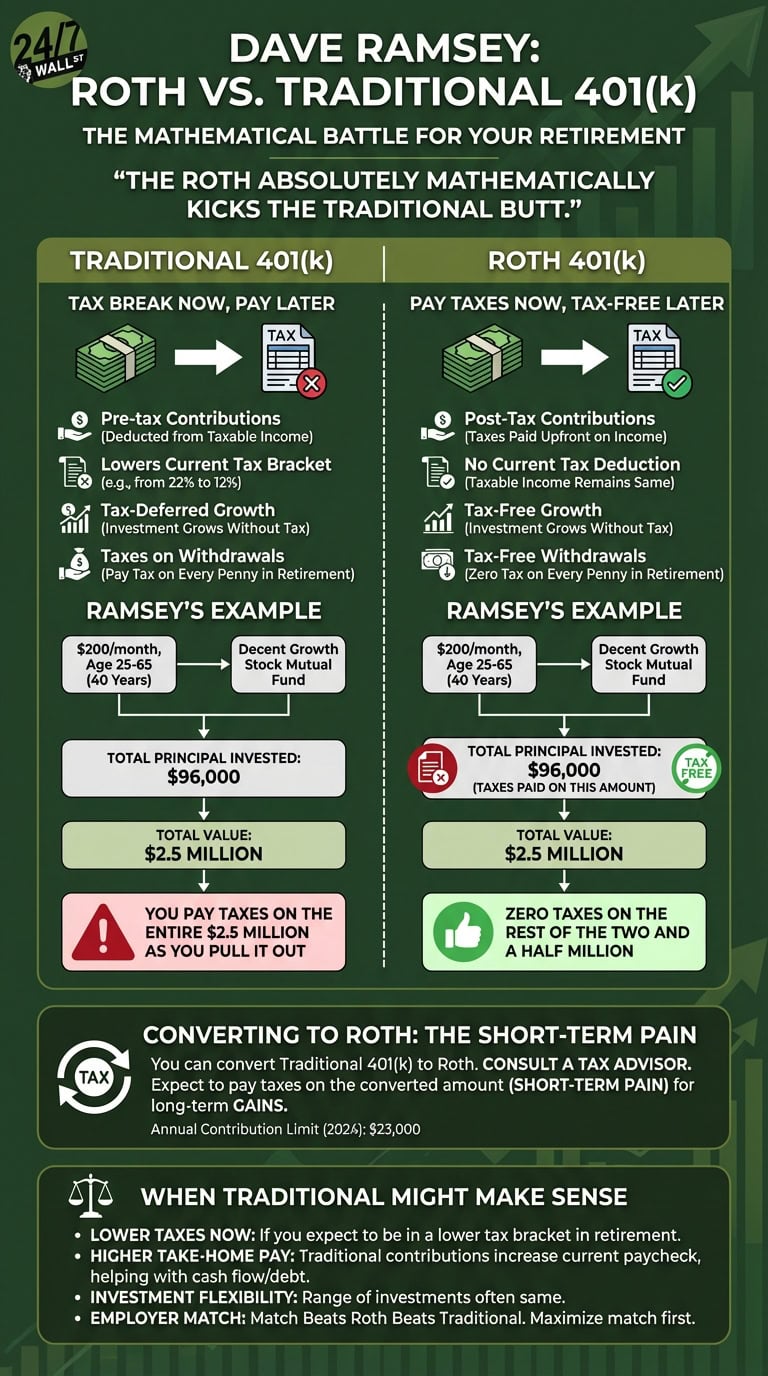
“The Roth absolutely mathematically kicks the traditional [IRA’s] butt. And here’s why: If you take $200 a month from age 25 to age 65, 40 years, and you invest that in a decent growth stock mutual fund, you’re gonna have $2.5 million dollars in there.
However, only $96,000 of the $2.5 million is actual principal that you put in. So if you did a traditional [401(k)], you would have got a tax break on $96,000. You would have not paid taxes yet on $96,000. But you’ll pay taxes on the entire $2.5 million as you pull it out.
If instead you did this with a Roth [401(k)], you would pay taxes on the $96,000 [before you put them in the plan as your contribution] and zero taxes on the rest of the two and a half million.”
Ramsey’s explanation is intuitive and punchy. But let’s walk through the mechanics step by step.
The History: 401(k) versus Roth 401(k)
The 401(k) plan traces its roots to 1978, when Congress passed the Revenue Act of 1978 and embedded Section 401(k) into the Internal Revenue Code. These plans gained traction in the early 1980s after the IRS issued implementing regulations, and they took off in earnest as traditional pension plans declined through the 1990s.
The Roth 401(k) came later. Congress authorized it through the Economic Growth and Tax Relief Reconciliation Act of 2001, though employers couldn’t actually offer it until January 1, 2006. Traditional 401(k) plans have therefore been around for nearly 50 years, while the Roth version has been available for about 20. Despite that runway, many workers still aren’t familiar with how the Roth option works. So what separates the two?
Here’s a simplified explanation. (Consult your tax advisor for specifics tailored to your situation.) Suppose you earn $50,000 annually. Between your contributions and your employer’s match, you set aside 10% of your salary ($5,000) in a 401(k). Under the traditional structure, that $5,000 goes in pre-tax: it’s deducted from your taxable income, dropping it to $45,000. In this example, you’ve also slipped from the 22% bracket into the 12% bracket.
That’s an immediate win. Over the years ahead, your contributions grow tax-deferred, meaning you owe nothing on the gains while the money compounds. The catch arrives at retirement: you pay ordinary income tax on every dollar you withdraw, gains included.
The Roth 401(k) reverses the timing. You pay tax on your full $50,000 income first, then deposit your $5,000 from the after-tax remainder. The account still grows without tax. But when you start withdrawing in retirement, every penny comes out tax-free, including both your contributions and every dollar of capital appreciation.
That’s a powerful advantage, and the math behind Ramsey’s $96,000 versus $2.5 million comparison illustrates exactly why.

Converting Your 401(k) to a Roth 401(k)
Now you can see why Ramsey favors a Roth 401(k) over a traditional 401(k). His broader playbook, spelled out on Ramsey Solutions, follows a simple three-step priority he calls “Match beats Roth beats traditional”: contribute enough to your 401(k) to capture the full employer match first, then max out a Roth IRA (up to $7,500 in 2026), then direct any remaining retirement savings back into the 401(k). But what if you’re already deep into a traditional 401(k)? You’re not locked in.
You can open a Roth 401(k) alongside your existing traditional 401(k), or split contributions between both, provided you don’t exceed the annual contribution limit. For tax year 2026, that combined employee limit is $24,500. Workers who are 50 or older can add a catch-up contribution of $8,000, raising the ceiling to $32,500. There is also a super catch-up provision: workers aged 60 to 63 can contribute an additional $11,250 in place of the standard $8,000, pushing the total to $35,750 for that age group.
You can also shift funds from your traditional 401(k) into a Roth 401(k), or convert the entire account, assuming your employer’s plan allows it. Starting in 2026, a provision under SECURE 2.0 requires high earners (those who earned more than $150,000 in FICA wages from the sponsoring employer in the prior year) to make all catch-up contributions as Roth after-tax contributions. This applies to workers age 50 and older. The IRS issued final regulations implementing this rule in September 2025; those regulations are formally effective beginning in 2027, but plans are expected to operate under reasonable, good-faith compliance throughout 2026.
For those pursuing Financial Independence and early retirement (FIRE), a Roth Conversion Ladder can be a strategic tool. The technique involves systematically moving funds into tax-free Roth accounts during low-income years, potentially allowing access to principal before age 59.5 without penalties.
Tax law is complex, and converting a traditional account involves upfront taxes on the money you move. A professional tax advisor can help you weigh the timing and the cost. Ramsey’s view is that this short-term tax hit is worth absorbing, given the long-term benefit of pulling a much larger balance out tax-free in retirement.
When a Traditional 401(k) Might Make Sense
Ramsey consistently recommends the Roth option when a plan offers one, but the traditional 401(k) is not without merit. In certain situations, deferring taxes can be the smarter move:
-
Lower Taxes Later: If you expect to be in a lower tax bracket during retirement than you are today, deferring taxes until then can reduce your lifetime tax bill. Retirees who sharply cut their spending often fall into lower brackets than during their peak-earning years.
-
Cash Flow Today: Traditional contributions reduce taxable income now, so more of your paycheck stays in your pocket each month. That extra liquidity can be valuable if you’re paying down high-interest debt or managing tight household expenses.
-
Asset Location Strategy: Some investors coordinate account types intentionally, placing high-yield bonds in traditional accounts and high-growth stocks in Roth accounts. The goal is to minimize taxes on assets most likely to generate ordinary income while letting the highest-growth holdings compound tax-free.
-
Expanded Flexibility via 529 Rollovers: SECURE 2.0 introduced a useful escape valve for families with unused college savings. Up to $35,000 in excess 529 plan funds can be rolled over into the beneficiary’s Roth IRA over time, provided the 529 account has been open for at least 15 years and the rollover goes to an account owned by the 529 beneficiary. This gives families a tax-free way to repurpose education savings for retirement rather than paying taxes and a 10% penalty on nonqualified withdrawals.
Editor’s note: This article has been updated to include Ramsey’s “Match beats Roth beats traditional” priority framework, the 2026 Roth IRA contribution limit of $7,500, and additional context on the SECURE 2.0 Roth catch-up rule, including that the IRS issued final implementing regulations in September 2025 that are formally effective in 2027, with good-faith compliance expected throughout 2026.
Contact [email protected] for any questions or corrections.













 Top Gaining Stocks
 Top Losing Stocks