If You Invested $20,000 In Costco (COST) 5 Years Ago, This Is How Much Cash From Dividends You Would Have Today
While other retailers continue to struggle against the online competition from Amazon and others, Costco continues to grow and post strong earnings, making it a favorite of many in the investment community. Back in the mid 1970’s, brothers Sol and…


While other retailers continue to struggle against the online competition from Amazon and others, Costco continues to grow and post strong earnings, making it a favorite of many in the investment community.
Back in the mid 1970’s, brothers Sol and Price founded Price Club, which pioneered the concept of warehouse sales to businesses. Roughly 7 years later, Jim Sinegal and Jeff Brofman launched Costco, inspired by Price Club’s warehouse model, and tweaked to cater to retail individuals as well as small businesses. The two companies went on to merge in 1993 to form the retailing juggernaut now known nationwide as Costco Wholesale Corporation (NASDAQ: COST | COST Price Prediction).
As reviewed in past 24/7 Wall Street articles, the membership club component has long been Costco’s “ace up the sleeve”. Since membership fees basically carry zero cost, those revenues go straight to Costco’s bottom line to boost revenues every quarter. The fact that the company routinely scores over a 90% customer satisfaction rating is a testament to the strength of the Costco business model, its practices, and a key element of its continued growth.
Investing in Costco
Costco has a strong history of solid annual returns:
- 1 year: +27.69%
- 3 year: +31.36%
- 5 year: +28.66%
- 10 year: +22.98%
While such strong growth is coveted when wealth building, a Dividend Reinvestment Plan (DRIP) can add extra juice to growth if the income component is not required for other purposes. Even at a relatively small 0.50% yield, DRIP can help augment ROI through compounding.
As the chart shows, a $20,000 investment in COST back in June, 2020 would be worth $73,143.68 today, at the time of this writing, which equates to a 265.72% ROI. The total return would be $53,143.68.
The annualized return equates to 29.61%. This calculation also includes compounding through reinvested dividends. The reinvested dividend value equates to $5,736.29. The actual cash dividends paid out from the initial 64.09 shares equates to $2,812.46. If the dividends were not reinvested, the total return would be $47,407.38 . Therefore, reinvesting the dividends enabled an additional return difference of $5,736.30, or +28.68% over the 5-year stretch.
DRIP Strategies And What A Costco Split Could Do
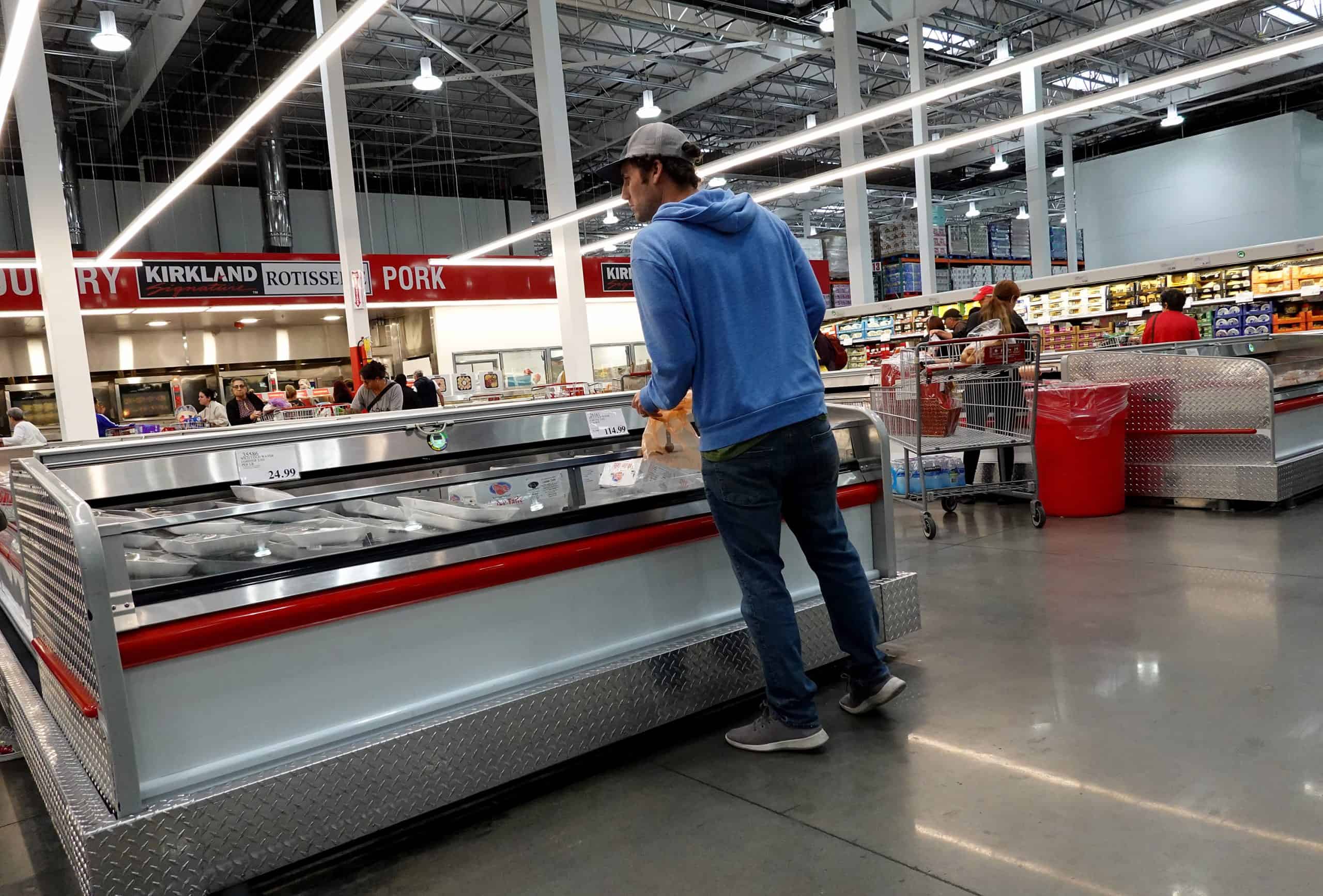
As covered in another previous 24/7 Wall Street article, Costco has had 3 forward splits in its history with the last one back in 2000, 25 years ago. If one is using a DRIP program, then reinvestment of dividends goes on autopilot and there are little, if any fees charged.
From a wealth building perspective, a forward split for Costco, based on its current price of over $1,000 per share, could easily go as far as a 10-for-1 forward split to bring market price to a more affordable $100. The resulting ability to buy additional shares would be commensurately expanded and would thus accelerate the compounding effect. Any increase in dividends would only add further fuel to this engine.
From a purely hypothetical and mathematical perspective, the additional 5 or so shares that could be acquired through dividends with the market price at $1,000 would be 50 more shares at $100 per share. These shares would then be generating dividends to continue the DRIP protocol until the investor decides otherwise.
Contact [email protected] for any questions or corrections.
After 15 years on Wall Street with 7 of them as Director of Corporate and Municipal Bond Trading for a NYSE member firm, I started my own project and corporate finance consultancy. Much of the work involves writing business plans, presentations, white papers and marketing materials for companies seeking budgetary allocations for spinoffs and new initiatives or for raising capital for expansion or startup companies and entrepreneurs. On financial topics, I have been published under my own byline at The Motley Fool, 247wallst.com, DealFlow Events’ Healthcare Services Investment Newsletter and The Microcap Newsletter, among others. Additionally, I have done freelance ghostwriting writing and editing for several financial websites, such as Seeking Alpha and Shmoop Financial. I have also written and been published on a variety of other topics from music, audiophile sound and film to musical instrument history, martial arts, and current events. Publications include Copper Magazine, Fidelity (Germany), Blasting News, Inside Kung-Fu, and other periodicals.