Is Capital Group Growth ETF A Good Choice For Retirees In 2026? | CGGR
Retirees in 2026 face a critical question: where should capital appreciation end and income generation begin? Capital Group Growth ETF (NYSEARCA:CGGR) leans heavily toward growth, making it a poor fit for traditional retirement portfolios focused on generating living expenses from…

Retirees in 2026 face a critical question: where should capital appreciation end and income generation begin? Capital Group Growth ETF (NYSEARCA:CGGR) leans heavily toward growth, making it a poor fit for traditional retirement portfolios focused on generating living expenses from dividends.
Built for Growth, Not Income
CGGR’s mandate is clear: provide growth through companies with superior appreciation potential. With over 57% concentrated in Information Technology, Communication Services, and Consumer Discretionary sectors, the fund pursues capital gains rather than dividend income. Top holdings include Meta Platforms (NASDAQ:META | META Price Prediction) (7.6%), Tesla (NASDAQ:TSLA) (6%), Broadcom (NASDAQ:AVGO) (5.7%), and Nvidia (NASDAQ:NVDA) (4.9%).
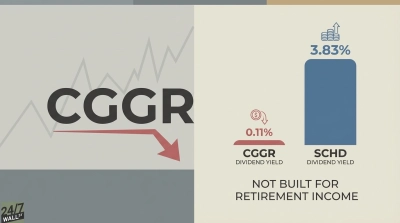
The fund’s 0.11% dividend yield tells the real story for retirees. A $500,000 investment would generate approximately $550 annually, barely covering monthly utilities. More concerning, CGGR’s 2025 distribution of $0.04 represents a 65% decline from the $0.12 paid in 2024, signaling this minimal income stream lacks reliability.

Performance Comes With Volatility
CGGR has delivered on its growth promise, returning 20.9% year-to-date in 2025 and outperforming the S&P 500 by roughly 3.6 percentage points. Since its February 2022 inception, the actively managed fund has beaten its benchmark through concentrated positions in high-conviction growth names.
But that outperformance demands tolerance for significant volatility. Holdings like Tesla, MicroStrategy (NASDAQ:MSTR) (0.56%), and Snap (NYSE:SNAP) (0.32%) can swing dramatically during market stress, precisely when retirees need stability. The fund’s 16% portfolio turnover keeps tax efficiency reasonable, but the underlying holdings carry risk profiles unsuited to capital preservation.
The Tradeoffs Retirees Must Accept
Using CGGR in retirement means accepting three fundamental compromises. First, income generation becomes nearly impossible, forcing retirees to sell shares systematically to fund expenses. Second, the growth-heavy sector allocation offers minimal defensive positioning, with less than 2% in Consumer Staples and under 1% in Utilities. Third, the fund’s short 3.8-year track record provides no evidence of performance during prolonged bear markets or recessions.
Who Should Avoid This ETF
CGGR is categorically wrong for two investor profiles. Traditional retirees depending on portfolio income for living expenses will find the 0.11% yield wholly inadequate and the declining distribution pattern alarming. Conservative investors within five years of retirement should also avoid it, as the growth concentration leaves little room for defensive positioning during market downturns.
Consider SCHD for Retirement Income Instead
Retirees seeking an alternative should examine Schwab U.S. Dividend Equity ETF (NYSEARCA:SCHD), which offers a 3.83% dividend yield, approximately 35 times higher than CGGR. With $71 billion in assets and a 0.06% expense ratio, SCHD focuses on dividend growth through defensive sectors like Energy (19.5%), Consumer Staples (18.4%), and Healthcare (16.2%). The fund has paid 56 consecutive quarterly dividends since 2011, providing the predictable income stream retirees need.
CGGR serves best as a small satellite position (5-10%) for retirees with substantial assets who can afford concentrated growth exposure, but its minimal yield and high volatility make it fundamentally incompatible with traditional retirement income strategies.
Contact [email protected] for any questions or corrections.
I am a long time investor and student of business, and believe finding good companies that can become great investments is the best game on earth. After 20 years of writing and researching the public markets it is clear that individuals have never had more tools and information to take control of their financial lives. From ETFs and $0 commissions to cryptos and prediction markets there has never been a greater democratization of access to investing.
I write to help people understand the investments available to them so they can make the best choice for their portfolio, whether they're starting out or looking for income in retirement.