Best Dividend Stocks to Buy in 2026
2025 tested investors on multiple fronts, from tariff uncertainty to persistent inflation. As 2026 progresses, building a portfolio around reliable income makes more sense than chasing short-term gains. Coca-Cola, Chevron, and Procter & Gamble offer strong fundamentals, long dividend-growth streaks,…


2025 tested investors on multiple fronts. Tariff uncertainty rattled markets, inflation lingered longer than expected, and volatility was a constant companion. Now, with 2026 well underway, the market has regained some momentum, but the lesson from last year holds: chasing short-term gains is a dangerous game. The smarter approach is building a portfolio around stocks that generate reliable income through any cycle.
That’s where dividend-paying stocks with strong fundamentals come in. They won’t always be the flashiest names in the room, but they tend to be the ones still standing when the dust settles. Three companies that fit this profile in 2026 are Coca-Cola (NYSE:KO | KO Price Prediction), Chevron (NYSE:CVX), and Procter & Gamble (NYSE:PG). All three happen to be long-standing positions in Warren Buffett’s portfolio. Here’s what makes each one worth owning today.
Coca-Cola
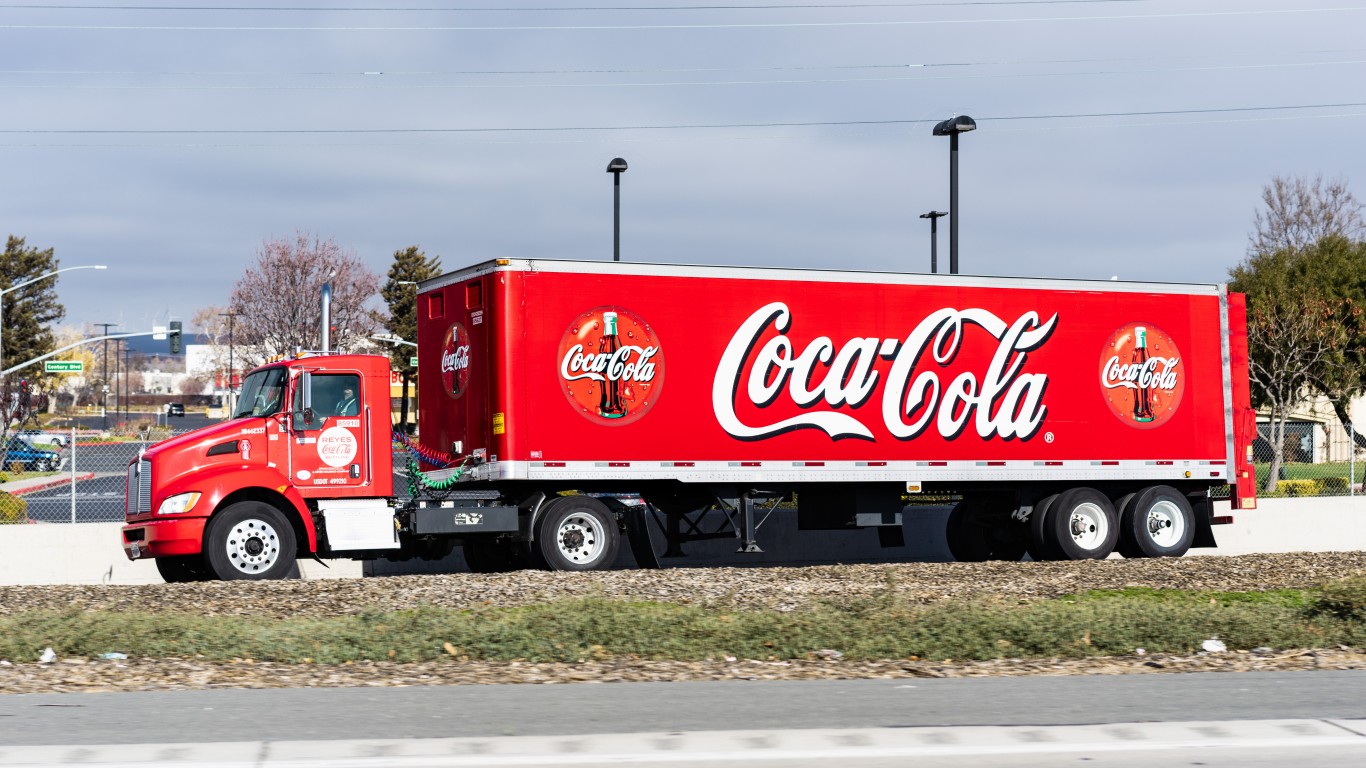
Warren Buffett has called Coca-Cola his favorite stock, and for income investors, it continues to justify that label. The company raised its quarterly dividend 4% in February 2026, lifting the payout from $0.51 to $0.53 per share and extending its streak of consecutive annual dividend increases to 64 years. The annualized dividend now stands at $2.12 per share, with the stock yielding roughly 2.5% near its current price around $84.
What sustains that payout is genuine cash generation, not financial engineering. In 2025, Coca-Cola reported $11.4 billion in adjusted free cash flow, and management projects that figure will grow to roughly $12.2 billion in 2026. Q1 2026 showed the business continuing to perform: revenue came in at $12.47 billion, EPS held at $0.86, and operating margin expanded to 35% from 32.9% a year earlier. KO stock has climbed roughly 20% so far in 2026, one of the stronger performances on the Dow.
The competitive moat here is straightforward. Coca-Cola operates in over 200 countries with a portfolio that spans sparkling beverages, juices, bottled water, tea, coffee, energy drinks, and sports drinks. Its asset-light model, built on refranchising bottlers over the past decade, keeps capital requirements low and margins high. The brand loyalty the company has built over more than a century is the kind of durable advantage that makes the dividend feel less like a promise and more like a certainty.
Chevron
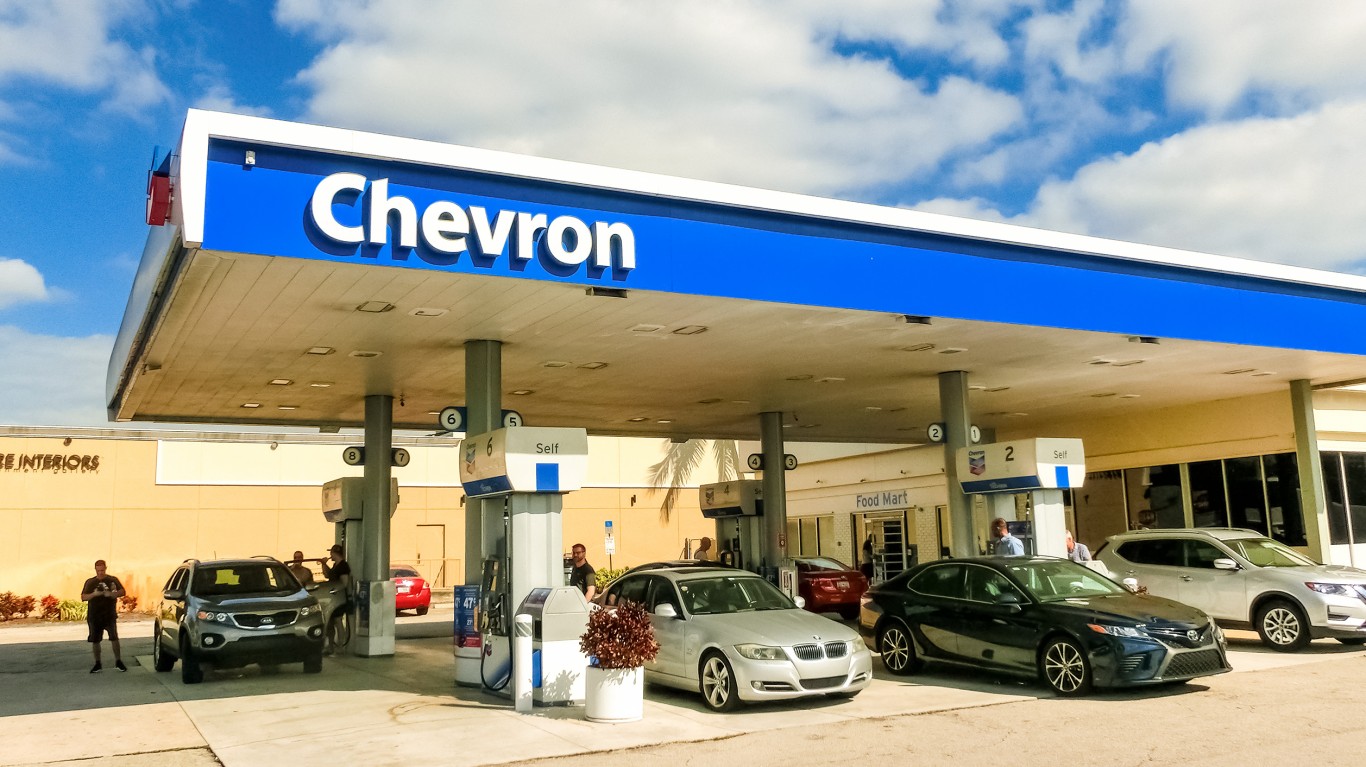
Chevron is an integrated energy company spanning upstream exploration and production, midstream operations, and downstream refining. It is also one of the most disciplined dividend payers in the energy sector. In January 2026, Chevron raised its quarterly dividend 4% to $1.78 per share, marking 39 consecutive years of annual dividend increases. The annualized payout runs to roughly $7.12 per share, with the stock yielding approximately 4% near current prices around $182.
The Hess acquisition, which closed in mid-2025, materially changed Chevron’s production profile. With Hess assets fully integrated for the first time in Q1 2026, worldwide net oil-equivalent production surged 15% year over year to 3,858 thousand barrels of oil equivalent per day. The deal added Hess’s 30% stake in the Stabroek Block offshore Guyana, a deepwater resource with estimated recoverable reserves exceeding 11 billion barrels, alongside Bakken shale assets in North Dakota. Permian Basin output crossed 1 million barrels per day for the third consecutive quarter in Q1 2026, and CFO Eimear Bonner has guided for 7% to 10% production growth for the full year.
The balance sheet is the safety net that makes Chevron’s dividend credible across commodity cycles. When oil prices dropped sharply in 2020, Chevron raised its dividend while peers including BP and Shell cut theirs. The company returned $27.1 billion to shareholders in 2025, including $12.8 billion in dividends and $12.1 billion in buybacks. For income investors with a multi-year horizon, Chevron’s combination of yield, production growth, and cost discipline is difficult to replicate elsewhere in the energy sector.
Procter & Gamble
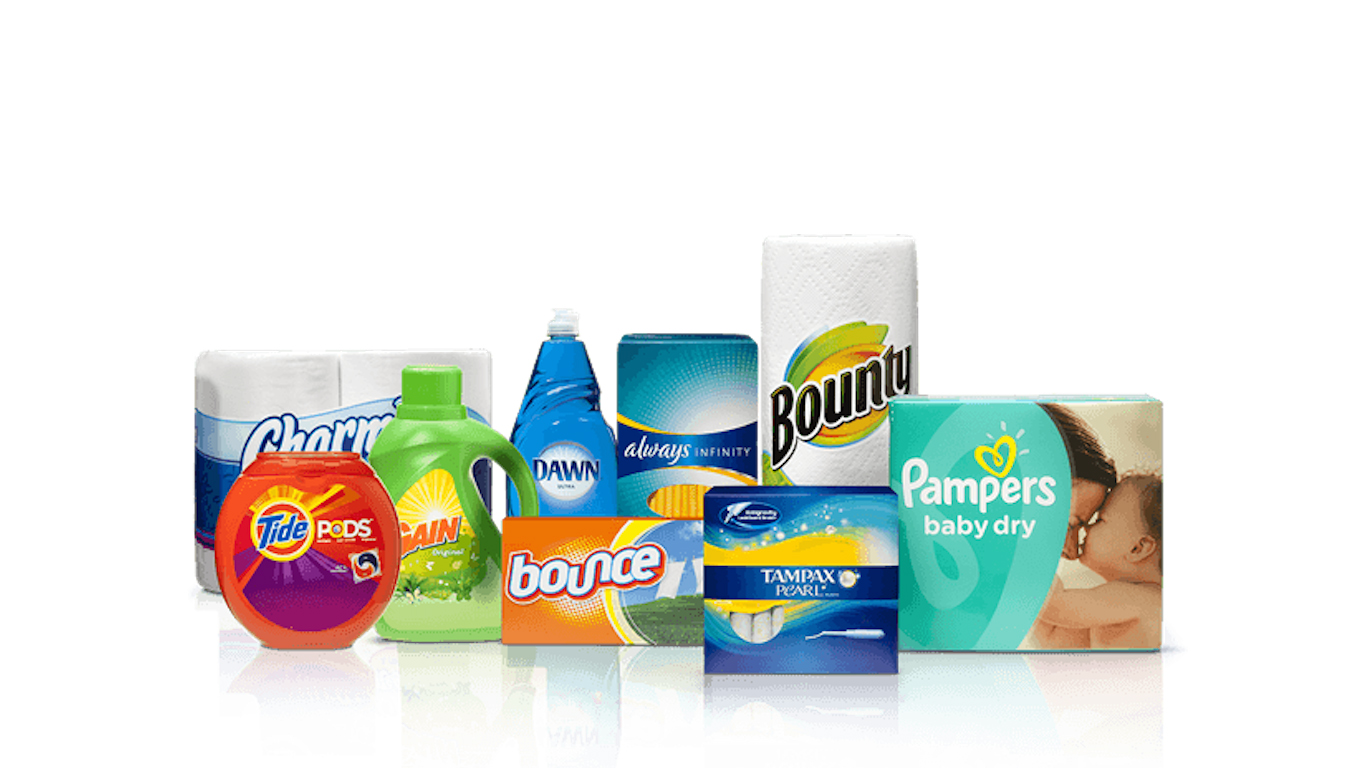
Procter & Gamble owns brands that consumers reach for without thinking twice: Pampers, Tide, Gillette, Crest, Dawn, and Febreze, among dozens of others. That kind of embedded demand across the consumer goods industry is what has allowed the company to raise its dividend every single year for 70 consecutive years, a milestone confirmed by P&G’s own SEC filing in April 2026. According to the Motley Fool, that streak puts P&G among only six publicly traded companies in the world with 70-plus years of uninterrupted dividend increases, a tier above the standard Dividend King designation.
The April 2026 increase lifted the quarterly dividend 3% to $1.0885 per share, bringing the annualized payout to approximately $4.35 per share. The stock currently trades near $150, giving it a forward yield around 2.9%. P&G has been paying a dividend continuously since 1890, a 136-year unbroken record.
The most recent results came from Q3 fiscal 2026, reported on April 24, 2026. Net sales rose 7% year over year to $21.24 billion, organic sales climbed 3%, and core EPS grew 3% to $1.59. Critically, product volume grew 2%, the first time in a year that P&G reported positive volume growth across the company. The beauty segment led the quarter with 7% organic sales growth. P&G returned $3.2 billion to shareholders in the quarter alone, including $2.5 billion in dividends and over $600 million in buybacks. Management did flag that tariffs will carry an estimated $400 million after-tax cost in fiscal 2026, a real headwind, though one the company is managing through productivity savings and pricing.
At current prices, Procter & Gamble is not cheap by historical standards, but it rarely is. The case for owning it rests on predictability. The dividend will almost certainly be higher a year from now than it is today, and the business generating that dividend has proven its durability through recessions, inflation spikes, pandemics, and geopolitical shocks. Wells Fargo carries an overweight rating on PG with a price target of $165, as does JPMorgan.
Editor’s note: This article has been updated to reflect current dividend figures for all three companies: Coca-Cola’s annual dividend increased to $2.12 per share with its 64th consecutive annual increase, Chevron’s quarterly dividend rose to $1.78 per share marking 39 consecutive years of raises, and Procter & Gamble’s quarterly dividend was lifted to $1.0885 per share, now representing 70 consecutive years of increases. Q1 2026 results for Coca-Cola and Chevron, and Q3 fiscal 2026 results for Procter & Gamble, have also been incorporated.
Contact [email protected] for any questions or corrections.
Vandita Jadeja is a financial publisher with over a decade of experience writing about financial topics, including investment, savings, retirement, insurance and banking. Vandita is a Chartered Accountant who loves to debunk financial concepts for readers.
Her work has appeared on sites that include The Motley Fool, InvestorPlace, and Benzinga. She covers investing and focuses on stock picks and price prediction for 24/7 Wall St.
When not looking for the next stock investment opportunity, she can be found traveling, reading, chasing sunsets and enjoying her iced latte.